
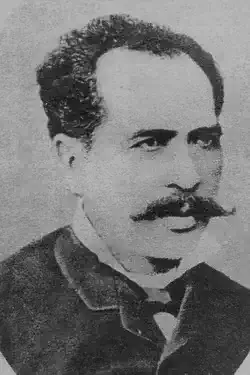
Tobias Barreto
 BR
BR
Tobias Barreto was a Brazilian poet, jurist, and journalist, one of the main figures of pre-modernism and symbolism in Brazil. Born in Sergipe, he stood out for his poetry with a social and philosophical bent, marked by a vigorous and innovative style. He was a fierce critic of the society and politics of his time, advocating for reforms and freer thought. His work, although less known compared to other figures of his time, is fundamental for understanding the literary and intellectual trends of the late 19th and early 20th centuries in Brazil, anticipating many of the concerns that would be central to Brazilian modernism.
n. 1839-06-07, Tobias Barreto · m. 1889-06-26, Recife
Bio
Identification and basic context
Tobias Barreto de Menezes was born in Propriá, Sergipe, Brazil. He was an influential poet, jurist, journalist, and thinker, considered a precursor to Brazilian modernism and one of the exponents of symbolism and pre-modernism in the country. His work is characterized by strong social engagement and a critical view of Brazilian reality.Childhood and education
He had a childhood marked by poverty, but he showed great intelligence and thirst for knowledge. He was self-taught in many areas. He studied Law at the Faculty of Law of Recife, where he stood out as a brilliant student and an original thinker, absorbing the new philosophical and scientific currents of the time, such as positivism and evolutionism.Literary career
His literary career began in Recife, where he founded, with other intellectuals, the "Cenáculo," a group that aimed to renew Brazilian culture. He published poems in newspapers and magazines of the time, gaining notoriety for his incisive language and innovative themes. Although he left a relatively small poetic output, his impact as a critic and thinker was immense, influencing later generations.Work, style, and literary characteristics
Tobias Barreto's poetry is marked by intensity, a critical tone, and reflection on Brazilian society. He addressed themes such as social injustice, misery, inequality, the homeland, and the search for a more just and modern Brazil. His style is vigorous, at times pessimistic, but always innovative, incorporating elements of symbolism and foreshadowing the concerns of pre-modernism. His prose, especially his articles and essays, is equally important for its argumentative strength and critical vision.Cultural and historical context
He lived in a period of great transformations in Brazil, the end of the Empire and the beginning of the Republic, with intense debates about national identity, abolitionism, and the country's future. Barreto was an active intellectual in this context, defending progressive and critical positions. His education in Recife brought him into contact with European scientific and philosophical thought, which he sought to adapt to Brazilian reality.Personal life
Tobias Barreto led a life dedicated to study, writing, and intellectual activism. He was known for his strong temperament and uncompromising stance on his convictions. His dedication to the cause of social justice and the renewal of Brazilian thought marked his trajectory. He had a close relationship with other intellectuals of the time, with whom he intensely debated ideas.Recognition and reception
Although his poetic work is scarce, Tobias Barreto is recognized as a fundamental intellectual for the history of Brazilian literature and thought. His name is associated with an important current of intellectual and literary renewal that paved the way for modernism. His social criticism and his vision of a transforming Brazil were widely debated and influenced many thinkers and writers.Influences and legacy
He was influenced by positivism, evolutionism, and philosophers such as Auguste Comte and Herbert Spencer. In turn, Tobias Barreto significantly influenced the pre-modernist and modernist Brazilian generation with his critical stance, innovative language, and concern for national identity. His work is seen as a landmark in the transition from a more formalist literature to an approach more engaged with Brazilian reality.Interpretation and critical analysis
Tobias Barreto's work is often analyzed from the perspective of his social engagement and his critique of power structures and inequalities in Brazil. His poetry is interpreted as a reflection of his philosophical convictions and his vision of a country in search of modernity and justice. The connection of his work with the scientific and philosophical thought of the time is also a central point of analysis.Curiosities and lesser-known aspects
Besides being a poet and jurist, Tobias Barreto was also a dedicated journalist, writing articles that often caused controversy and debate. His critical stance and sharp intellect made him a respected, but also controversial, figure. His involvement in "Cenáculo" in Recife was a landmark for the cultural renewal of the time.Death and memory
He died prematurely, which limited the development of his work, but did not diminish his impact as a thinker and influencer. His memory is celebrated as that of one of the great intellectuals who helped shape Brazilian thought and literature in the early 20th century.Poems
0No poems found
Comments (0)
No comments yet. Be the first to comment.