
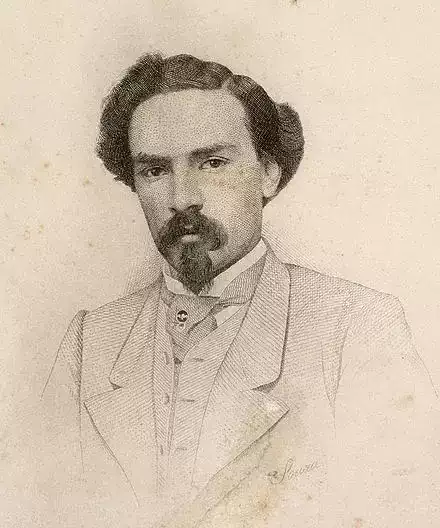
Tomás Ribeiro
 PT
PT
Tomás Ribeiro was a Portuguese poet and politician, a prominent figure in the poetry of the second half of the 19th century. His work, marked by late Arcadianism and the transition to Romanticism, explores themes such as love, nature, saudade, and patriotism, with a careful style and refined musicality. He stood out not only for his literary production but also for his political activity and dedication to public service. His poetry reflects a lyrical sensibility and a concern for form, consolidating him as an important name in Portuguese literature of his time.
n. 1831-07-01, Parada de Gonta · m. 1901-02-06, Lisboa
Bio
Identification and basic context
Tomás Manuel de Noronha Ribeiro, known as Tomás Ribeiro, was born in Coimbra. He was a Portuguese poet, writer, and politician. Pseudonyms or heteronyms are not prominent in his career. His work falls within the literary context of the 19th century in Portugal.Childhood and education
Tomás Ribeiro was born into a renowned family, which provided him with access to a privileged education. He attended the University of Coimbra, where he studied Law, a common path for young men of his social standing. His education was influenced by classical culture and European literary currents of the time, with an emphasis on Arcadianism and the early manifestations of Romanticism.Literary career
The beginning of his poetic writing dates back to his youth, with poems that already showed an inclination towards lyricism and careful form. Over time, his work evolved, absorbing Romantic influences without, however, completely abandoning the formal elegance of Arcadianism. He collaborated in various literary publications of the time, contributing to the dissemination of his work and to aesthetic debate.Work, style, and literary characteristics
Tomás Ribeiro's best-known work is "D. Lameirim" (1854), a long narrative poem that earned him recognition. Other works include "Jardim Poético" and "Últimos Poemas". Recurring themes are love, homeland, nature, religion, and saudade. His style is marked by musicality, elegance of language, and the pursuit of perfect form, with special appreciation for the sonnet and traditional meters. His poetic voice is lyrical and, at times, elegiac, expressing deep feelings with formal refinement.Work, style, and literary characteristics
Cultural and historical context Tomás Ribeiro lived in a time of transition in Portugal, marked by political instability and the consolidation of the liberal state. He was part of the so-called "Generation of 50", a group of writers who sought to modernize Portuguese literature by absorbing European influences, particularly from French Romanticism. He maintained relationships with other writers and intellectuals of the time, actively participating in literary and political circles.Work, style, and literary characteristics
Personal life Beyond his literary activity, Tomás Ribeiro held relevant political positions, having been a deputy and a minister. His personal and family relationships, although not explored in detail in his work, likely contributed to his worldview and sensibility. His life was marked by a deep sense of civic and patriotic duty.Work, style, and literary characteristics
Recognition and reception During his lifetime, Tomás Ribeiro was a recognized and respected poet, with his work being well-received by critics and the public. His poem "D. Lameirim" consolidated his position in the Portuguese literary pantheon. After his death, his recognition remained, although later generations of literary critics have re-evaluated his place, especially in the face of emerging literary vanguards.Work, style, and literary characteristics
Influences and legacy Tomás Ribeiro was influenced by classical poets and European Romantics. His legacy lies in the preservation of musicality and form in Portuguese poetry, and in his contribution to the transition from Arcadianism to Romanticism. He influenced poets who valued meter and careful lyricism.Work, style, and literary characteristics
Critical interpretation and analysis Tomás Ribeiro's work is often analyzed from the perspective of its lyricism and formal mastery. Modern critiques sometimes point to a certain thematic and stylistic conservatism when compared to the literary revolutions of the 20th century, but they recognize his importance as a bridge between two literary eras.Work, style, and literary characteristics
Curiosities and lesser-known aspects A curious aspect of his life was his involvement in politics, holding positions of great responsibility, which demonstrated a statesmanlike facet beyond that of a poet.Work, style, and literary characteristics
Death and memory Tomás Ribeiro died in Lisbon. The circumstances of his death are not particularly notable. His memory is preserved as that of an important Portuguese Romantic poet and a public figure dedicated to his country.Poems
0No poems found
Comments (0)
No comments yet. Be the first to comment.