
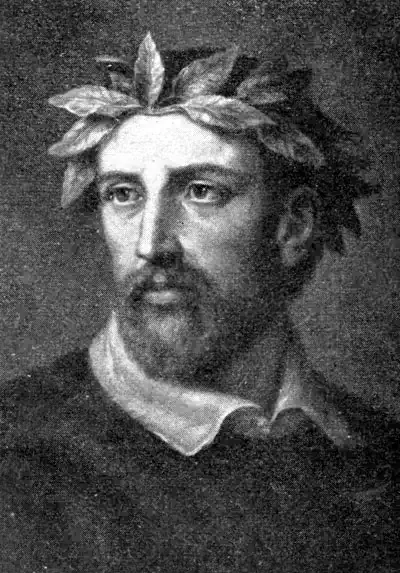
Torquato Tasso
1544–1595
· lived 51 years
 IT
IT
IT
Torquato Tasso was an Italian poet, playwright, and literary critic, renowned for his epic and lyrical poetry. His work is marked by deep religiosity, existential questioning, and the pursuit of an ideal of formal perfection. He faced several personal and intellectual crises throughout his life, which were reflected in his artistic production, oscillating between classical Renaissance and the spiritual tensions of his time. He is considered one of the greatest figures in Italian literature.
n. 1544-03-11, Sorrento · m. 1595-04-25, Roma
53
Views
Bio
Identification and basic context
Torquato Tasso (September 11, 1544 – February 25, 1595) was an Italian poet, playwright, and literary critic. Born in Sorrento, in the Kingdom of Naples, he died in Rome. He came from a noble family, but the political instability and religious persecution of his era profoundly shaped his path.Childhood and education
Son of a nobleman and writer, Torquato Tasso had a childhood marked by instability, with the death of his mother and the separation of his parents. He received an excellent education, studying Latin, Greek, and rhetoric in Naples and Rome. He absorbed influences from classical and Renaissance culture, as well as from his Jesuit education, which left a deep mark on him.Literary career
Tasso began writing early, demonstrating great talent for poetry. His work evolved from youthful themes to more complex and reflective compositions, culminating in his masterpiece, "Gerusalemme Liberata." He collaborated on various anthologies and was an active figure in the literary circles of his time.Work, style, and literary characteristics
Tasso's main work is the epic poem "Gerusalemme Liberata" (Jerusalem Delivered), published in 1581, which narrates the First Crusade. His dominant themes include faith, love, honor, war, and the search for redemption. Stylistically, Tasso combines classical elements with Renaissance sensibility, using the heroic verse with great mastery. His language is rich and musical, and his tone oscillates between the epic, the lyrical, and the tragic. He introduced greater psychological complexity and deeper introspection in his characters, distancing himself from the pure chivalric ideal.Cultural and historical context
Tasso lived during the late Renaissance and the Counter-Reformation. It was a period of intense religious and political changes in Italy. His work reflects the tensions between Renaissance humanism and Catholic orthodoxy. He was a friend of influential intellectuals but also a target of criticism and persecution, especially from the Inquisition.Personal life
His life was marked by nervous crises, paranoia, and a profound religious sentiment. Tasso spent years institutionalized in a psychiatric hospital in Ferrara, under the protection of the Duke of Ferrara, where he continued to write. His romantic relationships were complex, and solitude and suffering were recurring themes in his work.Recognition and reception
Torquato Tasso was widely recognized during his lifetime, although his work generated debates and criticism, especially regarding his religious orthodoxy. After his death, his fame grew, and "Gerusalemme Liberata" became a landmark of Italian and European literature.Influences and legacy
Tasso was influenced by Virgil and Petrarch. His work, in turn, influenced numerous later poets and writers, such as John Milton and Alexandre Herculano. His legacy lies in the formal sophistication, psychological depth, and exploration of existential and religious themes in his epic and lyrical poetry.Interpretation and critical analysis
Tasso's work has been interpreted from various perspectives, including religious, psychological, and historical. His bouts of madness and intense religiosity are frequently debated in relation to his literary production.Curiosities and lesser-known aspects
Tasso was known for his prodigious memory and erudition. His constant concern with the correction and censorship of his work, especially "Gerusalemme Liberata," reveals an insecure and tormented side.Death and memory
He died in Rome, shortly before being crowned a laureate poet by the Pope. His works continued to be published and studied, solidifying his position as one of the great poets of Italian literature.Poems
0No poems found
Quotes
1No poems found
Comments (0)
Log in
to post a comment.
No comments yet. Be the first to comment.