
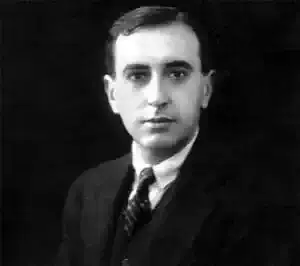
Vicente Huidobro
1893–1948
· lived 54 years
 --
--
--
Chilean poet, a central figure of the 20th-century literary avant-garde. Huidobro was a bold innovator, creator of "creationism," a movement that proposed that the poet should create a new reality through words, independent of imitating the outside world. His work, vast and experimental, explored diverse forms and languages, notably influencing Latin American and universal poetry. He was a cultural agitator, editor, and promoter of the arts, leaving a legacy of creative boldness and aesthetic renewal.
n. 1893-01-10, Santiago · m. 1948-01-02, Cartagena
73
Views
Bio
Identification and Basic Context
Vicente García Huidobro Fernández was a Chilean poet, art critic, and editor, born in Santiago. He is one of the most important figures of the 20th-century literary avant-garde and the creator of "creationism." His work is characterized by radical experimentation, the search for the autonomy of poetic language, and the creation of new realities through words.Childhood and Education
Huidobro came from a high-society Chilean family. His education was meticulous, receiving literary and artistic influences from a young age. Despite his comfortable background, he showed a rebellious and restless spirit early on, which led him to explore various currents of thought and aesthetics. He traveled extensively throughout Europe, where he came into direct contact with avant-garde movements.Literary Career
Huidobro's career is vast and prolific. He began his literary career with more traditional poetry but soon embraced avant-garde movements. In Paris, in 1916, he proclaimed the foundations of "creationism," a movement that advocated the idea that the poet should not imitate reality but create it through their work. He published numerous works in different countries, collaborated with avant-garde magazines, and actively participated in promoting new artistic trends.Work, Style, and Literary Characteristics
Among his most important works are "Elற்ற" (1916), "Poemas árticos" (1917), "Ecuatorial" (1918), "Sagitario" (1918), "Mío Cid" (1929), "Altazor o el viaje en paracaídas" (1931), and "Cagliostro" (1932). Creationism, his aesthetic doctrine, postulates the autonomy of the literary work, which must create its own world and its own laws, independent of external reality. His style is bold, experimental, and rupture-prone, with innovative use of language, metaphor, and syntax. He explores the disintegration of traditional form and meaning, seeking a pure and creative expression. Musicality, surprising imagery, and fragmentation are common resources in his poetry.Cultural and Historical Context
Huidobro moved in the epicenter of the European avant-garde movements of the early 20th century, associating with figures such as Apollinaire, Picasso, and Dalí. He was a witness and actor of his time, participating in the cultural and artistic effervescence that revolutionized the arts. His work reflects the tensions and quests of an era marked by war and modernity.Personal Life
Huidobro's life was as intense as his work. A tireless traveler, he actively participated in the social and political life of his time. He was married and had children. His personality was bold, innovative, and often controversial, which garnered him both admirers and detractors. He was a man of action, even participating in the Spanish Civil War.Recognition and Reception
Huidobro's recognition was uneven throughout his life. While he was acclaimed in European avant-garde circles, his figure often generated controversy in his home country. Over time, his work has been fully vindicated, and today he is considered one of the most influential and original poets of the 20th century.Influences and Legacy
Huidobro's influences encompass symbolism, cubism, futurism, and dadaism. His legacy is immense, especially through creationism, which opened new avenues for poetic experimentation worldwide. His work influenced poets of various generations and latitudes, setting a precedent for avant-garde poetry.Interpretation and Critical Analysis
Huidobro's work is subject to constant analysis due to its complexity and rupture-prone nature. There has been debate about the nature of creationism, the relationship of his poetry to reality, and his place in the history of literature. His poems invite active reading and the exploration of new meanings.Childhood and Education
Huidobro was also an active editor and cultural promoter, founding magazines and organizing exhibitions. His role as a soldier in the Spanish Civil War is also a little-known aspect of his life.Death and Memory
Vicente Huidobro passed away in Cartagena, Chile. His memory endures through his work, which continues to be studied, published, and admired, and through the institutions that bear his name and promote his legacy.Poems
0No poems found
Quotes
1No poems found
Comments (0)
Log in
to post a comment.
No comments yet. Be the first to comment.