
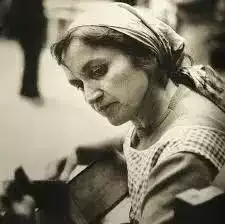
Violeta Parra
1917–1967
· lived 49 years
 CL
CL
CL
Violeta Parra was a Chilean composer, singer, visual artist, and folklorist, a central figure in popular music and the Nueva Canción Chilena movement. Her work, deeply rooted in Latin American culture, addresses themes such as social injustice, love, pain, and identity, with an intense and visceral poetic language. She is considered one of the most important artists on the continent.
n. 1917-10-04, San Carlos · m. 1967-02-05, La Reina
27
Views
Bio
Identification and basic context
Violeta del Carmen Parra Sandoval was a Chilean composer, singer, visual artist, poet, and folklorist, widely recognized as one of the most important figures in Latin American popular music and the mother of Nueva Canción Chilena. Born in 1917 and died in 1967. Her work, written in Spanish, is a vibrant reflection of the culture and aspirations of the Chilean and Latin American people. Originating from a family of musicians and artists, she grew up in an environment of poverty but rich in cultural traditions.Childhood and education
Violeta Parra was born into a humble family in southern Chile, where music and art were an integral part of daily life. Her father was a teacher and amateur musician, and her mother, a seamstress, sang traditional songs. From a very young age, she showed precocious talent for music and poetry, learning to play the guitar with her brother, the also musician and composer Nicanor Parra. Her education was marked by direct experience of Chilean folk traditions, observation of social realities, and life experiences.Literary career
Violeta Parra's literary career, although intrinsically linked to her music, reveals a powerful poetic vein. Her song lyrics are true poems, loaded with imagery, emotions, and social reflections. Her written work, including the book "Violeta Sola" (published posthumously), explores her deepest feelings, her pains, loves, and her critical view of the world. Her poetry is direct, raw, and deeply emotional, reflecting her own life and the struggles of the people.Work, style, and literary characteristics
Violeta Parra's work is vast and multifaceted, encompassing songs, poems, tapestries, ceramics, and paintings. Her music and poetry are marked by authenticity and a deep connection with Latin American folklore. Themes such as love (often painful and conflicting), social injustice, oppression, cultural identity, death, and spirituality are central to her work. Her style is characterized by direct, metaphorical language loaded with emotion, often using the song form to express her ideas. Violeta's poetic voice is strong, confessional, and universal, capable of expressing both individual pain and collective suffering. Her art broke barriers, influencing generations of artists and musical and cultural movements throughout Latin America.Work, style, and literary characteristics
Cultural and historical context Violeta Parra lived and produced her work during a period of great social and political effervescence in Chile and Latin America. Her music and poetry became a symbol of resistance and identity for many, especially during the 1960s when the Nueva Canción movement gained strength. She was a pioneer in rescuing and reinterpreting Chilean traditional folklore, giving it a new guise and socially engaged content. Her work dialogued with the yearnings for social justice and cultural sovereignty that marked the era.Work, style, and literary characteristics
Personal life Violeta Parra's life was marked by an intensity of passions, pains, and struggles. Her love affairs were often turbulent and brought her suffering, but also inspiration for many of her most emblematic songs. She faced economic difficulties and health problems throughout her life. Her dedication to art and the dissemination of Chilean popular culture was constant, even in the face of adversity.Work, style, and literary characteristics
Recognition and reception Although she received recognition during her lifetime, the true scope of her work and the dimension of her legacy were fully understood after her death. Violeta Parra is today an iconic figure of Latin American culture, celebrated worldwide. Her music is constantly reinterpreted, and her poetry continues to inspire. She is seen as an authentic and powerful voice that gave visibility and dignity to many social realities and human feelings.Work, style, and literary characteristics
Influences and legacy Violeta Parra profoundly influenced the music and poetry of all of Latin America, being considered a precursor to Nueva Canción. Artists such as Mercedes Sosa, Victor Jara, Joan Baez, and many others were directly touched by her work. Her legacy lies in her ability to unite art, politics, and life inseparably, giving voice to the marginalized and expressing the deepest human emotions through a universal and accessible language.Work, style, and literary characteristics
Interpretation and critical analysis Violeta Parra's work is rich in symbolism and allows for diverse interpretations. Her songs, such as "Gracias a la Vida" or "Volver a los Diecisiete," are anthems that transcend time and culture, addressing existential themes in a profound and moving way. Her art can be analyzed from the perspective of cultural anthropology, sociology, and psychology, given its connection to popular roots and the expression of universal feelings.Work, style, and literary characteristics
Curiosities and lesser-known aspects In addition to her music and poetry, Violeta Parra intensely dedicated herself to visual arts, creating tapestries, sculptures, and paintings that complement her work. Her house in La Reina, which became the Violeta Parra Documentation Center, was a meeting point for artists and intellectuals. The story of her last song, "Gracias a la Vida," composed shortly before her death, is a testament to her resilience and gratitude, despite all the suffering.Work, style, and literary characteristics
Death and memory Violeta Parra died in 1967, in tragic circumstances, taking her own life. Her premature death shocked Chile and Latin America, but her memory and work remain alive and inspiring. Posthumous publications of her lyrics and writings, as well as numerous recordings of her songs by other artists, keep her legacy alive and relevant.Poems
0No poems found
Comments (0)
Log in
to post a comment.
No comments yet. Be the first to comment.