
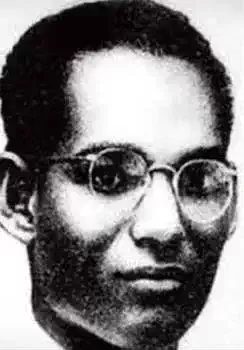
Viriato da Cruz
1928–1973
· lived 45 years
 AO
AO
AO
Viriato da Cruz was an Angolan poet, journalist, and politician, a central figure in the struggle for Angola's independence. His poetic work, marked by expressive power, engaged lyricism, and social denunciation, reflects the aspirations of the Angolan people and their struggle against colonialism. He was one of the founders of the MPLA.
n. 1928-03-25, Porto Amboim · m. 1973-06-13, Pequim
60
Views
Bio
Identification and basic context
Viriato da Cruz was an Angolan poet, journalist, and politician, considered one of the most important poets of the transition generation to Angola's independence. He was a prominent figure in the nationalist movement.Childhood and education
He was born in Luanda and had an upbringing that exposed him to both Angolan culture and external influences. His formal education, combined with his social and political experience, shaped his critical consciousness and his engagement.Literary career
Viriato da Cruz's literary career is intrinsically linked to his political activity and the context of the anti-colonial struggle. He began writing poetry in his youth, expressing in his verses the feelings of oppression and the aspiration for freedom. He was one of the founders of the Popular Movement for the Liberation of Angola (MPLA) in 1956, and his poetry served as an important vehicle for political mobilization and awareness.Work, style, and literary characteristics
Viriato da Cruz's poetry is marked by strong social and nationalist lyricism. His poems express the pain, revolt, and hope of the Angolan people, denouncing the injustices of the colonial regime. He uses direct and emotional language, often with expressive resources that evoke orality and African culture. Themes such as Angolan identity, the land, the struggle for freedom, and human dignity are central to his work. One of his best-known poems is "Makéla do Makéla," which became a hymn of resistance. His style, while accessible, possesses great expressive power and a musicality that brings it close to the oral tradition.Cultural and historical context
Viriato da Cruz lived and worked during a crucial period in Angola's history: the struggle for independence. He was one of the pioneers in articulating nationalist discourse and its artistic expression. His work as a journalist and political activist gave him a unique perspective on the challenges faced by his people.Personal life
In addition to his activity as a poet and politician, Viriato da Cruz dedicated himself to journalism, using this platform to promote his ideas and defend the Angolan cause. His life was marked by commitment to national liberation.Recognition and reception
Although his poetic work is not as extensive as that of other authors, Viriato da Cruz is widely recognized as one of the founding poets of modern Angolan literature and a symbol of resistance. His poetry is studied and valued for its historical testimony and aesthetic power.Influences and legacy
His poetry reflects influences from social and engaged poetry, but with a distinctive mark of Angolan reality. His legacy is that of a poet who knew how to give voice to the aspirations of a people and who contributed significantly to the formation of Angola's literary identity.Interpretation and critical analysis
Viriato da Cruz's work is seen as an important document of Angola's history and the struggle for its independence. His poetry is analyzed for how it manages to unite individual and lyrical expression with collective and political discourse.Curiosities and lesser-known aspects
He was one of the first to use the name "Angola" assertively in his poetry, contributing to the consolidation of a national sentiment.Death and memory
Viriato da Cruz died in exile, but his work and his legacy as an activist remain alive in the collective memory of Angola, being celebrated as a national hero and an important poet.Poems
0No poems found
Comments (0)
Log in
to post a comment.
No comments yet. Be the first to comment.