
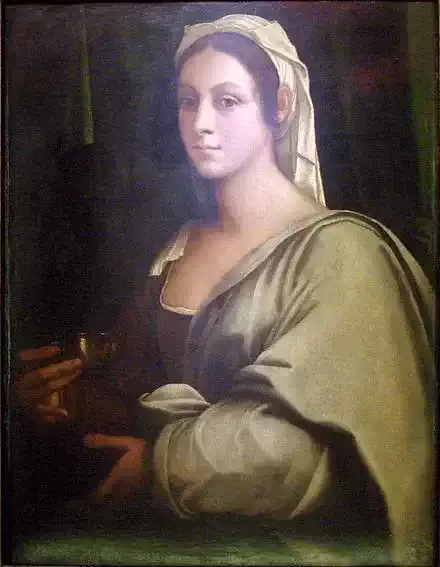
Vittoria Colonna
1490–1547
· lived 56 years
 IT
IT
IT
Vittoria Colonna was one of the most prominent Italian poets of the Renaissance, known for her lyrical and spiritual work. She received an excellent education that prepared her for a life of intellectuality and devotion. Her life was marked by profound religious experiences and an intense connection with important figures of her time.
n. 1490-04-01, Marino · m. 1547-02-25, Roma
40
Views
Bio
Identification and Basic Context
Vittoria Colonna was an Italian noblewoman, poet, and intellectual, a prominent figure of the Renaissance. She was born in Marino, near Rome, into an influential family, the Colonnas, with strong ties to the papal nobility. She was one of the most celebrated female figures of her time, known for her intelligence and erudition. She wrote in Italian.Childhood and Education
From an early age, Vittoria showed a sharp intellect and a deep inclination for studies. She received an excellent education by the standards of the time, including classical literature, philosophy, and theology. Her education was influenced by the humanist and religious environment in which she grew up, absorbing Renaissance ideals and strong spirituality.Literary Career
Vittoria Colonna began her literary activity with poems dedicated to her husband, but her work gained greater depth and expression after his death. Her most famous poems are the "Rime spirituali" (Spiritual Rhymes), which reflect her intense devotional life and her search for transcendental meaning. She collaborated and corresponded with renowned literary and religious figures, such as Pietro Bembo and Michelangelo.Work, Style, and Literary Characteristics
Vittoria Colonna's work predominantly focuses on lyrical and spiritual poetry. Her main themes include divine love, penance, faith, hope, and mortality. She frequently used the sonnet form, demonstrating mastery in its structure and expressiveness. Her language is elevated, sincere, and sometimes melancholic, reflecting her devotion and existential reflections. Her style is marked by lyrical purity and theological depth, fitting into the Petrarchan tradition but with strong originality in its spiritual content.Cultural and Historical Context
Vittoria Colonna lived during a period of great cultural and religious effervescence in Italy, the Renaissance, marked by intense theological debates and the Protestant Reformation. Her social position and deep religiosity placed her at the center of important intellectual and spiritual circles. She maintained close relationships with key figures of the Reformation and Counter-Reformation, such as Juan de Valdés and Michelangelo, with whom she shared intense theological and artistic discussions.Personal Life
Vittoria Colonna's life was profoundly marked by the loss of her husband, Fernando Francesco d'Avalos, in 1525, an event that drove her to a life of devotion and seclusion. Her relationship with Michelangelo Buonarroti was one of the most significant of her life, serving as a source of mutual inspiration and deep intellectual and spiritual dialogue. She dedicated a large part of her life to prayer, charity, and writing poetry that reflected her faith.Recognition and Reception
Vittoria Colonna was widely recognized during her lifetime as one of the greatest Italian poets. Her work "Rime spirituali" had several editions and was translated into other languages, solidifying her fame. Her intelligence and piety were admired by many, including figures like Ludovico Ariosto and Pietro Bembo.Influences and Legacy
She was influenced by Petrarch and Christian spirituality. Her legacy lies in her ability to fuse lyrical tradition with a deep expression of faith, paving the way for women's religious poetry. Her influence extended to later generations of poets and religious thinkers.Interpretation and Critical Analysis
Vittoria Colonna's work has been interpreted as a testament to the soul's search for God, using classical poetic forms to express feelings of divine love and longing for transcendence. Her reflections on faith, mortality, and repentance continue to resonate with readers seeking a connection between art and spirituality.Curiosities and Lesser-Known Aspects
Vittoria Colonna, despite her intense spiritual life, was a socially active and respected figure in Italian noble and intellectual circles. Her friendship with Michelangelo is one of the most fascinating aspects of her life, with exchanges of sonnets revealing deep admiration and intellectual and spiritual complicity.Death and Memory
Vittoria Colonna passed away in Rome. Her memory is preserved through her poetic work, which continues to be studied and appreciated as an important milestone of Italian Renaissance spiritual poetry. Her figure is remembered as one of the few women who achieved literary and intellectual renown in a male-dominated period.Poems
0No poems found
Comments (0)
Log in
to post a comment.
No comments yet. Be the first to comment.