
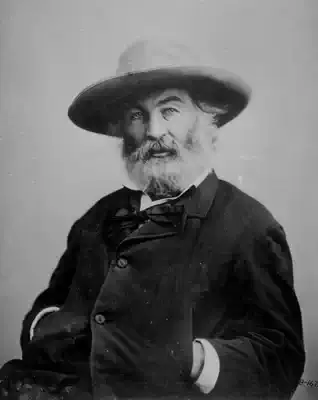
Walt Whitman

Walt Whitman

1819–1892 · lived 72 years US US

Walt Whitman was an American poet, essayist, journalist, and a deliberate humanist who became one of the most influential figures in American poetry. He is often called the "father of free verse." His seminal work, "Leaves of Grass," was a radical departure from the conventional poetry of its time, celebrating the individual, democracy, the body, and the spirit in expansive, cataloging lines. Whitman's poetry embraced a wide range of subjects, from the natural world and urban life to the experiences of laborers and soldiers. His work is characterized by its inclusive spirit, its celebration of the sensual and the spiritual, and its democratic vision. He sought to capture the diverse American experience in all its complexity and vitality, making him a truly unique voice in literature.

n. 1819-05-31, West Hills · m. 1892-03-26, Camden

77,335 Views

Year Of Meteors, 1859 '60

Year Of Meteors, 1859 '60

YEAR of meteors! brooding year!
I would bind in words retrospective, some of your deeds and signs;
I would sing your contest for the 19th Presidentiad;
I would sing how an old man, tall, with white hair, mounted the


scaffold in Virginia;
(I was at hand--silent I stood, with teeth shut close--I watch'd;
I stood very near you, old man, when cool and indifferent, but


trembling with age and your unheal'd wounds, you mounted the

scaffold;)
--I would sing in my copious song your census returns of The States,
The tables of population and products--I would sing of your ships and


their cargoes,
The proud black ships of Manhattan, arriving, some fill'd with
immigrants, some from the isthmus with cargoes of gold;
Songs thereof would I sing--to all that hitherward comes would I
welcome give; 10
And you would I sing, fair stripling! welcome to you from me, sweet
boy of England!
Remember you surging Manhattan's crowds, as you pass'd with your


cortege of nobles?
There in the crowds stood I, and singled you out with attachment;
I know not why, but I loved you... (and so go forth little song,
Far over sea speed like an arrow, carrying my love all folded,
And find in his palace the youth I love, and drop these lines at his


feet;)
--Nor forget I to sing of the wonder, the ship as she swam up my bay,
Well-shaped and stately the Great Eastern swam up my bay, she was 600

feet long,
Her, moving swiftly, surrounded by myriads of small craft, I forget
not to sing;
--Nor the comet that came unannounced out of the north, flaring in
heaven; 20
Nor the strange huge meteor procession, dazzling and clear, shooting
over our heads,
(A moment, a moment long, it sail'd its balls of unearthly light over


our heads,
Then departed, dropt in the night, and was gone;)
--Of such, and fitful as they, I sing--with gleams from them would I


gleam and patch these chants;
Your chants, O year all mottled with evil and good! year of
forebodings! year of the youth I love!
Year of comets and meteors transient and strange!--lo! even here, one
equally transient and strange!
As I flit through you hastily, soon to fall and be gone, what is this
book,
What am I myself but one of your meteors?
Read full poem
Bio

Identification and basic context

Walt Whitman was an American poet, essayist, journalist, and humanist. Born on Long Island, New York, he is considered one of the most influential figures in American literature. He wrote in English.

Childhood and education

Whitman's formal schooling was limited; he left school at the age of eleven to work. He became a printer and later worked as a journalist, editor, and teacher. This practical experience exposed him to a wide range of society and ideas, which deeply informed his writing. He was largely self-educated, voraciously reading literature, philosophy, and the Bible, and absorbing the democratic ideals of his time.

Literary trajectory

Whitman began his literary career as a journalist and editor, writing essays, short stories, and editorials. His major turning point was the publication of the first edition of 'Leaves of Grass' in 1855, a collection of poems that he would revise and expand throughout his life. This work was controversial but also groundbreaking, establishing his unique voice and style. He continued to write and publish new poems and editions of 'Leaves of Grass' for the rest of his life, self-publishing some editions and revising extensively.

Works, style, and literary characteristics

Whitman's magnum opus is 'Leaves of Grass,' first published in 1855 and issued in numerous expanded editions until his death. Other notable works include 'Democratic Vistas' (prose essays) and 'Specimen Days' (autobiographical sketches). Whitman's poetry is characterized by its radical use of free verse, lengthy, incantatory lines, and an expansive, catalogues approach to imagery. He celebrated the "self" as a microcosm of humanity and the cosmos, championing democracy, equality, the physical body, sensuality, nature, and the spiritual interconnectedness of all things. His tone is often prophetic, embracing, and deeply democratic. His language is robust, colloquial, and American, incorporating a vast vocabulary and a direct, unadorned style that sought to capture the essence of American experience.

Cultural and historical context

Whitman lived and wrote during a period of immense national transformation in the United States, including westward expansion, industrialization, and the tumultuous lead-up to and aftermath of the Civil War. He was a staunch advocate for democracy and envisioned a uniquely American poetry that reflected the diverse peoples and landscapes of the nation. His work was informed by Transcendentalist ideas, particularly the writings of Emerson, and he engaged with the social and political issues of his day, notably abolitionism.

Personal life

Whitman's personal life was complex and somewhat elusive. He never married and had no children. He served as a volunteer nurse in army hospitals during the Civil War, an experience that deeply affected him and led to poems like "The Wound-Dresser." His intense friendships, often with men, were significant, and he celebrated physical and spiritual connection. He lived a relatively simple life, often in poverty, but remained committed to his poetic vision.

Recognition and reception

Whitman's work was met with both fierce criticism and enthusiastic praise during his lifetime. While initially seen as scandalous and incomprehensible by many, he gradually gained recognition from literary figures like Emerson and was eventually hailed as a major American poet. His reputation grew posthumously, and he is now considered a cornerstone of American literature.

Influences and legacy

Whitman was influenced by Emerson, the Bible, and classical literature, but he forged a completely new poetic voice. He profoundly influenced the development of American poetry, paving the way for free verse and modern poetic sensibilities. His celebration of the individual, democracy, and the body continues to inspire poets and thinkers worldwide.

Interpretation and critical analysis

Critical interpretations of Whitman's poetry often center on his innovative use of free verse, his democratic ideals, his embrace of the body and sexuality, and his complex exploration of American identity. Debates have occurred regarding the sincerity of his democratic vision and the autobiographical elements within his work.

Curiosities and lesser-known aspects

Whitman was known for his distinctive appearance, often sporting a beard and informal clothing. He was also a skilled carpenter and builder in his youth. His extensive revisions of 'Leaves of Grass' show his meticulous attention to craft, despite his unconventional style.

Death and memory

Whitman died in Camden, New Jersey. He is remembered as one of America's most important and original poets, a visionary voice who captured the spirit of a nation in transformation and celebrated the inherent dignity of all human beings.

Poems

168

A Promise To California

A Promise To California

A PROMISE to California,
Also to the great Pastoral Plains, and for Oregon:
Sojourning east a while longer, soon I travel toward you, to remain,


to teach robust American love;
For I know very well that I and robust love belong among you, inland,
and along the Western Sea;
For These States tend inland, and toward the Western Sea--and I will
also.
466

A Paumanok Picture

A Paumanok Picture

TWO boats with nets lying off the sea-beach, quite still,
Ten fishermen waiting--they discover a thick school of mossbonkers-they
drop the join'd seine-ends in the water,
The boats separate and row off, each on its rounding course to the

beach, enclosing the mossbonkers,
The net is drawn in by a windlass by those who stop ashore,
Some of the fishermen lounge in their boats, others stand ankle-deep

in the water, pois'd on strong legs,
The boats partly drawn up, the water slapping against them,
Strew'd on the sand in heaps and windrows, well out from the water,

the green-back'd spotted mossbonkers.
514

A March In The Ranks, Hard-prest

A March In The Ranks, Hard-prest

A MARCH in the ranks hard-prest, and the road unknown;
A route through a heavy wood, with muffled steps in the darkness;
Our army foil'd with loss severe, and the sullen remnant retreating;
Till after midnight glimmer upon us, the lights of a dim-lighted


building;
We come to an open space in the woods, and halt by the dim-lighted
building;
'Tis a large old church at the crossing roads--'tis now an impromptu
hospital;
--Entering but for a minute, I see a sight beyond all the pictures
and poems ever made:
Shadows of deepest, deepest black, just lit by moving candles and
lamps,
And by one great pitchy torch, stationary, with wild red flame, and
clouds of smoke;
By these, crowds, groups of forms, vaguely I see, on the floor, some
in the pews laid down; 10
At my feet more distinctly, a soldier, a mere lad, in danger of
bleeding to death, (he is shot in the abdomen;)
I staunch the blood temporarily, (the youngster's face is white as a
lily;)
Then before I depart I sweep my eyes o'er the scene, fain to absorb
it all;
Faces, varieties, postures beyond description, most in obscurity,
some of them dead;
Surgeons operating, attendants holding lights, the smell of ether,
the odor of blood;
The crowd, O the crowd of the bloody forms of soldiers--the yard
outside also fill'd;
Some on the bare ground, some on planks or stretchers, some in the

death-spasm sweating;
An occasional scream or cry, the doctor's shouted orders or calls;
The glisten of the little steel instruments catching the glint of the

torches;
These I resume as I chant--I see again the forms, I smell the


odor; 20
Then hear outside the orders given, Fall in, my men, Fall in;
But first I bend to the dying lad--his eyes open--a half-smile gives

he me;
Then the eyes close, calmly close, and I speed forth to the darkness,
Resuming, marching, ever in darkness marching, on in the ranks,
The unknown road still marching.
473

A Hand-Mirror

A Hand-Mirror

HOLD it up sternly! See this it sends back! (Who is it? Is it you?)
Outside fair costume--within ashes and filth,
No more a flashing eye--no more a sonorous voice or springy step;
Now some slave's eye, voice, hands, step,
A drunkard's breath, unwholesome eater's face, venerealee's flesh,
Lungs rotting away piecemeal, stomach sour and cankerous,
Joints rheumatic, bowels clogged with abomination,
Blood circulating dark and poisonous streams,
Words babble, hearing and touch callous,
No brain, no heart left--no magnetism of sex; 10
Such, from one look in this looking-glass ere you go hence,
Such a result so soon--and from such a beginning!
535

A Farm-Picture

A Farm-Picture

THROUGH the ample open door of the peaceful country barn,
A sun-lit pasture field, with cattle and horses feeding;
And haze, and vista, and the far horizon, fading away.
539

A Child's Amaze

A Child's Amaze

SILENT and amazed, even when a little boy,
I remember I heard the preacher every Sunday put God in his
statements,
As contending against some being or influence.
380

ARM’D year! year of the struggle!

ARM’D year! year of the struggle!

No dainty rhymes or sentimental love verses for you, terrible year!

Not you as some pale poetling, seated at a desk, lisping cadenzas
piano;

But as a strong man, erect, clothed in blue clothes, advancing,
carrying a rifle on your shoulder,

With well-gristled body and sunburnt face and hands–with a knife in
the belt at your side,

As I heard you shouting loud–your sonorous voice ringing across the
continent;

Your masculine voice, O year, as rising amid the great cities,

Amid the men of Manhattan I saw you, as one of the workmen, the
dwellers in Manhattan;

Or with large steps crossing the prairies out of Illinois and
Indiana,

Rapidly crossing the West with springy gait, and descending the
Alleghanies;

Or down from the great lakes, or in Pennsylvania, or on deck along
the Ohio river;

Or southward along the Tennessee or Cumberland rivers, or at
Chattanooga on the mountain top,

Saw I your gait and saw I your sinewy limbs, clothed in blue, bearing
weapons, robust year;

Heard your determin’d voice, launch’d forth again and again;

Year that suddenly sang by the mouths of the round-lipp’d cannon,

I repeat you, hurrying, crashing, sad, distracted year.
454

A Boston Ballad, 1854

A Boston Ballad, 1854

TO get betimes in Boston town, I rose this morning early;
Here's a good place at the corner--I must stand and see the show.


Clear the way there, Jonathan!
Way for the President's marshal! Way for the government cannon!
Way for the Federal foot and dragoons--and the apparitions copiously


tumbling.

I love to look on the stars and stripes--I hope the fifes will play
Yankee Doodle.


How bright shine the cutlasses of the foremost troops!
Every man holds his revolver, marching stiff through Boston town.


A fog follows--antiques of the same come limping,
Some appear wooden-legged, and some appear bandaged and bloodless. 10


Why this is indeed a show! It has called the dead out of the earth!
The old grave-yards of the hills have hurried to see!
Phantoms! phantoms countless by flank and rear!
Cock'd hats of mothy mould! crutches made of mist!
Arms in slings! old men leaning on young men's shoulders!


What troubles you, Yankee phantoms? What is all this chattering of
bare gums?
Does the ague convulse your limbs? Do you mistake your crutches for
fire-locks, and level them?


If you blind your eyes with tears, you will not see the President's
marshal;
If you groan such groans, you might balk the government cannon.


For shame, old maniacs! Bring down those toss'd arms, and let your
white hair be; 20
Here gape your great grand-sons--their wives gaze at them from the
windows,
See how well dress'd--see how orderly they conduct themselves.


Worse and worse! Can't you stand it? Are you retreating?
Is this hour with the living too dead for you?


Retreat then! Pell-mell!
To your graves! Back! back to the hills, old limpers!
I do not think you belong here, anyhow.


But there is one thing that belongs here--shall I tell you what it

is, gentlemen of Boston?
I will whisper it to the Mayor--he shall send a committee to England;
They shall get a grant from the Parliament, go with a cart to the


royal vault--haste! 30


Dig out King George's coffin, unwrap him quick from the graveclothes,
box up his bones for a journey;
Find a swift Yankee clipper--here is freight for you, black-bellied
clipper,
Up with your anchor! shake out your sails! steer straight toward
Boston bay.


Now call for the President's marshal again, bring out the government
cannon,
Fetch home the roarers from Congress, make another procession, guard
it with foot and dragoons.

This centre-piece for them:
Look! all orderly citizens--look from the windows, women!


The committee open the box, set up the regal ribs, glue those that
will not stay,
Clap the skull on top of the ribs, and clap a crown on top of the
skull.


You have got your revenge, old buster! The crown is come to its own,
and more than its own.

Stick your hands in your pockets, Jonathan--you are a made man from
this day; 40
You are mighty cute--and here is one of your bargains.
501

Quotes

40

Videos

50

Comments (0)

Share
Log in to post a comment.

No comments yet. Be the first to comment.