
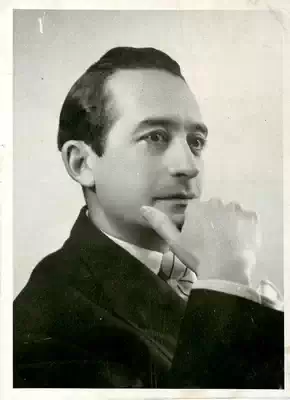
Xavier Villaurrutia
1903–1950
· lived 47 years
 MX
MX
MX
Xavier Villaurrutia was a Mexican poet, essayist, and playwright, a central figure in 20th-century Spanish-language literature. His poetic work, marked by existentialism and melancholy, explores themes such as death, solitude, time, and the search for identity. Villaurrutia is known for his refined style, his mysterious atmosphere, and his reflections on the human condition. His plays are also notable for their experimentation and psychological depth.
n. 1903-03-27, Cidade do México · m. 1950-12-25, Cidade do México
33
Views
Bio
Identification and basic context
Xavier Villaurrutia Calderón was a prominent Mexican poet, playwright, essayist, and literary critic. He was born in 1903 in Mexico City and died in 1950. He is considered one of the founders of the literary magazine "Contemporáneos", a landmark for modern Mexican literature. His work is written in Spanish.Childhood and education
Villaurrutia was born into an upper-class family and had access to a privileged education. He studied Law at the National University of Mexico, where he became involved with the intellectual and literary scene of the time. His education was influenced by European philosophical and literary currents, as well as by the Hispanic literary tradition.Literary career
Villaurrutia's literary career began with his active participation in the "Contemporáneos" group, which sought to modernize Mexican literature and engage in dialogue with international avant-garde movements. His poetry, initially influenced by modernism, evolved into a more personal and existential expression. In addition to poetry, he distinguished himself as a playwright, with plays that explored atmosphere and the human psyche.Work, style, and literary characteristics
Work, style, and literary characteristics Villaurrutia's poetic work is marked by a somber, melancholic, and reflective tone. Themes such as death, solitude, time, unrequited love, the city, and the search for identity are central. His style is characterized by sobriety, vocabulary precision, the use of nocturnal imagery, and the creation of an atmosphere of mystery and anguish. He used forms such as the sonnet, but also experimented with free verse. The poetic voice is often confessional, exploring the lyrical "I" in its vulnerability and in its confrontation with finitude. His theater, equally introspective, addresses psychological and existential conflicts.Work, style, and literary characteristics
Cultural and historical context Xavier Villaurrutia lived in a period of great cultural and political effervescence in Mexico, the post-revolutionary era. He and the "Contemporáneos" group faced criticism for their supposed "elitism" and their detachment from more explicit social themes, but they were also crucial for the renewal of Mexican literature and its integration into the international context. He maintained relationships with other intellectuals and artists of his generation.Work, style, and literary characteristics
Personal life Villaurrutia had a discreet and largely private personal life. His sexual orientation, homosexual, was an aspect that, although not explicitly addressed directly in his work, permeates some of his reflections on love and solitude. His affective relationships, though little documented publicly, seem to have been sources of inspiration for his poetry.Work, style, and literary characteristics
Recognition and reception Although he received recognition in Mexican literary circles during his lifetime, his place as one of the great poets of the Spanish language was consolidated posthumously. His work is studied and admired today for its originality, depth, and formal mastery.Work, style, and literary characteristics
Influences and legacy Villaurrutia was influenced by poets such as Rubén Darío, Paul Valéry, and T.S. Eliot. In turn, his work influenced later generations of Mexican and Latin American poets, especially those interested in exploring existential lyricism and the renewal of poetic language.Work, style, and literary characteristics
Interpretation and critical analysis Villaurrutia's work has been widely interpreted through the lens of existentialism, existential anguish, and melancholy. His reflections on death and solitude are central to many critical analyses, which highlight the universality of his feelings.Work, style, and literary characteristics
Curiosities and lesser-known aspects A curiosity is that, despite his law degree, he dedicated himself almost entirely to literature and theater. His play "La Hiedra" is a notable example of his dramatic talent, exploring claustrophobia and complex human relationships.Work, style, and literary characteristics
Death and memory Xavier Villaurrutia died prematurely from pneumonia during a trip to New York. His death left a void in Mexican literature, but his work continues to be read and revered, ensuring his memory and legacy.Poems
0No poems found
Comments (0)
Log in
to post a comment.
No comments yet. Be the first to comment.