
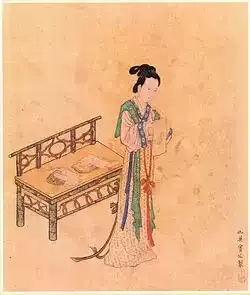
Xue Tao
768–831
· lived 63 years
 CN
CN
CN
Xue Tao was a celebrated Chinese poet of the Tang Dynasty, known for her beauty, talent, and independent spirit. Her poetry, often evocative and melancholic, explored themes of love, the passage of time, and the ephemeral beauty of life, reflecting her own experiences and insights. Xue Tao stood out in a male-dominated era, earning recognition for her sharp intellect and the lyrical quality of her compositions, becoming an iconic figure in Chinese literary history.
n. 0768-01-01, Changan · m. 0831-01-01, Changan
35
Views
Bio
Identification and basic context
Xue Tao (c. 761–831) was a famous Chinese poet of the Tang Dynasty. She is considered one of the most talented and influential poets in Chinese literary history. Born in Chang'an (modern Xi'an), the capital of the Tang Dynasty, into a family with some connection to the imperial bureaucracy, Xue Tao lived in a time of great cultural flourishing, but also of political instability that would mark the end of the dynasty.Childhood and education
Xue Tao's father, Xue Yun, was a minor official. Her family, though not of high nobility, possessed a certain level of education. Young Xue Tao showed remarkable literary talent from an early age, writing poetry as a child. However, her life took an unexpected turn with the premature death of her father. After his death, the family fell into financial difficulties, and Xue Tao, to support herself and her mother, was forced into the world of courtesans and entertainers in Chengdu, Sichuan province. This environment, although socially precarious, allowed her to develop her literary talent, surrounded by intellectuals and officials who frequented these circles.Literary career
Xue Tao's literary career began very early, with the writing of poems that already revealed remarkable maturity. Her entry into the world of entertainment, although motivated by necessity, ultimately became a catalyst for her poetic career. In Chengdu, she became a known figure in intellectual and bureaucratic circles, composing poems for social occasions, banquets, and as a way to express her feelings and observations. She developed a unique style and a reputation that made her recognized by many of the great poets of the era. She composed a large number of poems, many of which have been lost, but about a hundred have survived to this day.Work, style, and literary characteristics
Xue Tao's work is characterized by poignant lyricism, elegance, and deep introspection. Her poems often address themes such as lost or unrequited love, longing, the inexorable passage of time, the beauty of nature, solitude, and reflection on the human condition. Her poetic voice is often described as melancholic, but also strong and resilient, reflecting her own life of adversity. She used refined language and vivid imagery, with a remarkable ability to evoke emotions. One of her most famous contributions is the creation of "Xue Paper" (Xue Tao Jian), a handmade paper of reddish color, on which she wrote her poems, often in small scale to fit the paper.Work, style, and literary characteristics
Cultural and historical context Xue Tao lived during the Tang Dynasty, a period considered the "golden age" of Chinese poetry, but which was also marked by conflicts such as the An Lushan Rebellion. Although the rebellion occurred before her birth, its consequences and the subsequent instability shaped the social and political environment in which she lived. Chengdu, where she spent most of her adult life, was a vibrant cultural center, but also a place where life could be precarious. She interacted with many of the great poets of the time, such as Du Fu and Yuan Zhen, who recognized and admired her talent. Her position as a poet in a patriarchal society is, in itself, a reflection of the tensions and possibilities of the era.Work, style, and literary characteristics
Personal life Xue Tao's personal life was marked by the early loss of her father and the need to support herself through her art. Her activity as a singer and courtesan, although it allowed her to interact with the intellectual elite, also implied a certain social vulnerability. She is known to have had romantic relationships, including a significant connection with the poet Yuan Zhen. Her independence and talent allowed her to navigate these complexities, maintaining a dignity and inner strength that are reflected in her poetry.Work, style, and literary characteristics
Recognition and reception Xue Tao gained considerable recognition during her lifetime, being admired by many of her contemporaries, including renowned poets. Her work has been preserved and passed down through generations, solidifying her position as one of China's most important female poets. Her name has become synonymous with female poetic talent, and her story inspires many women. "Xue Paper" is also a tangible reminder of her presence and legacy.Work, style, and literary characteristics
Influences and legacy Xue Tao was influenced by the Chinese poetic tradition but developed her own distinctive style. Her legacy is her poetic work, which continues to be studied and appreciated, and her figure as an independent and talented woman in a restrictive era. She influenced later female poets, and her work is an example of how art can transcend social limitations. Her contribution to Chinese poetry is undeniable, enriching the canon with her unique lyrical voice.Work, style, and literary characteristics
Interpretation and critical analysis Xue Tao's poetry has been the subject of various interpretations, focusing on her ability to express universal emotions in such a personal and moving way. Her work is often analyzed in light of her biography, exploring how her life experiences shaped her writing. The melancholic beauty of her verses and her resilience in the face of adversity are central themes of critical analysis.Work, style, and literary characteristics
Curiosities and lesser-known aspects The creation of "Xue Paper" is one of the most curious and enduring aspects of her legacy. Legend has it that she dyed the paper with the juice of lychee flowers and sometimes added gold or silver powder. The poems she wrote on this paper were often short, with a specific number of characters, which perfectly matched the format of the paper, which was slightly smaller than the standard paper of the time. Her connection to the Huayang Temple in Chengdu is also a point of interest.Work, style, and literary characteristics
Death and memory Xue Tao died around 831. Although many of her poems have been lost, the legacy of her work and life endures. She is remembered not only for her poetry but as a symbol of talent, independence, and female resilience in ancient China. Her name is evoked whenever one speaks of great Chinese female poets.Poems
0No poems found
Comments (0)
Log in
to post a comment.
No comments yet. Be the first to comment.