Identification and basic context
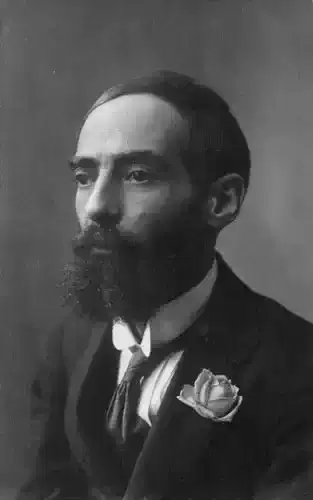
Camilo de Almeida Pessanha was a Portuguese poet, professor, translator, and orientalist. He was born on December 7, 1867, in Coimbra and died on March 1, 1926, in the same city. He came from a middle-class family with ties to the academic and administrative spheres. He was a Portuguese citizen and his writing language was Portuguese.
His life and work unfolded in a complex historical context, marked by the end of the monarchy in Portugal, the establishment of the Republic, and the Portuguese presence in the East, especially in Macau, during the last decades of the 19th and early 20th centuries.
Childhood and education
Pessanha's childhood was spent in an intellectual environment, influenced by the academic tradition of Coimbra. He studied Law at the University of Coimbra, but his true vocation leaned towards literature and the knowledge of Eastern cultures. He was self-taught in many aspects, especially in the study of Asian languages and cultures.
His initial readings were marked by French Parnassian and Symbolist poetry, as well as classic Portuguese literature. Eastern culture, philosophy, and Asian religions exerted a decisive influence on his thought and work.
Important events in his youth were his university studies and the opportunity to travel to Macau, where he would reside for many years.
Literary career
Camilo Pessanha's literary career is characterized by a relatively scarce but high-quality production. He debuted poetically in various literary magazines and participated in the famous anthology "Orpheu" (1915), which marked the beginning of Portuguese Modernism, although his style was more firmly rooted in Symbolism. His poetic work is a constant evolution towards formal refinement and thematic deepening, exploring sensuality, exoticism, and melancholy.
He collaborated in newspapers and magazines such as "A Águia", "Contemporânea", and the aforementioned "Orpheu". He also dedicated himself to translating Eastern texts and worked as a teacher in Macau.
Work, style, and literary characteristics
Pessanha's main poetic work is concentrated in "Clepsidra" (1920), his only book published during his lifetime, although posthumous compilations have added other poems. His dominant themes include carnal and spiritual love, melancholy, the transience of time (symbolized by the clepsidra or hourglass), sensuality, death, Eastern exoticism (with references to China and Japan), decadence, and the search for beauty.
His style is markedly Symbolist, characterized by great musicality, the use of refined and often archaic vocabulary, synesthesia, evocative metaphors, and a careful formal structure, although he also experimented with free verse. The poetic voice is lyrical, melancholic, sensual, and deeply introspective, often tinged with mystical orientalism.
He is considered one of the greatest representatives of Portuguese Symbolism, introducing an Eastern sensibility and imagery that distinguished him from other poets of his time. His work dialogues with the French Parnassian and Symbolist tradition, and anticipates certain concerns of Modernism.
Cultural and historical context
Camilo Pessanha lived in a period of cultural effervescence in Portugal, with the emergence of movements like Symbolism and Modernism. He was a contemporary of Fernando Pessoa, Mário de Sá-Carneiro, and Almada Negreiros, with whom he shared the desire for renewal, although his work maintained its own identity. His adherence to Symbolism places him in a current that sought to overcome Parnassianism and Realism.
His experience in Macau connected him with Eastern culture, enriching the perspective of Portuguese literature. His personal stance was often discreet, but his work reflects a deep sensitivity and a critical spirit.
Personal life
Pessanha's life was marked by his prolonged stay in Macau, where he worked as a professor and administrator. His personal relationships, although less documented than his work, suggest a reserved personality and a deep connection with the cultures that surrounded him. The experience of living in a setting so different from Europe notably influenced his worldview and his literary production.
There is no evidence that he lived exclusively from poetry; his teaching and administrative work in Macau provided him with sustenance. His spiritual beliefs, while not explicit, seemed to lean towards a synthesis between Eastern and Western spirituality.
Recognition and reception
Although his recognition during his lifetime was limited, Camilo Pessanha is today considered a fundamental figure of Portuguese Symbolism and a poet of great relevance in Portuguese-language literature. His inclusion in the "Orpheu" magazine gave him early visibility. Subsequent criticism has greatly valued the originality, musicality, and depth of his work, considering him a cult poet of unusual exquisiteness.
Influences and legacy
He was influenced by French poets such as Baudelaire, Verlaine, and Mallarmé, as well as classic Portuguese poetry. His work significantly influenced later poets, especially those who explored Symbolism and the fusion of cultures. His legacy lies in the introduction of a lyrical voice and an Eastern imagery that enriched Portuguese poetry, and in his mastery of verse.
Interpretation and critical analysis
Pessanha's work has been interpreted as an expression of existential melancholy, the search for beauty in the ephemeral, and the tension between spirit and flesh. The themes of time, death, and transcendence are approached from a sensual and at the same time spiritualized perspective, marked by Eastern influence.
Childhood and education
One of the most notable curiosities is his deep connection with Macau, where he lived for over 30 years, assimilating Chinese culture. He was a scholar of Eastern languages and literature. His reserved character and discreet life contrast with the intensity and sensuality of his poetry. It is said that he kept manuscripts and correspondence that reveal unpublished aspects of his thought.
Death and memory
He died in Coimbra, where he returned in the last years of his life. His death passed relatively unnoticed at the time, but over time his figure and work were reclaimed. Posthumous publications, including "Clepsidra" with additional poems, have consolidated his place in the history of Portuguese literature.