
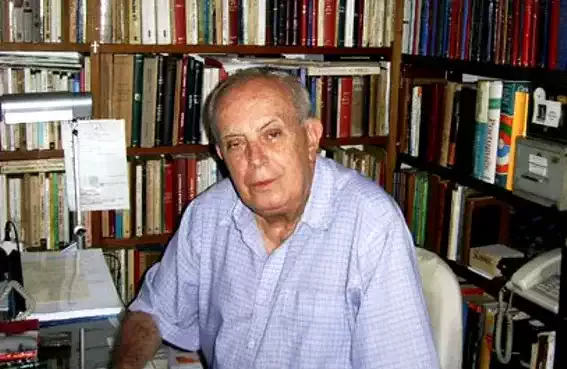
Gilberto Mendonça Teles
1931–2024
· vivió 93 años
 BR
BR
BR
Gilberto Mendonça Teles is a Brazilian poet, literary critic, and professor, whose work is distinguished by its intelligence, lyricism, and profound reflection on language and the human condition. His poetry oscillates between the personal and the universal, with formal rigor and expressive clarity. With a vast academic and literary career, he is an indispensable figure in contemporary Brazilian literature, influencing generations of writers and scholars.
n. 1931-01-01, Bela Vista de Goiás · m. 2024-12-04
56
Visualizaciones
Biografía
Identification and basic context
Gilberto Mendonça Teles is a renowned Brazilian poet, literary critic, university professor, and essayist. He was born in 1931, in Barra do Garças, Mato Grosso.Childhood and education
His academic training was marked by studies in Law and, later, in Letters. He obtained a doctorate in Comparative Literature from the University of São Paulo (USP), where he also taught. His intellectual trajectory was shaped by a deep interest in poetry, literary criticism, and philosophy.Literary career
He began his literary career as a poet, publishing "O Prisioneiro do Espaço" in 1956. Over the decades, he established himself as one of the important names in Brazilian poetry, exploring different lyrical and thematic facets. In addition to poetry, he distinguished himself as an influential literary critic, with works analyzing modern and contemporary Brazilian and Portuguese poetry, and as a university professor, training numerous students.Work, style, and literary characteristics
The poetic work of Gilberto Mendonça Teles is characterized by introspective lyricism, the search for the exact word, and a constant reflection on the passage of time, memory, identity, and the human condition itself. His style is marked by clarity, formal rigor, and intelligence, often exploring free verse with great sensitivity. Themes such as love, loneliness, the ephemeral beauty of life, and the search for meaning permeate his poetry. He dialogues with literary tradition while incorporating elements of modernity, without adhering to fleeting trends. He is often associated with poetry that values reflection and depth. Among his most relevant poetic works are "O Prisioneiro do Espaço" (1956), "Coração na Manhã" (1958), "Vigília" (1959), "Algum Movimento" (1965), "A Busca do Riso" (1975), "O Livro das Ignorâncias" (1986), "Poemas Escolhidos" (1998), and "Um Gato no Teclado" (2010). As a critic, he published fundamental works such as "Breve História da Literatura Brasileira" (1957), "Estudos de Poética Brasileira" (1965), and "A Poesia de Carlos Drummond de Andrade" (1972).Cultural and historical context
His trajectory developed during a period of cultural effervescence in Brazil, marked by important literary movements such as Concretism and Post-Concretism, although his poetic work followed a more introspective and lyrical path. As an intellectual, he participated in important debates about Brazilian literature and culture. His education and academic activity took place during a period of consolidation of Brazilian universities and expansion of literary studies.Personal life
Gilberto Mendonça Teles dedicated a large part of his life to literature and teaching. His personal life, although not widely disclosed in detail, is marked by discretion and deep dedication to his intellectual activities. His emotional and familial relationships, like those of any individual, certainly influenced his worldview and poetic sensibility, although he chose to focus more on the universality of themes in his work.Recognition and reception
He is widely recognized as one of the great figures of contemporary Brazilian poetry. His poetic and critical work has been the subject of study in universities and of laudatory reviews. He has received several awards and distinctions throughout his career, attesting to the importance of his contribution to Brazilian letters.Influences and legacy
He was influenced by great poets of the Portuguese language and by Western literary tradition. His legacy lies not only in his poetic work but also in his role as a critic and professor, who helped shape and direct thought on Brazilian literature. His poetry continues to inspire readers and writers through its depth and beauty.Interpretation and critical analysis
Mendonça Teles' work invites reflection on existence, language, and art. His literary criticism is valued for its analytical depth and expository clarity, offering insightful interpretations of the authors and works he addresses.Curiosities and lesser-known aspects
His work as a university professor, especially at USP, had a significant impact on the training of generations of Brazilian literature scholars. His discretion about his personal life contrasts with the lyrical openness of his poetic work.Death and memory
Still active and recognized, Gilberto Mendonça Teles remains a living and active figure in Brazilian literature. His legacy is consolidated in his works and in the memory of those he has influenced.Poemas
0No se encontraron poemas
Comentarios (0)
Iniciar sesión
para publicar un comentario.
Aún no hay comentarios. Sé el primero en comentar.