
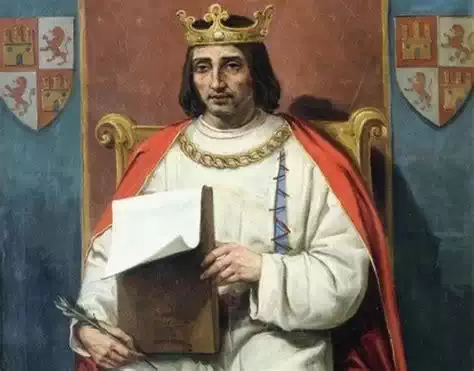
Afonso X
1221–1284
· lived 62 years
 ES
ES
ES
Afonso X, known as the Wise, was king of León and Castile and one of the most important figures in the history of the medieval Iberian Peninsula. His notoriety stems not only from his reign, but above all from his role as a patron of the arts and sciences and his vast intellectual output. He encouraged the translation of works into Castilian, promoting the development of the language and culture, and left a lasting legacy through his own compilations and treatises in various fields of knowledge.
n. 1221-11-23, Toledo · m. 1284-04-04, Sevilha
36
Views
Bio
Identification and basic context
Afonso X, nicknamed "the Wise", was king of León and Castile between 1252 and 1284. Born in Toledo, he was one of the most prominent medieval monarchs of the Iberian Peninsula. He belonged to the House of Burgundy (or the first House of Anjou) and succeeded his father, Ferdinand III. His nationality was Castilian (and Leonese, due to the union of the kingdoms) and the language in which culture was produced and promoted was Castilian, which he elevated to the status of a language of culture and administration. He lived in a period of great cultural and political effervescence in Europe and the Iberian Peninsula, marked by the Reconquista and the interaction between Christian, Muslim, and Jewish cultures.Childhood and education
Born in Toledo, Afonso X was educated for the exercise of power from an early age. He received a careful education, which included the study of the liberal arts, law, and military strategy. His education was influenced by the cosmopolitan cultural environment of Toledo, where Christians, Muslims, and Jews coexisted, and where the translation of scientific and philosophical works from Arabic and Hebrew into Latin and, later, into Castilian was practiced. He absorbed influences from classical and Arab thinkers, and the context of territorial expansion and consolidation of royal power shaped his political and cultural thought.Literary career
Afonso X's "literary career" does not refer to a writing activity in the traditional sense of an individual poet or prose writer, but rather to his role as an organizer, promoter, and author of vast compendiums of knowledge. He began his "writing" by promoting translations and compilations of existing works, with the aim of creating a body of knowledge in Castilian. His work is characterized by a chronological development that reflects his cultural and political ambitions. His court in Toledo became a center of intellectual production, where works in various fields were translated and written. Afonso X was not only a patron, but also the main driving force and, in many cases, the direct author or supervisor of the works that came from his chancellery.Work, style, and literary characteristics
Afonso X's work, "the Wise", covers various fields of knowledge: history, law, astronomy, games, and recreational literature. His main works include the "Siete Partidas" (a fundamental legal code), the "Grande e Geral Estória" (a universal history), the "Libros del Saber de Astronomía" (a collection of astronomical and astrological treatises), and the "Libro de Juegos" (about board games). Dominant themes are the order of the universe, the organization of society, the history of humanity, justice, and scientific knowledge. The "style" of his works is predominantly didactic and informative, with a clear and systematic language, adapted to disseminate knowledge. His great innovation was the use of Castilian as a language of culture and science, promoting its standardization and prestige. Although it does not fit into a "literary movement" in the modern sense, his work is a milestone in the development of Castilian prose and the dissemination of knowledge in the Middle Ages.Work, style, and literary characteristics
Cultural and historical context Afonso X reigned during a crucial period of the Christian Reconquista of the Iberian Peninsula. His court was a center of cultural exchange where scholars of diverse origins gathered. He belonged to a generation of kings who sought to assert their power and consolidate their kingdoms. His political position was often marked by internal and external conflicts, including succession disputes and conflicts with the kingdom of Granada. His ambition to be elected Holy Roman Emperor also influenced his politics and his cultural output.Work, style, and literary characteristics
Personal life Afonso X's personal life was marked by challenges. He had complex family relationships, including his sons' rebellion against him. He was known for his passion for knowledge and his dedication to his court of scholars. His life was dedicated to governance, war, and, above all, the production and compilation of knowledge, which earned him the epithet "Wise". His religious beliefs were those of Catholic Christianity, but his work shows great openness to the knowledge produced by other cultures.Work, style, and literary characteristics
Recognition and reception Afonso X's recognition as "the Wise" was consolidated over time, even though his reign faced difficulties and was not a success in all aspects (e.g., the imperial issue). His legal, scientific, and historical work had a profound and lasting impact on Iberian and European culture. He is considered one of the founders of Castilian prose and one of the great drivers of knowledge in the Middle Ages.Work, style, and literary characteristics
Influences and legacy Afonso X was influenced by classical culture, Arab and Hebrew science and philosophy, and the Roman and canon law tradition. His legacy is immense: the "court" of Toledo, the development of Castilian as a language of culture and administration, and the compilation and dissemination of a vast corpus of scientific, historical, and legal knowledge. He influenced generations of jurists, historians, and scientists in the Iberian Peninsula and Europe. His works were widely studied and translated.Work, style, and literary characteristics
Interpretation and critical analysis Afonso X's work is seen as a monumental effort to organize and systematize medieval knowledge. The "Siete Partidas", in particular, are a testament to his vision of an ordered and just society, based on law. His literary and scientific production reflects an attempt to unify knowledge under the aegis of the crown and the Castilian language, promoting a more cohesive Iberian cultural identity.Work, style, and literary characteristics
Curiosities and lesser-known aspects Afonso X was known for his vast library and his ability to attract the best scholars of the time to his court. His ambition to become Emperor of the Holy Roman Empire, for which he spent a considerable fortune, ultimately did not materialize and led to serious financial difficulties for the kingdom of Castile. The "Libro de Juegos" is a curiosity that demonstrates the king's interest not only in serious subjects but also in leisure and entertainment.Work, style, and literary characteristics
Death and memory Afonso X died in Toledo in 1284. His death was followed by a period of instability in the kingdom. However, the memory of his reign and, especially, of his intellectual work, endures to this day, consolidating him as one of the most important figures in the cultural history of Spain and medieval Europe. His works continue to be the subject of study and admiration.Poems
0No poems found
Quotes
1No poems found
Comments (0)
Log in
to post a comment.
No comments yet. Be the first to comment.