
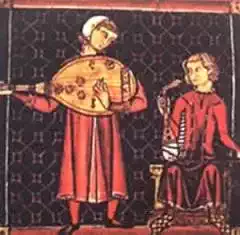
Airas Nunes
1230–1293
· lived 63 years
 ES
ES
ES
Airas Nunes was a Galician poet of the Middle Ages, known for composing 'cantigas de amigo' in Galician-Portuguese. His work, part of the troubadour lyric tradition, is notable for its expressiveness and its representation of themes such as love, saudade (longing), and nature, often filtered through the female voice. His cantigas are important testaments to the language and culture of the time, revealing a remarkable artistic sensibility for his era.
n. 1230, Reino da Galiza · m. 1293, Chinchón
61
Views
Bio
Identification and basic context
Airas Nunes (or Aires Nunes) was a Galician troubadour who lived during the Middle Ages. He is primarily known for his production of 'cantigas de amigo,' a lyrical genre characteristic of troubadour poetry in the Iberian Peninsula. His works were composed in the Galician-Portuguese language, the common language of Iberian lyric poetry during that period.Childhood and education
Details about Airas Nunes's childhood and education are scarce, as is the case with many medieval troubadours. It is known that he belonged to the nobility, which allowed him access to education and familiarity with courtly customs and chivalric codes, elements that often transpire in his poetry.Literary career
Airas Nunes was part of the Galician-Portuguese lyric movement, being one of the most representative troubadours of the 'cantiga de amigo' genre. His work, preserved in songbooks such as the one in the National Library of Lisbon and the one in Elvas, includes a considerable number of compositions that attest to his poetic activity.Work, style, and literary characteristics
Work, style, and literary characteristics Airas Nunes's work consists predominantly of 'cantigas de amigo.' These cantigas are characterized by the female lyrical voice that expresses her amorous feelings, often marked by saudade, the absence of the beloved, and communication with nature (the sea, flowers, birds) or with confidantes (mother, sister, ladies-in-waiting). Airas Nunes's style is noted for its expressiveness, its delicacy in describing feelings, and the musicality of his verses. He uses resources such as parallelism, refrain, and repetition to intensify the emotionality and rhythm of the compositions. Themes such as veiled love, waiting, suffering from separation, and the manifestation of desire are recurrent.Work, style, and literary characteristics
Cultural and historical context Airas Nunes lived in a period of intense cultural and political activity in the Iberian Peninsula, with the coexistence of Christian and Muslim kingdoms, and the flourishing of Galician-Portuguese lyricism as an artistic expression of the courtly elites. He belonged to the second generation of troubadours, at a time when lyric poetry reached a high degree of sophistication.Work, style, and literary characteristics
Personal life Information about Airas Nunes's personal life is limited. It is known that he was a nobleman and that his poetic activity was linked to the courtly environment, where troubadours were appreciated figures. His work, although centered on the female voice, reflects the social conventions and the sentiments of love and devotion that characterized the era.Work, style, and literary characteristics
Recognition and reception Airas Nunes is recognized as one of the most important troubadours of Galician-Portuguese lyric poetry. His work was preserved in the main medieval songbooks, demonstrating his relevance and impact on the literary tradition of the time. His contribution to the 'cantiga de amigo' genre is fundamental to understanding medieval Iberian poetry.Work, style, and literary characteristics
Influences and legacy Airas Nunes was influenced by the tradition of the 'cantiga de amigo' and by the lyrical models that preceded him. His legacy lies in the quality and expressiveness of his compositions, which served as models for other troubadours and continue to be studied and appreciated for their beauty and historical and linguistic importance. He contributed significantly to the consolidation of the meter and style of the 'cantiga de amigo.'Work, style, and literary characteristics
Interpretation and critical analysis Airas Nunes's poetry has been the subject of critical analysis that highlights his ability to create an authentic and expressive female lyrical voice, even though it was written by a man. The interpretation of his cantigas focuses on the representation of courtly love, the underlying social codes, and the relationship between the lyrical self and the external world.Work, style, and literary characteristics
Curiosities and lesser-known aspects A curious aspect of his work is Airas Nunes's skill, as a man, in placing himself in the female perspective to express such intimate feelings, which demonstrates great sensitivity and capacity for empathy.Work, style, and literary characteristics
Death and memory The circumstances of Airas Nunes's death are unknown, nor are there records of posthumous publications, as his work was compiled in songbooks during his lifetime or shortly thereafter.Poems
0No poems found
Comments (0)
Log in
to post a comment.
No comments yet. Be the first to comment.