
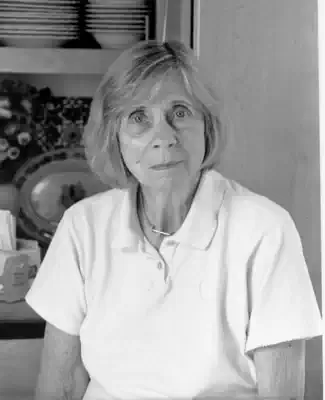
Barbara Guest
 US
US
Barbara Guest was an American poet recognized for her contribution to modern poetry, particularly associated with the New York School. Her work explores the complexities of language, perception, and identity, often in an experimental and innovative manner. Guest challenged poetic conventions through her distinctive use of verse and her fragmented, interconnected approach to form. Throughout her career, she explored themes such as memory, nature, art, and the female condition, using precise and imagistic language. Her poetry is often characterized by its intelligence, subtle musicality, and profound reflection on the limits of representation and expression.
n. 1920-09-06, Carolina do Norte · m. 2006-02-15, Berkeley
Bio
Identification and basic context
Barbara Guest (born Barbara Feinberg) was an American poet. She did not use any known pseudonyms or heteronyms. She was born in 1920 and passed away in 2013. Her family background and cultural context were influenced by American society of her time. She was of American nationality and wrote in English. She lived through most of the 20th century and the early 21st century, a period marked by significant social, cultural, and technological transformations.Childhood and education
Guest grew up in an upper-middle-class family environment in Los Angeles, California. She attended private preparatory schools and later the University of California, Berkeley, and Columbia University, where she studied literature and creative writing. Her early readings included both the classical literary tradition and modernist poets, whom she absorbed and reinterpreted in her own work. Significant events in her youth include her education and immersion in the literary and artistic world of New York.Literary career
Barbara Guest's writing began in her youth, but her literary career solidified from the 1950s onwards. Her work evolved over time, moving through phases of greater formal and thematic experimentation. She published several poetry collections, including "The Location of Things" (1960), "D Tritons" (1972), "Quartets" (1982), and "If I Want To" (2012). She collaborated with various literary publications and anthologies. She was also active as a literary critic.Work, style, and literary characteristics
Barbara Guest's major works include "The Location of Things" (1960), "D Tritons" (1972), "Quartets" (1982), and "If I Want To" (2012). The dominant themes in her poetry are memory, perception, nature, art, identity, and the female condition. Guest was known for her innovative use of free verse, her fragmented structure, and her exploration of the relationships between language and reality. Her poetic devices included surprising metaphors, subtle rhythm, and intrinsic musicality. The tone of her poetic voice could vary between contemplative, ironic, and analytical, with a personal and profoundly reflective voice. Her style was characterized by precise vocabulary, imagistic density, and sharp intelligence. She introduced formal and thematic innovations, exploring the limits of poetic representation. Her work engaged with the modernist tradition but also pointed towards future directions, being associated with the New York School of Poetry and, more broadly, with contemporary experimentalism.Cultural and historical context
Barbara Guest lived and produced her work during a period of intense cultural and artistic changes in the United States, notably the development of the New York School of poetry. She maintained relationships with other important writers and artists on the New York literary scene. Her generation of poets explored new forms of poetic expression in response to post-war transformations. Although not known for explicit political stances, her work reflects a deep sensitivity to the social and existential issues of her time.Personal life
Barbara Guest married art critic William Guest. Her personal life, relationships, and experiences shaped her worldview and, consequently, her poetic work. Her friendships within the artistic and literary circles were important. Guest explored themes of identity and place, which may have been influenced by her personal experiences. She is not known to have had significant parallel professions beyond her literary career. Her religious or philosophical beliefs are not a prominent theme in her known work, but her poetry demonstrates a profound existential exploration.Recognition and reception
Barbara Guest is recognized as an important figure in contemporary American poetry, especially within the New York School of Poetry. She received several awards and distinctions throughout her career, attesting to her recognition in the literary world. Critical reception of her work has been consistently positive, praising her originality and technical mastery. Her popularity, while perhaps not as widespread as that of other more mainstream poets, is significant among academics and readers of experimental poetry.Influences and legacy
Barbara Guest was influenced by modernist poets such as T.S. Eliot and Ezra Pound, as well as by the Black Mountain School and the New York School of Poetry. Her work, in turn, has influenced later generations of experimental and avant-garde poets. Her impact on American poetry lies in her continuous exploration of the limits of language and poetic form, and in her ability to create a cohesive and distinctive body of work.Interpretation and critical analysis
Barbara Guest's work allows for multiple readings, with a strong philosophical and existential component. Her poetry invites reflection on the nature of reality, perception, and representation. Critical analysis has focused on her use of language, her fragmented structure, and her relationship with the visual arts. No significant critical controversies are known to be associated with her work.Curiosities and lesser-known aspects
Barbara Guest was known for her intelligence and discretion. Her poetry, while often dense and intellectually stimulating, also possesses a strong lyrical and emotional component. Curious episodes about her personal life and writing habits are not widely publicized, but her dedication to poetic exploration is a striking aspect of her profile.Death and memory
Barbara Guest passed away in 2013. After her death, her work continued to be studied and celebrated, solidifying her place in the history of American poetry. Posthumous publications and reissues of her works ensure her continued presence in the literary landscape.Poems
0No poems found
Comments (0)
No comments yet. Be the first to comment.