
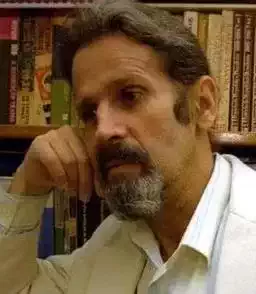
Bruno Tolentino
 BR
BR
Bruno Tolentino was a Brazilian poet, essayist, and translator whose work is characterized by erudition, philosophical depth, and the incessant pursuit of beauty and transcendence. His poetry, often marked by rigorous form and elaborate language, addresses universal themes such as time, memory, love, death, and faith, exploring the ambiguities of the human condition. Tolentino demonstrated a remarkable mastery of the Western poetic tradition, while at the same time imprinting his verses with a personal mark of intense reflection and spiritual stripping, leaving a legacy of dense work with great aesthetic rigor.
n. 1940-11-12, Rio de Janeiro · m. 2007-06-27, São Paulo
Bio
Identification and Basic Context
Bruno Tolentino was born in Rio de Janeiro and adopted the pseudonym "Bruno Tolentino" for his literary career. He was a poet, essayist, and translator. His nationality was Brazilian and his writing language was Portuguese. He lived in a period of intense cultural and political transformations in Brazil and worldwide, which influenced his worldview and his work.Childhood and Education
Bruno Tolentino had a childhood marked by a rigorous education and an early inclination for studies and reading. He revealed a precocious talent for literature and philosophy, showing a deep interest in classical tradition and Western culture from an early age. His education was largely self-taught, fueled by vast erudition and in-depth study of classical and modern authors, in literature as well as philosophy and theology. He absorbed diverse influences, ranging from poets of Greco-Roman antiquity to modern and contemporary thinkers.Literary Career
The beginning of his literary activity was marked by the publication of poems in magazines and anthologies. His main poetic work consolidated over his life, characterized by a gradual evolution in form and theme. He published poetry collections that were received with great attention from specialized critics. Besides being a poet, he was an important essayist, with articles published in renowned newspapers and magazines, and a translator of classical and modern works. His activity as a critic and intellectual contributed to the cultural debate of his time.Work, Style, and Literary Characteristics
Among his most outstanding poetic works are "A imagem em movimento" (1969), "O tomate enlatado" (1981), "O cerco da casa" (1985), and "A celestial inércia" (2002). His poems explore themes such as time, memory, beauty, death, spirituality, the human condition, and the quest for transcendence. Tolentino's style is marked by erudition, formal rigor, metaphorical density, and an elaborate and musical language. He frequently used classical forms, such as the sonnet, but also ventured into metrical experiments. His poetic voice is lyrical, reflective, and at times melancholic, laden with deep introspection. The relationship with the Western literary tradition is fundamental in his work, while also engaging with modernity, proposing poetry of a philosophical and spiritual nature.Cultural and Historical Context
Bruno Tolentino lived in a period of great intellectual and cultural debates in Brazil, marked by the military dictatorship and redemocratization. His work, although universal and timeless in nature, reflects to some extent the anxieties of his time. He maintained contact with other writers and intellectuals, participating in discussions about art, philosophy, and literature. His position as an erudite intellectual and his pursuit of profound poetry associate him with a more classical and reflective strand of Brazilian literature.Personal Life
Bruno Tolentino lived a life dedicated to art and thought. His dedication to writing and reading was the main mark of his existence. His personal relationships and life experiences, although not widely publicized, seem to have been sources of reflection and inspiration for his work, especially regarding the exploration of existential and spiritual themes. His life was marked by the search for a deeper meaning of existence and the pursuit of beauty.Recognition and Reception
Bruno Tolentino is recognized as one of the most important Brazilian poets of his generation. His work has been the object of admiration and study by specialized critics, who highlight his erudition, formal rigor, and the depth of his poetry. He received awards and distinctions that attest to the value of his literary contribution. His popularity, although perhaps more restricted to intellectual circles, is significant due to the quality and originality of his work.Influences and Legacy
Bruno Tolentino was influenced by a vast range of authors from universal literature, including classical poets, philosophers, and religious thinkers. His work, in turn, has influenced and continues to inspire poets and writers who seek poetry of great aesthetic rigor and intellectual depth. His legacy is that of a poet who knew how to unite tradition with contemporaneity, offering a lyrical and philosophical vision of human existence. His writings are studied in literature courses and his poetry is valued for its relevance and originality.Interpretation and Critical Analysis
Bruno Tolentino's work invites deep philosophical and existential reflections. His poems are frequently analyzed from the perspective of the search for beauty, the struggle with time and mortality, and the exploration of faith and spirituality. Critics highlight the complexity of his language and the universality of the themes he addresses.Curiosities and Lesser-Known Aspects
A remarkable aspect of Bruno Tolentino's life was his intense and dedicated devotion to poetic creation and study, living discreetly and focused on his intellectual production. His ability to absorb and rework the Western literary tradition so originally is also a point of emphasis. His work is a testament to a life dedicated to art and the search for the perfect word.Death and Memory
Bruno Tolentino passed away in Rio de Janeiro. His death left a legacy of poetic and essayistic work of great value, which continues to be read and appreciated. Posthumous publications and studies about his work keep his memory and the relevance of his contribution to Brazilian literature alive.Poems
0No poems found
Videos
50
Comments (0)
No comments yet. Be the first to comment.