
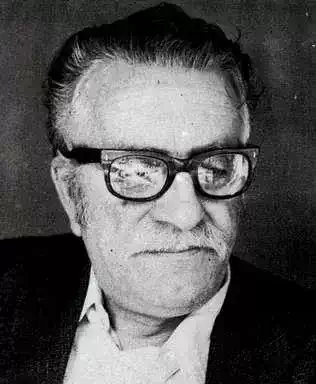
Celso Emilio Ferreiro
1912–1979
· lived 67 years
 ES
ES
ES
Celso Emilio Ferreiro was a Galician poet, journalist, and political activist, considered one of the central figures of contemporary Galician poetry. His work is marked by strong social and political engagement, the exploration of Galician identity, and direct, vigorous language. He was a tireless defender of Galician culture and language in times of repression.
n. 1912-01-06, Celanova · m. 1979-08-30, Vigo
53
Views
Bio
Identification and basic context
Celso Emilio Ferreiro, full name Celso Emilio Ferreiro Graña, was a Galician poet, journalist, and political activist. He is widely recognized as one of the pillars of contemporary Galician poetry, especially for his work published after the Spanish Civil War and during the Franco dictatorship. He was born in Ourense and lived most of his life in Galicia, being an uncompromising defender of the Galician language and culture.Childhood and education
Celso Emilio Ferreiro grew up in an environment marked by the social and political upheavals of 20th-century Spain. His initial education took place in Galicia, where he came into contact with the rich literary and oral tradition of his homeland. From an early age, he showed a strong sense of social justice and a deep love for his cultural identity.Literary career
Ferreiro's literary career was intrinsically linked to his political militancy and his passion for Galicia. He began publishing poetry and articles in newspapers and magazines, many of them in Galician, defending the autonomy and dignity of his people. His poetic work, although it faced censorship and publication difficulties due to the Franco regime, became a landmark of resistance and identity affirmation. He was also a journalist, using the press as a vehicle for his ideas and for the defense of the Galician language.Work, style, and literary characteristics
Celso Emilio Ferreiro's work is profoundly marked by social realism and existentialism. His central themes include oppression, social injustice, longing for his homeland, Galician identity, the struggle for freedom, and hope in difficult times. He used direct language, sometimes colloquial, but always loaded with expressive and emotional force. Free verse is predominant in his poetry, which is distinguished by its intense rhythm and its ability to evoke powerful images and visceral sensations. His poetry is a cry of resistance, a hymn to the land and to the Galician people.Cultural and historical context
Ferreiro lived under the dictatorship of Francisco Franco, a period of intense political and cultural repression, which aimed at the suppression of Spanish regional identities, including the Galician one. In this context, his work became an act of courage and a symbol of cultural resistance. He integrated and promoted what became known as the "Generation of '50" or "Second Nós Generation," a group of writers who sought to renew Galician literature in an adverse scenario. His poems dialogued with the social and political reality of Spain, but always with a focus on the specificity of Galicia.Personal life
Celso Emilio Ferreiro's life was dedicated to the struggle for his ideals. His political commitment led him to face persecution and difficulties, but he never gave up his conviction for the sake of freedom and Galician culture. His personal relationships and experiences in a turbulent period profoundly shaped his worldview and his literary output.Recognition and reception
During his lifetime, Celso Emilio Ferreiro was an admired and respected figure by his people and his intellectual peers, despite the difficulties imposed by the regime. Posthumously, his recognition has solidified, and he is celebrated today as one of Galicia's greatest poets, an icon of cultural resistance, and a defender of Galician identity.Influences and legacy
Ferreiro was influenced by the Galician poetic tradition, by socialism, and by poets who dared to express the pain and hope of their peoples. His legacy is immense, inspiring generations of Galician writers to keep alive the language and culture of their land, and to use literature as a tool for social and political intervention.Interpretation and critical analysis
Ferreiro's work is often analyzed from the perspective of social commitment, the defense of national identity, and the expression of the human condition in times of adversity. His poetry is seen as a powerful testament of a people fighting to preserve their soul.Curiosities and lesser-known aspects
Besides being a poet and journalist, Ferreiro also worked as a teacher. His connection to the Galician land and sea is a constant in his work, demonstrating a deep sense of belonging.Death and memory
Celso Emilio Ferreiro passed away in 1979, leaving a void in Galician literature, but his body of work remains a beacon of inspiration and a testament to his struggle. His memory is revered in his homeland, where he is remembered as one of Galicia's great cultural heroes.Poems
0No poems found
Comments (0)
Log in
to post a comment.
No comments yet. Be the first to comment.