
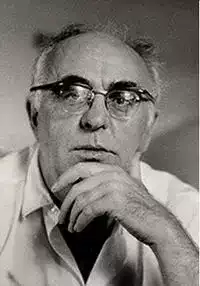
Charles Olson
 US
US
Charles Olson was an American poet, essayist, and academic, a central figure in post-World War II poetry. His work is marked by an intense exploration of individual experience and history, integrating philosophy and anthropology into verses that seek to capture the totality of being. Olson is often associated with Black Mountain College, where he taught and developed many of his theories on poetry, proposition, and perception. His legacy lies in redefining poetic practice, encouraging a more direct and visceral approach to language and reality, profoundly influencing generations of experimental poets.
n. 1910-12-27, Worcester · m. 1970-01-10, Nova Iorque
Bio
Identification and basic context
Charles Olson (born Charles Olson, December 11, 1910 – January 10, 1970) was an American poet, essayist, academic, and critic. He is considered one of the most important figures in American poetry after World War II, primarily associated with Black Mountain College and the Black Mountain Poetry movement.Childhood and education
Born in Worcester, Massachusetts, Olson grew up in a working-class family. His father worked for the post office, and his mother was a homemaker. From an early age, he showed a great interest in reading and history. He attended Worcester Academy and later Wesleyan University, where he studied English literature and delved into classical studies. His academic training was complemented by a self-taught interest in anthropology, American history, and philosophy.Literary career
Olson's early literary career was marked by a strong influence of modernism, especially Ezra Pound and T.S. Eliot. However, Olson quickly developed his own style, moving away from more traditional forms. His most productive and influential period occurred during his association with Black Mountain College, where he taught from 1951 to 1956. It was there that he formulated many of his poetic theories, such as "propositional poetry" and the concept of "Close Personal," which emphasized immediate experience and the relationship between the poet and the world.Work, style, and literary characteristics
Charles Olson's work is vast and multifaceted, including poetry, essays, and criticism. His major works include "The Maximus Poems" (a multi-volume epic exploring the history and geography of Gloucester, Massachusetts), "Call Me Ishmael" (an essay on Herman Melville), and "Projective Verse" (a fundamental poetic manifesto). Dominant themes in his work include American history, geography, mythology, anthropology, the human psyche, and the individual's relationship with the cosmos. Olson sought to capture the totality of experience, integrating spoken language and the rhythm of breath into his verses. The form was often free, experimental, with an emphasis on structure emerging from the very substance of experience. His style is dense, intellectual, and at times challenging, demanding active reader engagement. Olson used language that combined the scholarly with the colloquial, creating a powerful and urgent poetic voice. He was a pioneer in large-scale poetry, exploring the relationship between the local and the universal.Work, style, and literary characteristics
Cultural and historical context Olson lived in a period of intense cultural and political transformation in the United States, including the Cold War, the civil rights movement, and the flourishing of avant-garde artistic movements. His association with Black Mountain College placed him at the center of an experimental artistic community that sought new forms of expression in all arts. Olson was a critic of the cultural establishment and bureaucracy, advocating for a more authentic and libertarian approach to art and life.Work, style, and literary characteristics
Personal life Charles Olson had a complex and sometimes turbulent personal life. He was married to artist and poet Ruth Witt-Diamant and later to artist Bernice M. Panowitz. His relationships, often intense, reflected his pursuit of the totality of human experience. His health was also a recurring theme, with struggles against alcoholism and other health problems affecting him throughout his life.Work, style, and literary characteristics
Recognition and reception Although Olson did not achieve mainstream recognition during his lifetime, he became a cult and revered figure among experimental poets and academics. His work "The Maximus Poems" is considered a landmark in American poetry. His impact on the development of avant-garde poetry is undeniable.Work, style, and literary characteristics
Influences and legacy Olson was influenced by poets such as Ezra Pound, William Carlos Williams, and by the works of anthropologists like Franz Boas and Gregory Bateson. His legacy for experimental American poetry is immense, directly influencing poets of the "New York School," the "San Francisco Renaissance," and the following generation of poets who explored form, history, and personal experience in innovative ways.Work, style, and literary characteristics
Interpretation and critical analysis Olson's work has been the subject of numerous academic studies. His poetry is often analyzed from the perspective of his "propositional poetry" theory, which links poetic form to the structure of knowledge and perception. His poems are seen as attempts to understand and represent the complexity of the world and human experience, challenging literary and philosophical conventions.Work, style, and literary characteristics
Curiosities and lesser-known aspects Olson was known for his strong and charismatic personality. He was a prolific thinker and a voracious reader. His approach to poetry was almost anthropological, viewing the poet as someone who observes and records the world with utmost attention.Work, style, and literary characteristics
Death and memory Charles Olson died on January 10, 1970, in New York City, due to liver cancer. His work continued to be published and studied, solidifying his place as one of the most important American poets of the 20th century.Poems
0No poems found
Quotes
2
Videos
50
Comments (0)
No comments yet. Be the first to comment.