Poems List

I tried to think a lonelier Thing

I tried to think a lonelier Thing

532

I tried to think a lonelier Thing
Than any I had seen-
Some Polar Expiation-An Omen in the Bone
Of Death's tremendous nearness-

I probed Retrieverless things
My Duplicate-to borrow-
A Haggard Comfort springs

From the belief that Somewhere-
Within the Clutch of Thought-
There dwells one other Creature
Of Heavenly Love-forgot-

I plucked at our Partition
As One should pry the Walls-
Between Himself-and Horror's Twin-
Within Opposing Cells-

I almost strove to clasp his Hand,
Such Luxury-it grew-
That as Myself-could pity Him-
Perhaps he-pitied me-
232

I tie my Hat—I crease my Shawl

I tie my Hat—I crease my Shawl

443

I tie my Hat—I crease my Shawl—
Life's little duties do—precisely—
As the very least
Were infinite—to me—


I put new Blossoms in the Glass—
And throw the old—away—
I push a petal from my gown
That anchored there—I weigh
The time 'twill be till six o'clock
I have so much to do—
And yet—Existence—some way back—
Stopped—struck—my tickling—through—
We cannot put Ourself away
As a completed Man
Or Woman—When the Errand's done
We came to Flesh—upon—
There may be—Miles on Miles of Nought—
Of Action—sicker far—
To simulate—is stinging work—
To cover what we are
From Science—and from Surgery—
Too Telescopic Eyes
To bear on us unshaded—
For their—sake—not for Ours—
'Twould start them—
We—could tremble—
But since we got a Bomb—
And held it in our Bosom—
Nay—Hold it—it is calm—


Therefore—we do life's labor—
Though life's Reward—be done—
With scrupulous exactness—
To hold our Senses—on—
215

I think the longest Hour of all

I think the longest Hour of all

635

I think the longest Hour of all
Is when the Cars have come-
And we are waiting for the Coach-
It seems as though the Time

Indignant-that the Joy was come-
Did block the Gilded Hands-
And would not let the Seconds by-
But slowest instant-ends-

The Pendulum begins to count-
Like little Scholars-loud-
The steps grow thicker-in the Hall-
The Heart begins to crowd-

Then I-my timid service done-
Tho' service 'twas, of Love-
Take up my little Violin-
And further North-remove.
268

I think just how my shape will rise

I think just how my shape will rise

237

I think just how my shape will rise-
When I shall be "forgiven"-
Till Hair-and Eyes-and timid Head-
Are out of sight-in Heaven-

I think just how my lips will weigh-
With shapeless-quivering-prayer-
That you-so late-"Consider" me-
The "Sparrow" of your Care-

I mind me that of Anguish-sent-
Some drifts were moved away-
Before my simple bosom-broke-
And why not this-if they?

And so I con that thing-"forgiven"Until-
delirious-borne-
By my long bright-and longer-trust-
I drop my Heart-unshriven!
300

I tend my flowers for thee

I tend my flowers for thee

339

I tend my flowers for thee-
Bright Absentee!
My Fuchsia's Coral Seams
Rip-while the Sower-dreams


Geraniums-tint-and spot-
Low Daisies-dot-
My Cactus-splits her Beard
To show her throat


Carnations-tip their spice-
And Bees-pick up-
A Hyacinth-I hid-
Puts out a Ruffled Head-
And odors fall
From flasks-so small-
You marvel how they held-

Globe Roses-break their satin glake-
Upon my Garden floorYet-
thou-not there-
I had as lief they bore
No Crimson-more-

Thy flower-be gay-
Her Lord-away!
It ill becometh meI'll
dwell in Calyx-Gray-
How modestly-alway-
Thy Daisy-
Draped for thee!
373

I stole them from a Bee

I stole them from a Bee

200

I stole them from a BeeBecause-
Thee-
Sweet plea-
He pardoned me!
402

I sing to use the Waiting

I sing to use the Waiting

850

I sing to use the Waiting
My Bonnet but to tie
And shut the Door unto my House
No more to do have I

Till His best step approaching
We journey to the Day
And tell each other how We sung
To Keep the Dark away.
316

I started Early - Took my Dog

I started Early - Took my Dog

I started Early - Took my Dog -
And visited the Sea -
The Mermaids in the Basement
Came out to look at me -

And Frigates - in the Upper Floor
Extended Hempen Hands -
Presuming Me to be a Mouse -
Aground - upon the Sands -

But no Man moved Me - till the Tide
Went past my simple Shoe -
And past my Apron - and my Belt
And past my Bodice - too -

And made as He would eat me up -
As wholly as a Dew
Upon a Dandelion's Sleeve -
And then - I started - too -

And He - He followed - close behind -
I felt His Silver Heel
Upon my Ankle - Then my Shoes
Would overflow with Pearl -

Until We met the Solid Town -
No One He seemed to know -
And bowing - with a Mighty look -
At me - The Sea withdrew -
267

I should not dare to leave my friend

I should not dare to leave my friend

205

I should not dare to leave my friend,
Because-because if he should die
While I was gone-and I-too late-
Should reach the Heart that wanted me-

If I should disappoint the eyes
That hunted-hunted so-to see-
And could not bear to shut until
They "noticed" me-they noticed me-

If I should stab the patient faith
So sure I'd come-so sure I'd come-
It listening-listening-went to sleep-
Telling my tardy name-

My Heart would wish it broke before-
Since breaking then-since breaking then-
Were useless as next morning's sun-
Where midnight frosts-had lain!
292

I shall know why—when Time is over

I shall know why—when Time is over

193

I shall know why—when Time is over—
And I have ceased to wonder why—
Christ will explain each separate anguish
In the fair schoolroom of the sky—


He will tell me what "Peter" promised—
And I—for wonder at his woe—
I shall forget the drop of Anguish
That scalds me now—that scalds me now!
332

Comments (0)

Log in to post a comment.

NoComments

Identification and basic context

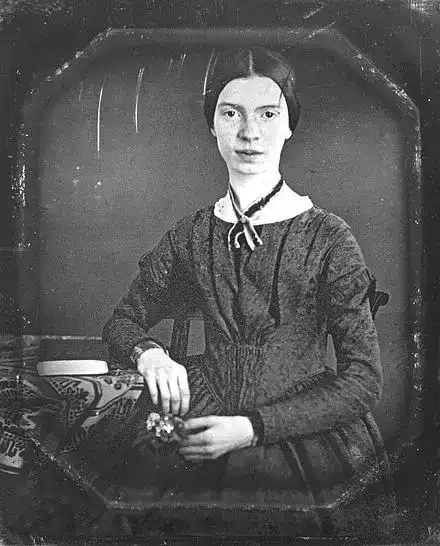
Emily Dickinson is one of America's most celebrated poets. She often wrote under her own name. She was born in Amherst, Massachusetts, and died there. Her family was prominent in Amherst society, and she came from a lineage of lawyers and politicians. She was an American national and wrote in English.

Childhood and education

Dickinson grew up in a devoutly religious household, which likely influenced her later theological explorations. She attended Amherst Academy and Mount Holyoke Female Seminary, receiving a rigorous education for the time. Her early readings included the Bible, works by Ralph Waldo Emerson, and classical literature, which undoubtedly shaped her intellectual and poetic development. Significant events in her youth included periods of intense religious engagement and growing introspection.

Literary trajectory

Dickinson began writing poetry at a young age, with her output increasing significantly in the 1860s. Her style evolved, becoming increasingly concise, introspective, and experimental. While she shared her poems with friends and family, she did not actively seek publication. A few poems were published anonymously during her lifetime, often altered by editors. She did not engage with literary magazines or anthologies in a conventional manner.

Works, style, and literary characteristics

Dickinson's major works are her nearly 1,800 poems, most of which were published posthumously. Dominant themes include nature, death, immortality, faith, doubt, love, and the self. Her poems are known for their radical compression, slant rhyme, unconventional capitalization, and use of dashes. Her poetic devices are striking, creating vivid imagery and a unique rhythm. The tone can range from ecstatic to despairing, often employing irony and a deeply personal voice that transcends to the universal. Her language is precise, often using domestic imagery to explore profound philosophical ideas. She is associated with no specific literary movement but is a precursor to modernism.

Cultural and historical context

Dickinson lived during a period of significant social and intellectual change in the United States, including the abolitionist movement and the Civil War, though these are not overt subjects in her poetry. She engaged intellectually with Transcendentalism, particularly through Emerson's writings, and her work reflects a broader cultural questioning of religious and social norms. Her isolation in Amherst created a unique space for her creative development, setting her apart from established literary circles.

Personal life

Dickinson's personal life was largely private and centered in Amherst. Her relationships with family, particularly her brother Austin and his wife Susan Gilbert, were complex and deeply influential. Friendships, such as with Thomas Wentworth Higginson, provided intellectual companionship and some encouragement. Her intense inner life, marked by periods of profound introspection and perhaps illness, is reflected in the depth and originality of her poetry. She did not pursue a parallel profession, dedicating herself to her inner world and writing.

Recognition and reception

During her lifetime, Dickinson received very little recognition, with only a handful of poems published in altered forms. Her major posthumous publication in 1890 by Mabel Loomis Todd and Thomas Wentworth Higginson marked the beginning of her rise to prominence. Over time, her work has achieved immense critical acclaim and immense academic recognition, establishing her as a central figure in American literature.

Influences and legacy

Dickinson was influenced by the Bible, hymnology, and writers like Ralph Waldo Emerson. Her legacy is immense; she profoundly influenced modern poetry with her innovative use of language, form, and thematic exploration. She is a cornerstone of the American literary canon, and her poems are widely translated, studied, and adapted into music and other art forms. Her work continues to inspire poets and readers worldwide.

Interpretation and critical analysis

Dickinson's poetry invites multiple interpretations, often focusing on her exploration of consciousness, spirituality, and the human condition. Critical analysis has delved into her complex relationship with faith and doubt, her unique perspective on death, and the psychological dimensions of her work. Debates often surround the dating and ordering of her poems and the extent of her engagement with social issues.

Curiosities and lesser-known aspects

Dickinson was known for her reclusive habits in her later years, often dressing in white. There is a fascinating tension between her seemingly quiet life and the radical, often explosive, nature of her poetry. Anecdotal evidence suggests her intense observational skills and a profound, sometimes unsettling, wit. She was known to bake and engage in household activities, which stood in contrast to her abstract poetic explorations.

Death and memory

Emily Dickinson died in Amherst, Massachusetts. Her memory is preserved through her extraordinary body of work, the preservation of her home as a museum, and ongoing critical and scholarly engagement with her life and poetry. Numerous posthumous collections and scholarly editions have ensured her enduring presence in literary history.