
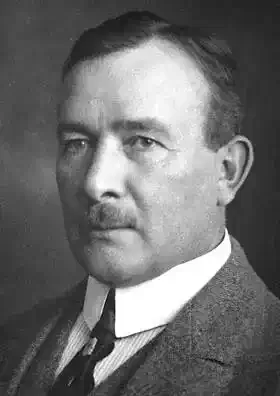
Erik Axel Karlfeldt
1864–1931
· lived 66 years
 SE
SE
SE
Erik Axel Karlfeldt was a Swedish poet, awarded the Nobel Prize in Literature. His work is deeply rooted in the landscape and rural life of Sweden, celebrating nature, work, and folk traditions with a rich and evocative language. His poems combine melancholic lyricism with subtle humor, exploring themes such as love, death, and the passage of time, always with a strong connection to Nordic culture and folklore.
n. 1864-07-20, Folkärna · m. 1931-04-08, Engelbrekt church parish
84
Views
Bio
Identification and Basic Context
Erik Axel Karlfeldt (1864-1931) was a Swedish poet, librarian, and member of the Swedish Academy, having received the Nobel Prize in Literature in 1931, posthumously. He was born in the province of Dalecarlia, a rural region of Sweden, which would become a central source of inspiration in his work.Childhood and Education
Karlfeldt grew up in a rural environment, which shaped his deep connection with nature, folk traditions, and Swedish folklore. He attended Uppsala University, where he studied literature and philology, laying the groundwork for his academic and literary career.Literary Career
His literary career began with the publication of "Vildmarks- och kärleksvisor" (Songs of the Wild and Love) in 1895. Throughout his career, he published several collections of poetry that consolidated his reputation as one of the most important Swedish poets of his time. He also worked as a librarian and served as secretary at the Swedish Academy.Work, Style, and Literary Characteristics
Karlfeldt's work is characterized by a lyricism that celebrates Swedish nature, agricultural work, folk traditions, and rural life. His poems are marked by a rich, musical, and imagistic language, with a vocabulary that evokes the natural world and folklore. He explores themes such as love, death, time, memory, and spirituality, often with a melancholic tone, but also with subtle humor and profound empathy for the human condition. Stylistically, he combined elements of folk tradition with formal innovations.Cultural and Historical Context
Karlfeldt lived during a period of great transformations in Sweden, including industrialization and urbanization, but his work remained faithful to the celebration of rural life and traditions, acting as a counterpoint to these changes. He belonged to the so-called "90s generation" of Swedish literature, which sought a more authentic and national expression.Personal Life
Karlfeldt married Gerda Holmberg and had five daughters. His life was marked by dedication to poetry and his work as a librarian and secretary of the Swedish Academy. His connection with the nature and rural culture of his childhood remained a constant throughout his life.Recognition and Reception
Erik Axel Karlfeldt was widely recognized in Sweden during his lifetime. His election to the Swedish Academy was a testament to his prestige. International recognition culminated with the award of the Nobel Prize in Literature in 1931, which was granted posthumously, honoring his work for its depth and beauty.Influences and Legacy
Karlfeldt was influenced by Swedish folk poetry, folklore, and the natural landscape. He influenced subsequent generations of Swedish poets with his linguistic mastery, his ability to evoke the national spirit, and his deep connection to the land. His work is considered a cornerstone of modern Swedish literature.Interpretation and Critical Analysis
Karlfeldt's work is often analyzed from the perspective of his profound connection with Swedish identity and nature. His poems can be interpreted as a meditation on life, death, and the ephemeral beauty of the natural world, expressed through lyrical and accessible language.Curiosities and Lesser-Known Aspects
Karlfeldt refused the Nobel Prize in Literature in 1916, which was offered to him by the Swedish Academy, stating that he was already a member of the institution and should not receive such an honor. His work, though focused on Sweden, possesses a universality that resonates with readers from diverse cultures.Death and Memory
Erik Axel Karlfeldt died in 1931, shortly before officially learning of the award of the Nobel Prize in Literature. His memory is perpetuated not only by his poetic work but also by his importance as a cultural and academic figure in Sweden.Poems
0No poems found
Comments (0)
Log in
to post a comment.
No comments yet. Be the first to comment.