
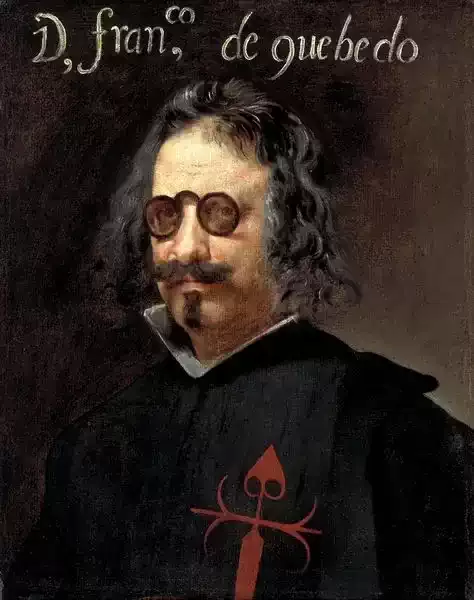
Francisco de Quevedo

Francisco de Quevedo

1584–1645 · lived 60 years ES ES

Francisco de Quevedo y Villegas (1580-1645) was one of the greatest poets and prose writers of Spanish literature during the Golden Age. Known for his satirical, witty, and often dark style, Quevedo mastered a wide range of literary genres, from lyrical and philosophical poetry to satirical and political prose. His work reflects a cynical and realistic view of the society of his time, marked by social criticism and the exploration of themes of death, time, and the human condition. Quevedo is celebrated for his mastery of the Spanish language, his use of neologisms, and his ability to create vivid and impactful imagery.

n. 1584-09-14, Madrid · m. 1645-09-08, Villanueva de los Infantes

74 Views
Bio
Francisco de Quevedo was born in Madrid, Spain, on September 14, 1580. Educated in theology and known for his intelligence and erudition, Quevedo had a turbulent life, marked by involvement in political intrigues and exiles. He was a fierce critic of the corruption and decadence of Spain in his time. His poetic production ranges from poems of love and disillusionment to metaphysical and religious reflections. In prose, "The Great Rogue" (El Gran Tacaño) and "The Dreams" (Los Sueños) stand out, where he uses satire and allegory to expose the vices and hypocrisies of society. Quevedo died in Villanueva de los Infantes on September 8, 1645, leaving an invaluable legacy to the Spanish-language literature.

Poems

0

No poems found

Comments (0)

Share
Log in to post a comment.

No comments yet. Be the first to comment.