
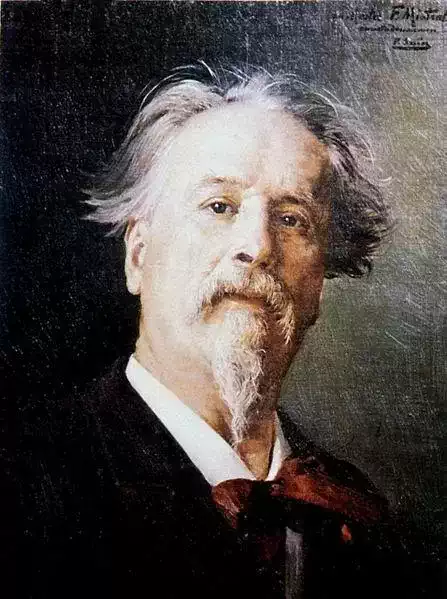
Frédéric Mistral
 FR
FR
Frédéric Mistral was a French poet and lexicographer, a central figure of the Félibrige movement, which aimed at the revitalization and promotion of the Provençal language and culture. His poetic work, written in Provençal, celebrated the land, traditions, and way of life of southern France, gaining international recognition, including the Nobel Prize in Literature. Mistral dedicated his life to the defense of Occitan, compiling a monumental vocabulary and encouraging the use of the language in various spheres. His poetry is marked by a strong sense of regional identity, bucolic landscapes, and a deep love for his homeland, establishing him as one of the most important defenders of minority cultures and linguistic diversity.
n. 1830-09-08, Maillane · m. 1914-03-25, Maillane
Bio
Identification and basic context
Frédéric Mistral was a French poet, lexicographer, and cultural activist, born in Maillane, Provence. He is widely recognized as a prominent figure of the Félibrige movement, dedicated to the promotion and revitalization of the Provençal language and culture (Occitan).Childhood and education
Born into a family of wealthy farmers, Mistral had a childhood immersed in the Provençal culture and language. His academic education included studies in Arles and Aix-en-Provence, where he earned a law degree. It was during this period that he delved deeper into the study of the Occitan language, under the influence of professors like Joseph Roumanille.Literary career
Mistral's literary career began with the publication of his first poems in Provençal. His masterpiece, "Mirèio" (1859), was a landmark that propelled the Félibrige movement. Throughout his life, he published several other poetic works and began compiling "Lou Tresor dóu Felibrige," a monumental dictionary of the Occitan language. His activity as a language defender extended to the translation and promotion of Provençal literature.Work, style, and literary characteristics
Mistral's work is deeply linked to Provence, celebrating its landscapes, traditions, history, and the way of life of its people. His style is epic and lyrical, with a strong adherence to traditional poetic form and a vocabulary rich in regional terms. Themes such as love for the land, rural life, memory, and Provençal identity are central to his poetry. "Mirèio" narrates a love story amidst the natural beauty of Provence, while other works explore legends and the region's history. Mistral sought to restore the dignity and beauty of the Occitan language, using it in poems of great aesthetic and cultural value.Cultural and historical context
Mistral lived in a period when French was consolidating as the hegemonic language in France, leading to the decline of regional languages like Occitan. The Félibrige movement, of which he was a founder, emerged as a reaction to this process, seeking to preserve and exalt Provençal identity. His work engages with the literary currents of the time but is distinguished by its strong regionalism and cultural defense.Personal life
Mistral married Marie-Reine Vialla. His life was largely dedicated to defending Provençal culture, which led him to travel and correspond with intellectuals from various parts of the world. His dedication to the Occitan language was a passion that permeated all aspects of his existence.Recognition and reception
Mistral's recognition was immense, culminating in the awarding of the Nobel Prize in Literature in 1904, "in recognition of the creative spirit and the extraordinary application of his poetic genius," and also "in honor of the artist who portrayed the life of his people with remarkable beauty and as the faithful representative of his Provençal soul." He received several other honors, and his work was fundamental to the preservation of the Occitan language.Influences and legacy
Mistral was influenced by classical poetry and by medieval Occitan troubadours. In turn, his work influenced generations of Provençal writers and defenders of regional languages worldwide. His most enduring legacy is the consolidation of Félibrige and the preservation of Occitan memory and language, in addition to his vast poetic work.Interpretation and critical analysis
Mistral's work is often analyzed from the perspective of cultural preservation and regional identity. His poetry is seen as an act of linguistic and cultural resistance, celebrating the beauty and vitality of a people and their language.Curiosities and lesser-known aspects
A curious aspect is that Mistral, despite his fervent defense of the Occitan language, also spoke and wrote in French. He also refused to accept the Chair of French Poetry at the Sorbonne University, preferring to dedicate himself entirely to Provence.Death and memory
Frédéric Mistral died in his hometown, Maillane, in 1914. He was buried in a mausoleum he designed himself. His memory is kept alive through the Félibrige movement, cultural institutions, and the continued appreciation of his poetic and lexicographical work.Poems
0No poems found
Comments (0)
No comments yet. Be the first to comment.