
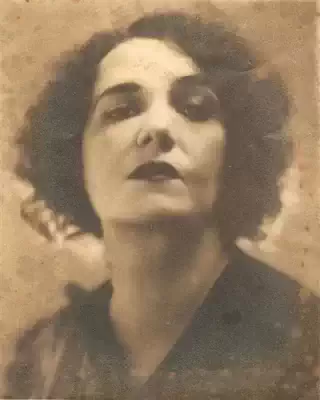
Gilka Machado
 BR
BR
Gilka Machado was a Brazilian poet, recognized for her lyrical and sensual work, which explored themes such as love, passion, the female body, and spirituality with a rich and imagistic language. Her poetry, often considered transgressive for the time, addressed sensuality explicitly and innovatively, breaking with literary and social conventions. She was the first woman to join the Brazilian Academy of Letters, a milestone for Brazilian female writers. Her work continues to be valued for its expressive power and its contribution to female poetry in Brazil.
n. 1893-01-01, Rio de Janeiro · m. 1980-01-01, Rio de Janeiro
Bio
Identification and basic context
Gilka Machado was a notable Brazilian poet, whose full name was Gilka de Mello Machado. Born in Rio de Janeiro, she dedicated her life to writing, exploring in her verses the complexity of love, passion, eroticism, and spirituality, often from the perspective of female experience. Her work is written in Portuguese and is part of a historical context of social and literary transformations in Brazil, especially in the early 20th century.Childhood and education
Gilka Machado had a childhood and youth in a family environment that provided her with access to culture and education. Although the details of her formal education are less known, a deep literary knowledge and keen sensitivity are evident in her work. Readings of classical and contemporary poets, as well as influences from the Rio de Janeiro cultural scene, certainly shaped her trajectory.Literary career
Gilka Machado's literary career began to stand out with the publication of her first poetry books. Her work evolved towards greater thematic and stylistic daring, exploring sensuality and the body in an increasingly explicit and poetic way. She collaborated with various literary publications of the time, gaining recognition for her unique lyrical voice. Gilka Machado was the first woman elected to the Brazilian Academy of Letters, in 1924, a feat of great historical importance for female representation in Brazilian literature.Work, style, and literary characteristics
Gilka Machado's main works include "O Inútil" (1911), "Servidões" (1914), "Coração em Dois Tempos" (1922), "Estados de Alma" (1928), and "Poemas Escolhidos" (1945). Her central themes revolve around love, ardent passion, eroticism, the pain of separation, the search for transcendence, and the strength of women. Her poetic form often aligns with Parnassianism and Symbolism, but with a thematic freedom that distinguished her. She uses resources such as metaphor, rich adjectivation, and accentuated musicality in her verses. The poetic voice is predominantly lyrical and confessional, expressing the depths of her emotions and desires. The language is elaborate, with an expressive vocabulary and an imagistic density that evokes strong sensations. Gilka Machado introduced thematic daring by addressing female sensuality directly, which represented an innovation for the time, dialoguing with the literary tradition while also proposing new approaches to the expression of the female lyrical self.Work, style, and literary characteristics
Cultural and historical context Gilka Machado produced her work in a period of great transformations in Brazil, with the Rio de Janeiro Belle Époque, the rise of Modernism, and intense debates about women's social roles. Her poetry, by frankly addressing sensuality, often shocked and generated controversy, but also paved the way for a freer expression of femininity in art. Her election to the Brazilian Academy of Letters was a historic milestone, challenging the patriarchal structures of the time and opening doors for other female writers.Work, style, and literary characteristics
Personal life The details of Gilka Machado's personal life are less documented, but it is known that her work intensely reflects her emotional experiences and her views on love and relationships. Her dedication to poetry and her position as a prominent female figure in the Brazilian literary scene indicate a strong and independent personality.Work, style, and literary characteristics
Recognition and reception Gilka Machado received recognition during her lifetime, especially with her election to the Brazilian Academy of Letters, one of the highest literary honors in the country. Her work, although it faced some resistance due to its daring themes, was gradually valued by critics and the public, consolidating her place as one of the important female poetic voices in Brazil.Work, style, and literary characteristics
Influences and legacy Gilka Machado's work was influenced by authors who knew how to explore the depth of feelings and the beauty of language. Her legacy lies in her courage to express the female voice and body poetically and powerfully, paving the way for future generations of female writers seeking greater expressive freedom. Her poetry continues to be studied and appreciated for its aesthetic quality and thematic relevance.Work, style, and literary characteristics
Interpretation and critical analysis Gilka Machado's poetry is often analyzed from the perspective of erotic lyricism and the representation of women in literature. Her explorations of desire and passion offer rich possibilities for interpretation regarding female subjectivity and the social taboos of the time.Work, style, and literary characteristics
Curiosities and lesser-known aspects One of the most notable aspects of Gilka Machado's work is how she managed, in a period when female expression was restricted, to give voice to sensuality and bodily desires in such a poetic and captivating way.Work, style, and literary characteristics
Death and memory Gilka Machado passed away in Rio de Janeiro. Her memory endures through her work, which continues to be revisited and celebrated as a landmark of Brazilian poetry and the struggle for female expression in literature.Poems
0No poems found
Comments (0)
No comments yet. Be the first to comment.