
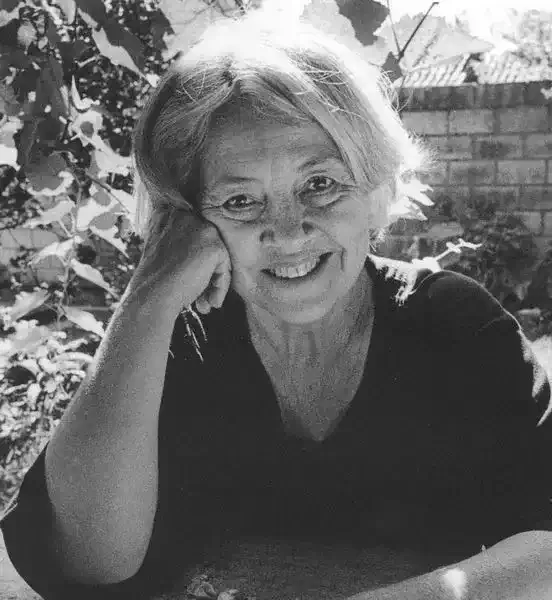
Adélia Prado
 BR
BR
Adélia Prado is a contemporary Brazilian poet, known for her poetry that intertwines the everyday with the sacred, the profane with the spiritual, and the trivial with the transcendent. Her work, marked by direct, colloquial, and sometimes unexpectedly lyrical language, reflects a profound contemplation of the female condition, faith, the body, death, and the search for meaning in a reality often devoid of transcendence. Prado offers a unique vision of urban life and human relationships, where poetry emerges from the simplest gestures and most common moments, revealing the beauty and mystery hidden in everyday experience.
n. 1935-12-13, Divinópolis
Bio
Identification and basic context
Adélia Prado is a prominent Brazilian poet, short story writer, and essayist, born in Divinópolis, Minas Gerais. She is one of the most unique and influential voices in contemporary Brazilian literature. Her work is marked by a deep connection with everyday life, the body, religious faith, and the search for a transcendental meaning amidst common life. She writes in Portuguese, and her poetry is recognized for its originality and its ability to combine the prosaic with the sacred.Childhood and education
Adélia Prado grew up in Divinópolis, a town in the interior of Minas Gerais, where her childhood and youth experiences, marked by strong Catholic religiosity and family life, would profoundly influence her work. She received a basic education, and despite not pursuing a traditional academic path in literature, she was always a voracious reader and a keen observer of the world around her.Literary career
Her literary career began with the publication of her first poetry book, "Bagagem" (Baggage), in 1976, which achieved immediate and surprising success. Since then, Adélia Prado has consolidated her position as one of Brazil's most important poetic voices, alternating the publication of poetry with short stories and essays. Her work has evolved towards a deepening of her central themes, exploring with increasing mastery the relationship between body and spirit, the earthly and the celestial.Work, style, and literary characteristics
Her most known works include "Bagagem" (1976), "O Coração Desanuviado" (The Unclouded Heart) (1978), "Terra de Santa Cruz" (Land of the Holy Cross) (1981), "Mulheres" (Women) (1985), "A Faca no Peito" (The Knife in the Chest) (1988), and "Oráculos de Primavera" (Oracles of Spring) (2013). The central themes in her poetry are religious faith, the body, sexuality, everyday life, the female condition, death, and the search for the sacred in everything. Her style is characterized by accessible, colloquial language close to popular speech, but which, with impressive subtlety, is capable of reaching moments of great lyricism and metaphysical depth. She uses metaphor in an original way, and her poetic voice is simultaneously intimate, confessional, and universal. Adélia Prado is in continuity with the Brazilian literary tradition but introduces a unique perspective on the female experience and religiosity in the contemporary world.Work, style, and literary characteristics
Cultural and historical context Adélia Prado emerged during a period of cultural and political effervescence in Brazil, with the end of the military dictatorship and the redemocratization. Her work, however, does not fit into specific literary movements but dialogues with the tradition of Brazilian poetry, especially that which explores identity and faith. Her popularity and critical recognition demonstrate the relevance of her voice in a context of seeking new forms of expression and spirituality.Work, style, and literary characteristics
Personal life Adélia Prado is married and has children. Her personal life, with its challenges and joys, is intensely and honestly reflected in her work. Her Catholic religiosity is a fundamental pillar in her life and her poetic creation. Her experience as a woman, mother, and citizen shapes her worldview and her approach to the themes she explores.Work, style, and literary characteristics
Recognition and reception Adélia Prado is one of the most widely read and admired Brazilian poets, both in Portugal and in other Portuguese-speaking countries. She has received several important literary awards, and her work has been the subject of in-depth academic studies. Her ability to touch readers with her authenticity and depth has secured her a prominent place in contemporary literature.Work, style, and literary characteristics
Influences and legacy While it is difficult to pinpoint direct influences, her work dialogues with the tradition of mystical and religious poetry, as well as poetry that explores everyday life. Her legacy lies in how she has given voice to the experiences and longings of many women and men, finding the sublime in the ordinary and the sacred in the earthly. She has influenced a generation of poets through her originality and her unique approach to faith and the body.Work, style, and literary characteristics
Interpretation and critical analysis Adélia Prado's work is often analyzed from the perspective of her religious faith, her relationship with the body, and her feminist viewpoint. Her poems challenge the dichotomy between the sacred and the profane, showing how both coexist and interconnect in the human experience. Critics have highlighted her skill in transforming the trivial into poetry and in expressing the complexity of existence with clear and powerful language.Work, style, and literary characteristics
Curiosities and lesser-known aspects Adélia Prado is also known for being a keen observer of human behavior and for finding poetry in the simplest everyday gestures. Her home and family life are often mentioned as sources of inspiration for her writing.Work, style, and literary characteristics
Death and memory Adélia Prado continues to be fully active literarily, being a living and active figure on the Brazilian cultural scene. Her memory is that of a poet who knew how to reclaim the spiritual dimension of life and the body, offering the reader a profoundly human and comforting perspective on existence.Poems
0No poems found
Videos
50
Comments (0)
No comments yet. Be the first to comment.