
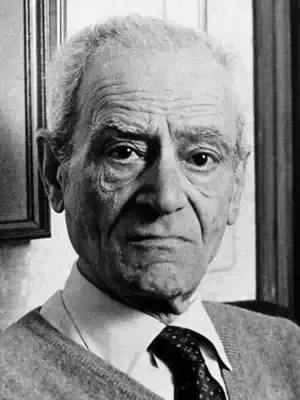
Giorgio Caproni
 IT
IT
Giorgio Caproni was an Italian poet whose work is characterized by a profound melancholy, a constant questioning of existence, memory, and the search for meaning in a world marked by loss and transience. His poetry, of great formal and expressive rigor, often explores themes such as childhood, the maternal figure, the city of Livorno, and the human condition in the face of the mystery of being. Considered one of the great names in 20th-century Italian poetry, Caproni built a unique poetic universe, where existential reflection unites with a lyrical and musical language, sometimes ironic and bitter, but always imbued with rare authenticity.
n. 1912-01-07, Livorno · m. 1990-01-22, Roma
Bio
Identification and Basic Context
Giorgio Caproni was an Italian poet. He was born in Livorno, Tuscany, and spent much of his life in Genoa and Rome. His work is deeply connected to his homeland and his personal history. He wrote in Italian.Childhood and Education
Born in 1912, Caproni had a childhood marked by the figure of his mother, to whom he dedicated some of his most emblematic poems, and by the city of Livorno, which became a recurring setting in his work. His education was largely self-taught, complemented by classical studies. From an early age, he showed an interest in literature and poetry.Literary Career
Caproni began publishing poetry in the 1930s, but his work gained greater prominence after World War II. His literary career was marked by gradual evolution, while maintaining thematic and stylistic coherence. He published several books of poetry and collaborated with important Italian literary magazines. He was also a literary critic and translator of authors such as Baudelaire and Rilke.Work, Style, and Literary Characteristics
His most important works include 'Canti di Livorno' (1933), 'Finzioni' (1941), 'Il passaggio d'Enea' (1956), 'Il seme dell'altre stelle' (1959), 'Congregazione in un giorno di pioggia' (1961), 'Poesie (1938-1961)' (1962), 'Il muro della terra' (1970), and 'Residenze invernali' (1985). The central themes of his poetry are memory, childhood, the maternal figure (especially his mother, Anna), the city of Livorno, the sea, the human condition, death, and the search for a transcendent meaning. His style is marked by formal rigor, intrinsic musicality, and precise language use. He often resorted to traditional poetic forms, but also explored free verse. The poetic tone oscillates between melancholy, elegy, existential reflection, and a certain bitter irony. His poetry is dense, evocative, and imbued with deep spirituality.Work, Style, and Literary Characteristics
Cultural and Historical Context Giorgio Caproni lived through the rise of fascism, World War II, and the subsequent reconstruction of Italy. His poetry, although often introspective, subtly reflects the anxieties and transformations of his time. He was close to other important Italian writers and intellectuals, fitting into the literary panorama of Neorealism and, later, poetic trends that sought greater depth and reflection.Work, Style, and Literary Characteristics
Personal Life Caproni dedicated much of his life to teaching and literature. His personal relationships, particularly his love for his mother and his experiences in Livorno and Genoa, profoundly shaped his worldview and his writing. He was known for his discretion and dedication to the poetic art.Work, Style, and Literary Characteristics
Recognition and Reception Giorgio Caproni is widely considered one of the most important poets of 20th-century Italian poetry. He received several literary awards throughout his career, consolidating his position in the Italian literary canon. His work is the subject of academic study and is appreciated for its originality and depth.Work, Style, and Literary Characteristics
Influences and Legacy Caproni was influenced by poets such as Dante Alighieri, Petrarch, Leopardi, Ungaretti, and Montale. His legacy lies in his ability to merge Italian lyrical tradition with modern and existential sensibility, influencing subsequent generations of poets with his formal mastery and reflective depth.Work, Style, and Literary Characteristics
Interpretation and Critical Analysis Caproni's work is often analyzed for its thematic and stylistic complexity, exploring philosophical and existential aspects of the human condition. His poetry is seen as a relentless search for truth and meaning, confronting the fragility of existence with beauty and transcendence.Work, Style, and Literary Characteristics
Curiosities and Lesser-Known Aspects A curious aspect of his life is his strong connection to the city of Livorno, which became almost a character in his poems, serving as a symbol of identity and memory. Caproni was also passionate about art and music, elements reflected in his poetic sensibility.Work, Style, and Literary Characteristics
Death and Memory Giorgio Caproni passed away in 1990. His death left a void in Italian poetry, but his work continues to be read, studied, and revered. His poems are still published and continue to inspire readers and writers.Poems
0No poems found
Videos
50
Comments (0)
No comments yet. Be the first to comment.