
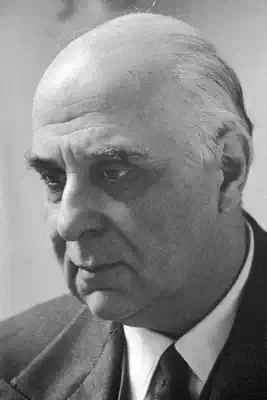
Giorgos Seferis
 GR
GR
Giorgos Seferis was a prominent Greek poet and essayist, considered one of the central figures of 20th-century Greek literature and one of the greatest Greek-language poets. His work is marked by a deep reflection on Greek identity, history, memory, and the human condition, often set in the landscapes and myths of the Aegean. His poetry, though rooted in classical and Byzantine tradition, innovated by incorporating colloquial language and a modern existential approach, earning international recognition and a Nobel Prize in Literature.
n. 1900-03-13, Urla · m. 1971-09-20, Atenas
Bio
Identification and Basic Context
Giorgos Seferis, pseudonym of Giorgos Stylianou Seferiadis, was born in Vourla, Asia Minor (present-day Turkey), and died in Athens, Greece. He was a Greek citizen and wrote in Modern Greek. His life and work were intrinsically linked to the turbulent Greek history of the 20th century, including the Balkan Wars, World War I, the Greek Civil War, and the military dictatorship.Childhood and Education
Born into a middle-class family with ties to commercial and cultural activities, Seferis moved with his family to Athens at a young age, fleeing the upheaval in Asia Minor. He completed his secondary education in Athens and later studied Law at the University of Paris. During his time in Paris, he absorbed literary, artistic, and philosophical influences from Europe, which would shape his worldview and his writing.Literary Career
The beginning of his poetic career was marked by the publication of "Strofi" (The Turn) in 1931, a work that already announced his unique voice. Over the following decades, Seferis published several poetry collections that solidified his reputation, such as "Mythistorema" (1935) and "Kichli" (The Hare, 1947). Alongside his literary career, Seferis had a long and distinguished diplomatic career in the service of Greece, which allowed him to live in various countries and gain broad exposure to other cultures.Work, Style, and Literary Characteristics
Seferis's main works include "Strofi" (1931), "Mythistorema" (1935), "Kichli" (1947), "Logbook I-III" (1940-1955), and "The King of Asine" (1958). The dominant themes in his poetry are Greek identity, the search for a sense of belonging, collective and individual memory, the Aegean Sea as a mythical and geographical space, solitude, mortality, and the relationship between past and present. Formally, Seferis combined Modern Greek language with tradition, often using free verse, but with remarkable musicality and structural rigor. His style is characterized by apparent clarity, but with symbolic depth and ambiguity, evoking strong images and a melancholic and contemplative tone.Cultural and Historical Context
Seferis lived and wrote during periods of intense historical and political transformation in Greece and Europe. World War II, the occupation of Greece, the Civil War, and the Cold War left deep marks on his consciousness and work, reflecting the fragility of existence and the need to find permanence amidst change. He was a contemporary of other great Greek poets such as Konstantinos Kavafis and Odysseas Elytis, with whom he established a literary and generational dialogue.Personal Life
Giorgos Seferis married Maria Zannou. His diplomatic career led him to reside in London, Ankara, and other capitals, experiences that enriched his cosmopolitan perspective. He was known for his discretion and his deep dedication to poetry and Greek culture.Recognition and Reception
Seferis achieved significant international recognition, culminating in the award of the Nobel Prize in Literature in 1963 "for his lyrical writing, inspired by a very strong feeling for what is important in the Greek cultural tradition, and for his tendency to express it with clarity and a keen ear for the rhythm of the English language." He received numerous other awards and distinctions throughout his life, consolidating his place as one of the most important Greek poets of the 20th century.Influences and Legacy
Seferis was influenced by ancient and Byzantine Greek poetry, by French Symbolist poets, and by existential thinkers. His legacy is immense, having influenced generations of Greek and non-Greek poets who found in his work a deep meditation on identity, history, and the human condition. His work continues to be studied and admired internationally.Interpretation and Critical Analysis
Seferis's work has been the subject of extensive critical analysis, exploring his complex relationship with Greek history, classical mythology, and the search for identity in a constantly changing world. His reflections on exile, memory, and language are central to critical interpretations.Curiosities and Lesser-Known Aspects
Seferis was known for his passion for classical music and art. His extensive correspondence reveals a deeply reflective man and an attentive observer of the world around him. His notebooks and manuscripts offer a fascinating glimpse into his creative process.Death and Memory
Giorgos Seferis passed away in Athens, and his funeral was an event of great national mourning. His memory is celebrated through buildings and institutions that bear his name, and his work continues to be published and studied worldwide, keeping alive his profound influence on literature and culture.Poems
0No poems found
Quotes
1No poems found
Comments (0)
No comments yet. Be the first to comment.