
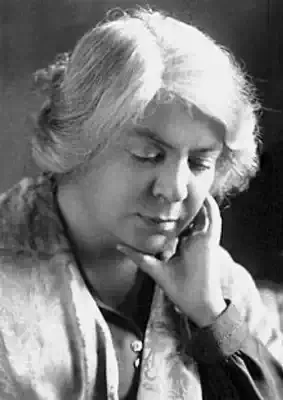
Grazia Deledda
 IT
IT
Grazia Deledda was an Italian writer, awarded the Nobel Prize in Literature in 1926. Her work, deeply rooted in Sardinia, explores the human condition, moral conflicts, and the power of fate. Deledda masterfully portrayed her homeland, its customs, and the psychology of its inhabitants, often through characters marked by intense passions and ethical dilemmas. Through rich and evocative language, the author gave voice to the landscapes and soul of Sardinia, addressing universal themes such as love, sin, redemption, and fatality. Her style, realistic yet charged with symbolism, earned her international recognition and established her as one of the most important voices in 20th-century Italian literature.
n. 1871-09-27, Nùoro · m. 1936-08-15, Roma
Bio
Identification and basic context
Grazia Deledda was a prominent Italian writer, born in Sardinia. She is widely recognized for her profound exploration of Sardinian culture and landscape, as well as her skill in portraying the complexity of the human condition and moral conflicts. Her work is marked by a strong sense of place and psychological analysis of her characters. Nationality: Italian. Language of writing: Italian.Childhood and education
Grazia Deledda was born into a wealthy Sardinian family. Her childhood and adolescence took place on the island, immersed in local culture and traditions, which would become the source of inspiration for much of her work. She received a formal education but was largely self-taught in her literary studies. The readings of the time, Sardinian popular culture, and orally transmitted stories shaped her worldview and her future literary path.Literary career
Grazia Deledda's literary career began early, with the publication of her first works in her youth. Her writing evolved over time, deepening psychological analysis and the representation of the Sardinian environment. She collaborated with various publications, gaining visibility and recognition. Her dedication to literary writing became her main professional activity, culminating in her international acclaim.Work, style, and literary characteristics
Grazia Deledda's works, such as "Elias Portolu" (1900), "Cenere" (1904), "L'edera" (1906), and "Canne al vento" (1913), explore themes such as love, sin, guilt, redemption, fate, and the force of traditions. Her style is characterized by vivid realism in the description of Sardinia's landscape and customs, combined with a deep psychological analysis of characters, often tormented by inner conflicts and fatality. Deledda uses rich and evocative language, with a strong sense of musicality and rhythm. Her poetic tone and her ability to convey the island's atmosphere lend her works a remarkable uniqueness. She was associated with Italian verismo, but her work transcends the movement, with elements of symbolism and a unique approach to the human condition.Cultural and historical context
Grazia Deledda lived in a period of significant transformations in Italy, including unification and social and cultural tensions. Sardinia, in particular, was a region with strong traditions and a distinct cultural identity. Deledda engaged with the European literature of her time but always maintained a strong connection to her roots. Her work reflects the complexities of Sardinian society and its relationship with the broader Italian national context.Personal life
Grazia Deledda's personal life, although less publicly documented in detail, was marked by her deep connection to Sardinia. Her family relationships and the island's social environment were fundamental to her inspiration. She dedicated her life to writing, living a relatively private life but deeply immersed in her creative world.Recognition and reception
Grazia Deledda's recognition reached its peak with the award of the Nobel Prize in Literature in 1926, a remarkable achievement for an Italian woman writer and for Sardinian literature. Her work was widely translated and appreciated internationally, consolidating her place as one of the great voices of 20th-century literature. Contemporary critical reception highlighted the originality and expressive power of her writing.Influences and legacy
Influences on Deledda's work include European realist literature, Sardinian folk traditions, and her own keen sensibility. Her legacy lies in the way she portrayed Sardinia and the human condition, inspiring future generations of writers to explore their cultural roots and the depths of the human psyche. Her work continues to be studied and appreciated for its literary quality and thematic relevance.Interpretation and critical analysis
Grazia Deledda's work has been interpreted from various perspectives, notably the analysis of her existential themes, such as the struggle between good and evil, expiation, and the search for redemption. Her characters are often seen as archetypes of the human condition, confronted with internal and external forces that shape their destiny. Critics have praised her ability to create engaging narratives and explore the depths of the human soul.Curiosities and lesser-known aspects
Although known for her literary work, Grazia Deledda maintained a relatively discreet life. The intensity of her narratives, at times dark and laden with fatalism, contrasts with the public image of a dedicated and sensitive writer. Her deep connection to Sardinia, which she never completely abandoned, even after international recognition, is a striking aspect of her personality and her journey.Death and memory
Grazia Deledda passed away in Rome. Her death marked the end of a prolific literary career. Her memory endures through her immortalized work, which continues to be a testament to Sardinia's cultural richness and the universality of her themes.Poems
0No poems found
Comments (0)
No comments yet. Be the first to comment.