
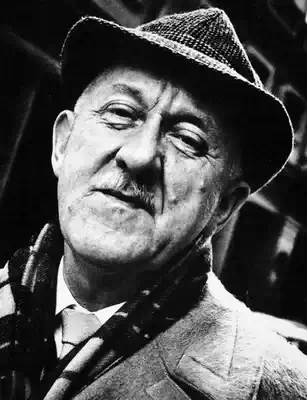
Halldór Laxness
 IS
IS
Halldór Laxness was one of the most prominent Icelandic writers, awarded the Nobel Prize in Literature in 1955. His vast and diverse work encompasses novels, short stories, plays, poems, and essays, exploring Icelandic identity, the struggle for survival in a hostile environment, and social criticism with a rich and innovative language. He is recognized for his ability to blend realism with elements of Icelandic folklore and sagas. With a unique literary style, Laxness addressed themes such as poverty, social injustice, religion, and the search for existential meaning, leaving a literary legacy that continues to influence world literature and represent the soul and history of Iceland.
n. 1902-04-23, Reykjavík · m. 1998-02-08, Mosfellsbær
Bio
Identification and basic context
Halldór Kiljan Laxness (born Halldór Guðjónsson) was a world-renowned Icelandic writer, honored with the Nobel Prize in Literature in 1955. Born in Reykjavik, Iceland, he showed an early deep connection with his homeland and its culture. His work reflects the historical context of Iceland in the 20th century, marked by the struggle for independence, the preservation of national identity, and social and economic transformations.Childhood and education
Halldór Laxness had a childhood marked by rural life in Iceland. From an early age, he showed an interest in reading and writing, being influenced by medieval Icelandic sagas, the Bible, and European authors. His education, although not rigidly academic in the traditional sense, was profoundly shaped by his readings and life experiences, absorbing elements of literary and philosophical movements that led him to question social and artistic conventions.Literary career
Laxness's literary career began with works that already foreshadowed his unique style. His evolution over time was remarkable, going through different stylistic and thematic phases, from his early novels to his more mature and acclaimed works. He actively collaborated in literary and cultural publications, and his activity as a critic and, in a way, as a disseminator of Icelandic culture, was fundamental to the projection of his work.Work, style, and literary characteristics
Halldór Laxness's work is vast and includes novels such as "Salka Valka" (1931-1932), "The Bell of Iceland" (1943), and "Independent People" (1934-1935), among many others. The dominant themes in his writing include the individual's struggle against the forces of society and nature, criticism of social exploitation, spirituality, the search for Icelandic identity, and the relationship between man and the land. His style is characterized by narrative mastery, the ability to blend realism with the fantastic and the folkloric, and an expressive and innovative use of the Icelandic language. Laxness's poetic and narrative voice is often ironic, critical, and profoundly human, with a rich vocabulary and vivid imagery. He introduced formal and thematic innovations, engaging with the saga tradition while embracing literary modernity.Cultural and historical context
Laxness lived and produced his work during a crucial period in Iceland's history, including its struggle for independence from Denmark and its subsequent integration into the international context after World War II. His work reflects the social and political tensions of the time, the lives of fishermen and peasants, and the search for a strong national identity. He is considered a leading figure of Icelandic Modernism, although his style transcends rigid classifications. His political and philosophical positions, often critical of capitalism and imperialism, were made explicit in his work and activism.Personal life
Halldór Laxness's personal life was rich in experiences. His family and romantic relationships, his travels, and his social and political involvements, including his initial sympathy for communism, shaped his worldview and, consequently, his writing. His literary friendships and rivalries, as well as the personal crises and conflicts he faced, contributed to the depth and complexity of his work.Recognition and reception
The recognition of Halldór Laxness's work reached its peak with the Nobel Prize in Literature in 1955, consolidating his position as one of the greatest writers of the 20th century. His work was widely translated and internationally acclaimed, and is considered fundamental to Icelandic and world literature. Critical reception during his lifetime was, for the most part, very positive, with particular emphasis on the originality of his style and the depth of his themes.Influences and legacy
Halldór Laxness was influenced by Icelandic sagas, European literature, and the philosophical and social currents of his time. His legacy is immense, having influenced generations of Icelandic writers and significantly contributed to the projection of Iceland's literature on the world stage. His work is a subject of academic study and continues to inspire readers and writers through its universality and its ability to portray the human condition.Interpretation and critical analysis
Laxness's work is rich in interpretations, from the analysis of his social and political criticisms to the exploration of existential themes and Norse mythology present in his writings. Controversies surrounding some of his political and literary positions enrich the critical debate about his figure and his work.Curiosities and lesser-known aspects
Some curiosities about Halldór Laxness include his life at Gljúfrasteinn, his house in Mosfellsdalur, which has become a museum, and his writing habits. His complex and sometimes controversial personality, as well as striking episodes in his life, such as his period of creative seclusion, contribute to the richness of his biographical profile.Death and memory
Halldór Laxness passed away in 1998, leaving a vast literary legacy. Posthumous publications and studies of his work continue to be released, keeping alive his memory and the importance of his contribution to world literature.Poems
0No poems found
Videos
50
Comments (0)
No comments yet. Be the first to comment.