
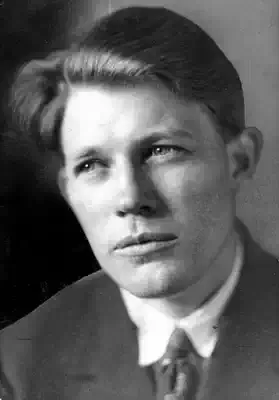
Harry Martinson
1904–1978
· lived 73 years
 SE
SE
SE
Harry Martinson was a Swedish poet, writer, and essayist, awarded the Nobel Prize in Literature in 1974. His work, deeply marked by nature and reflection on the human destiny and the cosmos, is characterized by a language rich in imagery and a profound ecological and existential sensibility. He explored themes such as man's relationship with the environment, the search for meaning in a constantly changing universe, and criticism of industrial and warfare society.
n. 1904-05-06, Blekinge · m. 1978-02-11, Estocolmo
101
Views
Bio
Identification and Basic Context
Full name: Harry Edmund Martinson Date and place of birth: May 6, 1904, in Jämshög, Blekinge, Sweden. Date and place of death: June 11, 1978, in Stockholm, Sweden. Family background, social class, and cultural origin: Born into a family of poor peasants. His father passed away when Harry was very young, and his mother emigrated to the United States, leaving the children in the care of guardians. This humble origin and parental absence profoundly marked his worldview and his work. Nationality and writing language(s): Swedish. Historical context in which he lived: Lived through a large part of the 20th century, a period marked by profound social, technological, and political transformations, including two World Wars, the advance of industrialization, the development of nuclear energy, and the Cold War. These events and trends are often reflected in his work, with a growing concern for the future of humanity and the planet.Childhood and Education
Family background and social environment: His childhood was marked by poverty and the absence of parents, having grown up in a rural society. He was housed by foster families and lived in sometimes unstable homes. Formal education and self-teaching: He attended primary school, but his education was largely self-taught. He worked early in various occupations, including as a sailor, which gave him vast contact with the world and its realities. Initial influences (readings, culture, religion, politics): His readings were vast and eclectic, including poetry, philosophy, and science. Life experiences as a worker and traveler shaped his perspective. Nature was always a primary source of inspiration and knowledge. There is no record of a strong formal religious influence, but his work shows a deep spirituality and a search for meaning. Literary, philosophical, or artistic movements absorbed: Although not strictly affiliated with a specific movement, his work dialogues with the Swedish lyrical tradition and, at the same time, anticipates ecological and cosmic concerns that would become more prominent in the 20th century. His exploration of existential themes and his concern for the human condition resonate with philosophical currents of the time. Moments of significance in youth: Leaving home at a very young age, experiences as a sailor on long voyages, and the precocity of his awareness of life's fragility and nature's beauty were crucial events in his formation.Literary Career
Beginning of writing (when and how he started): Began writing poetry in his youth as a way to express his experiences and his deep connection with nature. He published his first poems in literary magazines. Evolution over time (phases, style changes): His work evolved from poetry more connected to nature and the landscapes of southern Sweden to a more abstract and cosmic reflection. His phases can be characterized by a growing concern with the themes of technology, war, and the destiny of civilization, culminating in ambitious works like "Aniara." Chronological evolution of work: Started with collections of lyrical and landscape poems, evolved to epic and philosophical poems that address universal and existential questions. Contributions to magazines, newspapers, and anthologies: Actively collaborated with various Swedish literary publications throughout his career. Activity as a critic, translator, or editor: He was also an essayist and literary critic, contributing to the cultural debate of his time. There is no significant record of activity as a translator or editor.Work, Style, and Literary Characteristics
Main works with dates and production context: - *Spökstaderna* (The Ghost Cities, 1929): Poetry, one of his earliest works. - *Landstorm* (The Land Storm, 1930): Poetry. - *Världsliga skälvningar* (Worldly Tremors, 1931): Poetry. - *Se xefar sig* (Blindness, 1934): Poetry. - *Han som fick leva om sitt liv* (He Who Got to Live His Life Again, 1934): Poetry. - *Nätterna* (The Nights, 1938): Poetry. - *Passad tuil* (Trade Winds, 1941): Poetry. - *Den blomstertid nu kommer* (Now Comes the Time of Flowers, 1941): Poetry. - *Kärlek i vindens land* (Love in the Land of the Wind, 1942): Poetry. - *Dikt om liv* (Poem about Life, 1945): Poetry. - *Tjuvarnas land* (The Land of Thieves, 1948): Poetry. - *Aniara: En revy om människan i tiden* (Aniara: A Review about Man in Time, 1956): Epic poem, his most famous work, a space epic narrating the journey of an exile ship from a devastated Earth, exploring despair, the search for meaning, and human loneliness. - *Vägen till Köknes* (The Road to Köknes, 1957): Poetry. - *Dikter om kärlek och död* (Poems about Love and Death, 1960): Poetry. - *Kärl till en ö* (Vessels for an Island, 1964): Poetry. - *Tekniken och människan* (Technology and Man, 1968): Essay. - *Vildmarkens frihet* (The Freedom of the Wilderness, 1969): Poetry. - *Klockor vid en annan strand* (Bells on Another Shore, 1970): Poetry. Dominant themes — love, death, time, nature, identity, homeland, spirituality, etc.: Nature (especially the sea and the Swedish landscape), man's relationship with the cosmos and technology, the destiny of humanity, loneliness, the search for meaning, the fragility of existence, criticism of modern and industrial society, spirituality, and transcendence. Form and structure — use of sonnet, free verse, fixed form, metrical experimentation: Predominantly used free verse, with great metrical and rhythmic flexibility. In "Aniara," the epic structure allows for a complex and fragmented narrative, reflecting the fragmentation of the human experience. Poetic devices (metaphor, rhythm, musicality): Rich in powerful metaphors, vivid imagery, and strong musicality. The language is dense, evocative, and often onomatopoeic, capturing the sounds of nature and existential melancholy. Tone and poetic voice — lyrical, satirical, elegiac, epic, ironic, confessional: The tone varies between contemplative lyrical, melancholic elegiac, grand epic in "Aniara," and at times, ironic or prophetic. The poetic voice is often personal and confessional, but it rises to a universality that reflects the human condition. Poetic voice (personal, universal, fragmented, etc.): Combines the personal and intimate voice with a universal and cosmic dimension. In "Aniara," the fragmented voice reflects the anguish and disorientation of the passengers. Language and style — vocabulary, imagistic density, preferred rhetorical devices: Precise language, sometimes arid, but loaded with sensory and intellectual imagery. Use of alliteration, assonance, and a vocabulary that transitions between the scientific and the poetic. The style is marked by conciseness, evocative power, and the ability to create dense atmospheres. Formal or thematic innovations introduced in literature: "Aniara" is considered an innovative work for its science fiction themes and its existential and ecological approach in an epic poetic form. It introduced a cosmic sensibility to Swedish poetry. Relationship with tradition and modernity: Dialogues with the Swedish lyrical tradition, but embraces the concerns of modernity, questioning technological progress and the direction of society. Literary movements associated (e.g., symbolism, modernism): Although not adhering to a single movement, his work shares affinities with modernism for its formal and thematic experimentation, and with existentialism for its philosophical depth. Lesser-known or unpublished works: His vast poetic work, beyond "Aniara," includes many other poems exploring nature, rural life, and meditation on existence. Some less-known correspondence and writings were published posthumously.Work, Style, and Literary Characteristics
Cultural and Historical Context Relationship with historical events (wars, revolutions, regimes): The two World Wars, the development of the atomic bomb, and the Cold War created a backdrop of apprehension and questioning about humanity's future, central themes in "Aniara." Relationship with other writers or literary circles: Was an important figure in Swedish literature, with connections to other writers and intellectuals of his generation. Was a member of the Swedish Academy. Generation or movement to which he belongs (e.g., Romanticism, Modernism, Surrealism): Considered one of the great names in 20th-century Swedish poetry, sharing with the modernist generation the concern for formal and thematic renewal. Political or philosophical stance: His works reflect a critical stance towards industrial society, militarism, and the unchecked exploitation of natural resources. Philosophically, his work is marked by deep meditation on the human condition, loneliness, and the search for meaning. Influence of society and culture on his work: Post-war Swedish society, with its material progress but also its existential anxieties, is a constant backdrop. Nature culture, so present in Sweden, is a fundamental element. Dialogues and tensions with contemporaries: Actively participated in Swedish cultural debate, his works dialogued with those of other writers and artists of the time. Critical reception during his lifetime vs. posthumous recognition: Received recognition during his lifetime, but the Nobel Prize solidified his place as one of the world's great poets. After his death, his work continued to be studied and valued, especially for its ecological and existential relevance.Work, Style, and Literary Characteristics
Personal Life Significant emotional and family relationships and how they shaped his work: The absence of a stable family structure in childhood and the early loss of his father left a deep mark. His connection with nature became a refuge and a source of solace. Friendships and literary rivalries: Maintained relationships with other Swedish writers. Was a member of the Swedish Academy, which implies recognition and a certain literary circle. Personal experiences and crises, illnesses, or conflicts: Suffered from tuberculosis in his youth, which led him to abandon life at sea and dedicate himself more intensely to writing. His life was marked by deep introspection and, at times, existential crises. Parallel professions (if he did not live solely from poetry): Worked as a sailor, farm laborer, and essayist. Writing became his main activity and source of livelihood, though with difficulties in certain phases. Religious, spiritual, or philosophical beliefs: Although not tied to an institutionalized religion, his work reveals a deep spiritual quest and admiration for the mystery of the universe and life. Political positions and civic involvement: He was not a political activist in the conventional sense, but his works express strong social criticism and concern for the future of humanity and the planet.Work, Style, and Literary Characteristics
Recognition and Reception Place in national and international literature: One of the most important poets in 20th-century Swedish literature, with significant international recognition, especially after the Nobel Prize. Awards, distinctions, and institutional recognition: Awarded the Nobel Prize in Literature in 1974 (shared with Eyvind Johnson), in addition to other important Swedish awards. Was a member of the Swedish Academy. Critical reception at the time and over time: His work was widely praised by critics, who highlighted its originality, philosophical depth, and beautiful language. Its ecological relevance has been increasingly recognized. Popularity vs. academic recognition: Enjoys strong academic and critical recognition, and his work "Aniara" has achieved cult status, being popularized through adaptations.Work, Style, and Literary Characteristics
Influences and Legacy Authors who influenced him: The Swedish lyrical tradition, but also influences from Russian and French poetry. His personal experience and observation of nature were his greatest sources of inspiration. Poets and movements he influenced: Influenced later generations of Swedish poets, particularly those interested in ecological, cosmic, and existential themes. His approach to poetic science fiction opened new paths. Impact on national and world literature and subsequent generations of poets: A landmark in Swedish poetry. His work, especially "Aniara," continues to resonate with contemporary concerns about the environment and the future of humanity. Entering the literary canon: Firmly established in the Swedish literary canon and widely recognized in world literature. Translations and international dissemination: Translated into several languages, with "Aniara" being the most widely disseminated work internationally. Adaptations (music, theater, film): "Aniara" has been adapted into an opera, a film (2018), and plays, demonstrating its lasting cultural relevance. Academic studies dedicated to his work: Extensive academic and critical bibliography in various languages, analyzing his themes, style, and impact.Work, Style, and Literary Characteristics
Interpretation and Critical Analysis Possible readings of his work: The work can be read as a profound meditation on the human condition, man's relationship with the universe, the fragility of civilization, and the importance of nature. "Aniara" is often interpreted as an allegory for humanity's journey through time and space, confronted with its own destiny. Philosophical and existential themes: Addresses themes such as existentialism, the search for meaning in an apparently absurd existence, cosmic loneliness, and the question of freedom and determinism. Controversies or critical debates: The awarding of the Nobel Prize in 1974 was somewhat controversial in Sweden, having been shared with Eyvind Johnson, but its literary merit is widely consensual today.Work, Style, and Literary Characteristics
Curiosities and Lesser-Known Aspects Lesser-known aspects of his personality: Despite his introspection, he was known for being an attentive observer of life and nature. His life experiences as a sailor shaped his perspective. Contradictions between life and work: No striking contradictions, but his deep ecological sensibility contrasts with an era when industrialization was viewed predominantly positively. Significant or anecdotal episodes that illuminate the author's profile: His ability to capture the essence of the Swedish landscape and the sea in few words. Objects, places, or rituals associated with poetic creation: Nature was his main sanctuary. The landscapes of southern Sweden and the Baltic Sea were constant sources of inspiration. Writing habits: Dedicated himself intensely to writing, exploring different forms and themes throughout his life. Curious episodes: His long and successful career as a poet, combined with a life marked by hardships, demonstrates remarkable resilience. Manuscripts, diaries, or correspondence: There are manuscripts and correspondence that help to understand his creative process and his life.Work, Style, and Literary Characteristics
Death and Memory Circumstances of death: Died in Stockholm on June 11, 1978, from cancer. Posthumous publications: Several collections of poems and writings have been published posthumously, compiling unpublished or lesser-known material.Poems
0No poems found
Comments (0)
Log in
to post a comment.
No comments yet. Be the first to comment.