
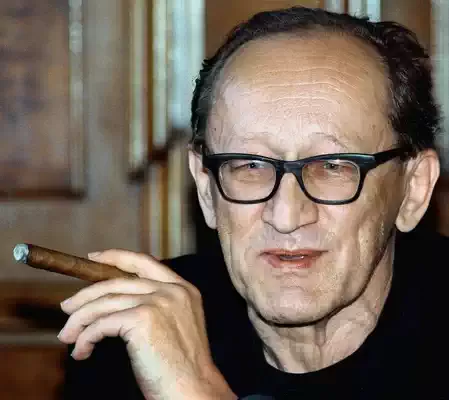
Heiner Müller
 DE
DE
Heiner Müller was a prominent German playwright, theater director, and writer, a central figure of post-war theater, known for his radical and experimental approach. His work is characterized by the deconstruction of language, the exploration of myths, and the confrontation with history and identity, especially in the context of divided and reunified Germany. Müller challenged theatrical conventions, creating fragmented and visual texts that provoke and question the spectator about the human condition, violence, and collective memory.
n. 1929-01-09, Eppendorf · m. 1995-12-30, Berlim
Bio
Identification and Basic Context
Heiner Müller was born on January 13, 1929, in Eppendorf, Saxony, East Germany, and died on May 30, 1995, in Berlin, Germany. He was one of the most important German playwrights and directors of the second half of the 20th century. His work is intrinsically linked to the historical and political experiences of divided Germany and post-war Europe.Childhood and Education
He grew up in Nazi Germany and, after World War II, lived in East Germany under the communist regime. His education was marked by these experiences. He initially worked as a journalist and editor but soon turned to theater, where he developed his unique scenic language. He was influenced by Bertolt Brecht, but also by Marxism and various mythologies.Literary Career
Müller began writing plays in the 1950s. His early plays, such as "The Hindenburg Flight" (1954), still showed a certain realism, but he quickly evolved towards a more experimental and fragmented writing style. Plays like "Hamletmachine" (1977), "The Mission" (1980), and "Quartet" (1987) consolidated his international reputation. He was also a director, often staging his own plays, which allowed him to control the complete scenic vision.Work, Style, and Literary Characteristics
Heiner Müller's work is known for its radicality and experimentation. He deconstructed the traditional language of theater, using fragments, collages, monologues, and non-linear dialogues. His texts frequently mix elements of classical myths, history, politics, and popular culture, creating dreamlike and violent landscapes. Recurring themes include historical guilt, alienation, the crisis of identity, the relationship between man and machine, political oppression, and the search for a new humanism. "Hamletmachine" is a paradigmatic example of his technique, recontextualizing Shakespeare to discuss the history and politics of East Germany. His style is often described as epic, dialectical, and hallucinatory.Cultural and Historical Context
Müller lived through the division of Germany and the Cold War, experiences that profoundly shaped his worldview and his work. He was critical of both bureaucratic communism and Western capitalism. His work frequently confronted audiences with the brutalities of German and European history, including Nazism and Stalinism. He was one of the few artists from East Germany to gain significant international recognition during his lifetime, but he also faced censorship and difficulties from the authorities.Personal Life
His life was marked by political turmoil and the complexities of living under a totalitarian regime. He maintained complex relationships with cultural authorities and other artists. His dedication to theater and writing was intense and uninterrupted, consuming much of his energy.Recognition and Reception
Heiner Müller received numerous awards and distinctions throughout his career, including the Georg Büchner Prize (1985). His work is widely studied and performed worldwide, considered a landmark in contemporary theater. However, his radical language and challenging themes often generated controversy and intense debate.Influences and Legacy
Müller was influenced by authors such as Bertolt Brecht, Franz Kafka, Antonin Artaud, and by various mythologies. His legacy is immense, influencing generations of playwrights, directors, and visual artists who seek to break with conventions and explore new forms of theatrical expression. He is seen as one of the fathers of post-dramatic theater.Interpretation and Critical Analysis
Müller's work invites multiple interpretations. Critics often analyze his texts as allegories about the human condition in modernity, the violence inherent in power structures, and the search for meaning in a fragmented world. His deconstruction of language is seen as a way to reveal underlying ideologies and mechanisms of social control.Curiosities and Lesser-Known Aspects
Müller was known for his enigmatic personality and his dark humor. He was a prolific thinker, and his notes and written fragments reveal a deep dive into philosophical and existential questions. His approach to theater was often seen as that of a "stage writer," more concerned with the structure and impact of the text than with traditional narrative.Death and Memory
Heiner Müller died in Berlin in 1995 after an illness. His death was mourned as the loss of one of the most important and innovative voices in world theater. His work continues to be a fertile ground for theatrical research and experimentation, keeping his artistic and intellectual relevance alive.Poems
0No poems found
Comments (0)
No comments yet. Be the first to comment.