
People in those old times had convictions; we moderns only have opinions. And it needs more than a mere opinion to erect a Gothic cathedral.
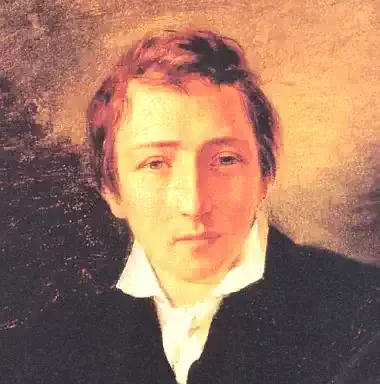
Heinrich Heine
1797–1856
· lived 58 years
 DE
DE
DE
Heinrich Heine was a German poet, journalist, and essayist, widely regarded as one of the most important poets of the German language. His work is marked by deep irony, melancholy, and a critical view of society, mixing intense lyricism with biting satire. Heine explored themes such as love, nature, politics, and the human condition, with a style that transitioned between romanticism and realism. His influence extended across various fields, and his poetic legacy continues to be celebrated for its modernity and its ability to express the complexity of the modern world with a language that is both accessible and sophisticated.
n. 1797-12-13, Düsseldorf · m. 1856-02-17, Paris
4,587
Views
Bio
Identification and basic context
Heinrich Heine was born in Düsseldorf, Kingdom of Prussia (present-day Germany), on December 13, 1797. His birth name was Christian Johann Heinrich Heine. He used the name Heinrich Heine throughout his literary career. Heine was of Jewish origin, the son of a textile merchant, and lived in a period of great social and political transformations in Europe, marked by the Napoleonic Wars and the Restoration.Childhood and education
Heine grew up in a middle-class family environment, where Jewish tradition mingled with the influences of emerging German culture. His father, Samson Heine, wanted his son to pursue a commercial career, but Heinrich showed an early aptitude for studies and literature. Initially, he was educated at home and later attended schools in Hamburg and Frankfurt. Although he converted to Protestant Christianity in 1825 to facilitate his career in a predominantly Christian society, his Jewish origin and his experience of being an "outsider" profoundly shaped his worldview and his work.Literary career
Heine's literary career began with the publication of poems in newspapers and magazines, gaining notoriety with his first poetry volume, "Gedichte" (Poems), in 1822. His most celebrated work, the book "Buch der Lieder" (Book of Songs), published in 1827, consolidated his reputation as one of the leading German lyric poets. Throughout his life, Heine lived in various German cities and, from 1831, settled in Paris, where he became an important cultural correspondent and journalist, writing for German and French newspapers. His output included poetry, prose, literary criticism, and political essays, demonstrating remarkable versatility.Work, style, and literary characteristics
Heine's work is characterized by a striking duality between lyricism and irony. His poems frequently address themes such as lost love, melancholy, longing for homeland, and social and political criticism. He used traditional poetic forms, such as sonnets and lyrical songs, but subverted them with an ironic tone and colloquial language. His poetry is known for its musicality, the strength of its imagery, and its ability to express complex emotions concisely and impactfully. The "love song" is one of the most explored genres in his work, but often tinged with disillusionment and sarcasm. His work "Buch der Lieder" is a landmark of German romanticism but already foreshadowed elements of realism and modernity.Cultural and historical context
Heine lived in a period of intense changes in Europe, after the French Revolution and the Napoleonic Wars. He was a critical observer of the political and social movements of his time, including German nationalism and the struggles for liberalization. His work reflects the tensions between romantic idealism and harsh political reality. In Paris, he associated with prominent figures of European intellectualism, such as Balzac, Victor Hugo, and Marx, and was a defender of liberal and socialist ideas, which led to surveillance by Prussian authorities.Personal life
Heine's personal life was marked by challenges. His conversion to Christianity, although motivated by practical reasons, generated internal and external conflicts. His romantic relationships, often turbulent, served as inspiration for many of his most moving lyrical poems, but also led him to states of deep melancholy. He suffered from a serious illness (possibly multiple sclerosis) in the last years of his life, which confined him to a bed in Paris, but did not prevent him from continuing to write and engage intellectually.Recognition and reception
Heine achieved fame during his lifetime, especially with "Buch der Lieder," which became a classic of German poetry. However, his political positions and his criticism of Prussian society led to censorship and the banning of some of his works in Germany. His critical reception was mixed, with admiration for his poetic genius, but also suspicion for his radical opinions and skepticism.Influences and legacy
Heine was influenced by poets such as Goethe and the German lyrical tradition, but also by French and English poetry. His legacy is immense; he influenced countless later poets, both in Germany and abroad, and is considered a precursor of modern poetry. His irony, lyricism, and critical view of society resonated with authors such as Bertolt Brecht and T.S. Eliot. His work continues to be studied and admired for its depth and modernity.Interpretation and critical analysis
Heine's work is often interpreted as a reflection of the human condition in a transitional world, marked by the loss of illusions and the search for meaning. His irony can be seen as a defense mechanism against suffering or as a tool to expose the contradictions of society. The tension between the beautiful and the grotesque, the sublime and the trivial, is a central element in his poetry.Curiosities and lesser-known aspects
Heine was known for his sharp sense of humor and his insightful observations about people and society. He had a particular fondness for France and French culture, where he spent much of his adult life. Despite his literary fame, he also faced financial difficulties at various times in his life, relying in part on subsidies from friends and admirers.Death and memory
Heinrich Heine died in Paris on February 17, 1856, after years of physical suffering. His death was felt as a great loss to German and European literature. His works continued to be published and reissued, and his memory is honored as that of one of the greatest lyric poets and social critics in German history.Poems
0No poems found
Quotes
37Mark this well, you proud men of action: You are nothing but the unwitting agents of the men of thought who often, in quiet self-effacement, mark out most exactly all your doings in advance.
Auf Flügeln des Gesanges . On Wings of Song.
No poems found
Comments (0)
Log in
to post a comment.
No comments yet. Be the first to comment.