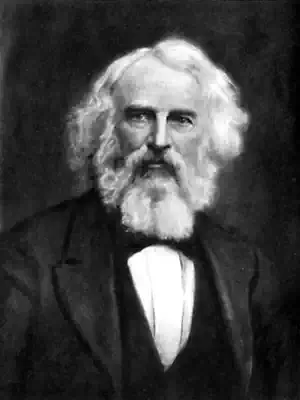
Ultima Thule: Bayard Taylor
Ultima Thule: Bayard Taylor
Dead he lay among his books!
The peace of God was in his looks.
As the statues in the gloom
Watch o'er Maximilian's tomb,
So those volumes from their shelves
Watched him, silent as themselves.
Ah! his hand will nevermore
Turn their storied pages o'er;
Nevermore his lips repeat
Songs of theirs, however sweet.
Let the lifeless body rest!
He is gone, who was its guest;
Gone, as travellers haste to leave
An inn, nor tarry until eve.
Traveller! in what realms afar,
In what planet, in what star,
In what vast, aerial space,
Shines the light upon thy face?
In what gardens of delight
Rest thy weary feet to-night?
Poet! thou, whose latest verse
Was a garland on thy hearse;
Thou hast sung, with organ tone,
In Deukalion's life, thine own;
On the ruins of the Past
Blooms the perfect flower at last.
Friend! but yesterday the bells
Rang for thee their loud farewells;
And to-day they toll for thee,
Lying dead beyond the sea;
Lying dead among thy books,
The peace of God in all thy looks!
Travels By The Fireside. (Birds Of Passage. Flight The Fourth)
Travels By The Fireside. (Birds Of Passage. Flight The Fourth)
The ceaseless rain is falling fast,
And yonder gilded vane,
Immovable for three days past,
Points to the misty main,
It drives me in upon myself
And to the fireside gleams,
To pleasant books that crowd my shelf,
And still more pleasant dreams,
I read whatever bards have sung
Of lands beyond the sea,
And the bright days when I was young
Come thronging back to me.
In fancy I can hear again
The Alpine torrent's roar,
The mule-bells on the hills of Spain,
The sea at Elsinore.
I see the convent's gleaming wall
Rise from its groves of pine,
And towers of old cathedrals tall,
And castles by the Rhine.
I journey on by park and spire,
Beneath centennial trees,
Through fields with poppies all on fire,
And gleams of distant seas.
I fear no more the dust and heat,
No more I feel fatigue,
While journeying with another's feet
O'er many a lengthening league.
Let others traverse sea and land,
And toil through various climes,
I turn the world round with my hand
Reading these poets' rhymes.
From them I learn whatever lies
Beneath each changing zone,
And see, when looking with their eyes,
Better than with mine own.
To William E. Channing
To William E. Channing
The pages of thy book I read,
And as I closed each one,
My heart, responding, ever said,
"Servant of God! well done!"
Well done! Thy words are great and bold;
At times they seem to me,
Like Luther's, in the days of old,
Half-battles for the free.
Go on, until this land revokes
The old and chartered Lie,
The feudal curse, whose whips and yokes
Insult humanity.
A voice is ever at thy side
Speaking in tones of might,
Like the prophetic voice, that cried
To John in Patmos, "Write!"
Write! and tell out this bloody tale;
Record this dire eclipse,
This Day of Wrath, this Endless Wail,
This dread Apocalypse!
To The River Yvette. (Birds Of Passage. Flight The Fifth)
To The River Yvette. (Birds Of Passage. Flight The Fifth)
O lovely river of Yvette!
O darling river! like a bride,
Some dimpled, bashful, fair Lisette,
Thou goest to wed the Orge's tide.
Maincourt, and lordly Dampierre,
See and salute thee on thy way,
And, with a blessing and a prayer,
Ring the sweet bells of St. Forget.
The valley of Chevreuse in vain
Would hold thee in its fond embrace;
Thou glidest from its arms again
And hurriest on with swifter pace.
Thou wilt not stay; with restless feet,
Pursuing still thine onward flight,
Thou goest as one in haste to meet
Her sole desire, her heart's delight.
O lovely river of Yvette!
O darling stream! on balanced wings
The wood-birds sang the chansonnette
That here a wandering poet sings.
To Vittoria Colonna. (Sonnet V.)
To Vittoria Colonna. (Sonnet V.)
Lady, how can it chance--yet this we see
In long experience--that will longer last
A living image carved from quarries vast
Than its own maker, who dies presently?
Cause yieldeth to effect if this so be,
And even Nature is by Art at surpassed;
This know I, who to Art have given the past,
But see that Time is breaking faith with me.
Perhaps on both of us long life can I
Either in color or in stone bestow,
By now portraying each in look and mien;
So that a thousand years after we die,
How fair thou wast, and I how full of woe,
And wherefore I so loved thee, may be seen.
To The Driving Cloud
To The Driving Cloud
Gloomy and dark art thou, O chief of the mighty Omahas;
Gloomy and dark as the driving cloud, whose name thou hast taken!
Wrapped in thy scarlet blanket, I see thee stalk through the city's
Narrow and populous streets, as once by the margin of rivers
Stalked those birds unknown, that have left us only their
footprints.
What, in a few short years, will remain of thy race but the
footprints?
How canst thou walk these streets, who hast trod the green turf
of the prairies!
How canst thou breathe this air, who hast breathed the sweet air
of the mountains!
Ah! 'tis in vain that with lordly looks of disdain thou dost
challenge
Looks of disdain in return, and question these walls and these
pavements,
Claiming the soil for thy hunting-grounds, while down-trodden
millions
Starve in the garrets of Europe, and cry from its caverns that
they, too,
Have been created heirs of the earth, and claim its division!
Back, then, back to thy woods in the regions west of the Wabash!
There as a monarch thou reignest. In autumn the leaves of the
maple
Pave the floors of thy palace-halls with gold, and in summer
Pine-trees waft through its chambers the odorous breath of their
branches.
There thou art strong and great, a hero, a tamer of horses!
There thou chasest the stately stag on the banks of the Elkhorn,
Or by the roar of the Running-Water, or where the Omaha
Calls thee, and leaps through the wild ravine like a brave of the
Blackfeet!
Hark! what murmurs arise from the heart of those mountainous
deserts?
Is it the cry of the Foxes and Crows, or the mighty Behemoth,
Who, unharmed, on his tusks once caught the bolts of the thunder,
And now lurks in his lair to destroy the race of the red man?
Far more fatal to thee and thy race than the Crows and the Foxes,
Far more fatal to thee and thy race than the tread of Behemoth,
Lo! the big thunder-canoe, that steadily breasts the Missouri's
Merciless current! and yonder, afar on the prairies, the
camp-fires
Gleam through the night; and the cloud of dust in the gray of the
daybreak
Marks not the buffalo's track, nor the Mandan's dexterous
horse-race;
It is a caravan, whitening the desert where dwell the Camanches!
Ha! how the breath of these Saxons and Celts, like the blast of
the east-wind,
Drifts evermore to the west the scanty smokes of thy wigwams!
To the River Charles
To the River Charles
River! that in silence windest
Through the meadows, bright and free,
Till at length thy rest thou findest
In the bosom of the sea!
Four long years of mingled feeling,
Half in rest, and half in strife,
I have seen thy waters stealing
Onward, like the stream of life.
Thou hast taught me, Silent River!
Many a lesson, deep and long;
Thou hast been a generous giver;
I can give thee but a song.
Oft in sadness and in illness,
I have watched thy current glide,
Till the beauty of its stillness
Overflowed me, like a tide.
And in better hours and brighter,
When I saw thy waters gleam,
I have felt my heart beat lighter,
And leap onward with thy stream.
Not for this alone I love thee,
Nor because thy waves of blue
From celestial seas above thee
Take their own celestial hue.
Where yon shadowy woodlands hide thee,
And thy waters disappear,
Friends I love have dwelt beside thee,
And have made thy margin dear.
More than this;--thy name reminds me
Of three friends, all true and tried;
And that name, like magic, binds me
Closer, closer to thy side.
Friends my soul with joy remembers!
How like quivering flames they start,
When I fan the living embers
On the hearth-stone of my heart!
'T is for this, thou Silent River!
That my spirit leans to thee;
Thou hast been a generous giver,
Take this idle song from me.
To an Old Danish Song-Book
To an Old Danish Song-Book
Welcome, my old friend,
Welcome to a foreign fireside,
While the sullen gales of autumn
Shake the windows.
The ungrateful world
Has, it seems, dealt harshly with thee,
Since, beneath the skies of Denmark,
First I met thee.
There are marks of age,
There are thumb-marks on thy margin,
Made by hands that clasped thee rudely,
At the alehouse.
Soiled and dull thou art;
Yellow are thy time-worn pages,
As the russet, rain-molested
Leaves of autumn.
Thou art stained with wine
Scattered from hilarious goblets,
As the leaves with the libations
Of Olympus.
Yet dost thou recall
Days departed, half-forgotten,
When in dreamy youth I wandered
By the Baltic,--
When I paused to hear
The old ballad of King Christian
Shouted from suburban taverns
In the twilight.
Thou recallest bards,
Who in solitary chambers,
And with hearts by passion wasted,
Wrote thy pages.
Thou recallest homes
Where thy songs of love and friendship
Made the gloomy Northern winter
Bright as summer.
Once some ancient Scald,
In his bleak, ancestral Iceland,
Chanted staves of these old ballads
To the Vikings.
Once in Elsinore,
At the court of old King Hamlet
Yorick and his boon companions
Sang these ditties.
Once Prince Frederick's Guard
Sang them in their smoky barracks;--
Suddenly the English cannon
Joined the chorus!
Peasants in the field,
Sailors on the roaring ocean,
Students, tradesmen, pale mechanics,
All have sung them.
Thou hast been their friend;
They, alas! have left thee friendless!
Yet at least by one warm fireside
Art thou welcome.
And, as swallows build
In these wide, old-fashioned chimneys,
So thy twittering songs shall nestle
In my bosom,--
Quiet, close, and warm,
Sheltered from all molestation,
And recalling by their voices
Youth and travel.
To Italy. (From Filicaja)
To Italy. (From Filicaja)
Italy! Italy! thou who'rt doomed to wear
The fatal gift of beauty and possess
The dower funest of infinite wretchedness
Written upon thy forehead by despair;
Ah! would that thou wert stronger or less fair,
That they might fear thee more or love thee less,
Who in the splendour of thy loveliness
Seem wasting, yet to mortal combat dare!
Then from the Alps I should not see descending
Such torrents of armed men, nor Gallic horde
Drinking the wave of Po, distained with gore,
Nor should I see thee girded with a sword
Not thine, and with the stranger's arm contending,
Victor or vanquished, slave for evermore.
Tide Rises, the Tide Falls, The
Tide Rises, the Tide Falls, The
The tide rises, the tide falls,
The twilight darkens, the curlew calls;
Along the sea-sands damp and brown
The traveler hastens toward the town,
And the tide rises, the tide falls.
Darkness settles on roofs and walls,
But the sea, the sea in darkness calls;
The little waves, with their soft, white hands
Efface the footprints in the sands,
And the tide rises, the tide falls.
The morning breaks; the steeds in their stalls
Stamp and neigh, as the hostler calls;
The day returns, but nevermore
Returns the traveler to the shore.
And the tide rises, the tide falls.