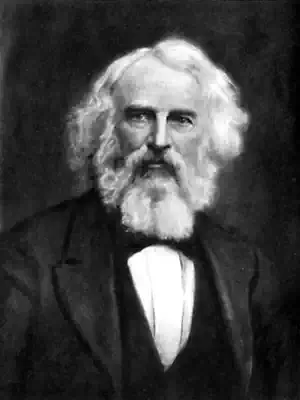
The Golden Legend: II. A Farm In The Odenwald
The Golden Legend: II. A Farm In The Odenwald
A garden; morning;_ PRINCE HENRY _seated, with a
book_. ELSIE, _at a distance, gathering flowers._
_Prince Henry (reading)._ One morning, all alone,
Out of his convent of gray stone,
Into the forest older, darker, grayer,
His lips moving as if in prayer,
His head sunken upon his breast
As in a dream of rest,
Walked the Monk Felix. All about
The broad, sweet sunshine lay without,
Filling the summer air;
And within the woodlands as he trod,
The twilight was like the Truce of God
With worldly woe and care;
Under him lay the golden moss;
And above him the boughs of hemlock-tree
Waved, and made the sign of the cross,
And whispered their Benedicites;
And from the ground
Rose an odor sweet and fragrant
Of the wild flowers and the vagrant
Vines that wandered,
Seeking the sunshine, round and round.
These he heeded not, but pondered
On the volume in his hand,
A volume of Saint Augustine;
Wherein he read of the unseen
Splendors of God's great town
In the unknown land,
And, with his eyes cast down
In humility, he said:
'I believe, O God,
What herein I have read,
But alas! I do not understand!'
And lo! he heard
The sudden singing of a bird,
A snow-white bird, that from a cloud
Dropped down,
And among the branches brown
Sat singing
So sweet, and clear, and loud,
It seemed a thousand harp strings ringing.
And the Monk Felix closed his book,
And long, long,
With rapturous look,
He listened to the song,
And hardly breathed or stirred,
Until he saw, as in a vision,
The land Elysian,
And in the heavenly city heard
Angelic feet
Fall on the golden flagging of the street.
And he would fain
Have caught the wondrous bird,
But strove in vain;
For it flew away, away,
Far over hill and dell,
And instead of its sweet singing
He heard the convent bell
Suddenly in the silence ringing
For the service of noonday.
And he retraced
His pathway homeward sadly and in haste.
In the convent there was a change!
He looked for each well known face,
But the faces were new and strange;
New figures sat in the oaken stalls,
New voices chaunted in the choir,
Yet the place was the same place,
The same dusky walls
Of cold, gray stone,
The same cloisters and belfry and spire.
A stranger and alone
Among that brotherhood
The Monk Felix stood
'Forty years,' said a Friar.
'Have I been Prior
Of this convent in the wood,
But for that space
Never have I beheld thy face!'
The heart of the Monk Felix fell:
And he answered with submissive tone,
'This morning, after the hour of Prime,
I left my cell,
And wandered forth alone,
Listening all the time
To the melodious singing
Of a beautiful white bird,
Until I heard
The bells of the convent ringing
Noon from their noisy towers,
It was as if I dreamed;
For what to me had seemed
Moments only, had been hours!'
'Years!' said a voice close by.
It was an aged monk who spoke,
From a bench of oak
Fastened against the wall;-
He was the oldest monk of all.
For a whole century
Had he been there,
Serving God in prayer,
The meekest and humblest of his creatures.
He remembered well the features
Of Felix, and he said,
Speaking distinct and slow:
'One hundred years ago,
When I was a novice in this place,
There was here a monk, full of God's grace,
Who bore the name
Of Felix, and this man must be the same.'
And straightway
They brought forth to the light of day
A volume old and brown,
A huge tome, bound
With brass and wild-boar's hide,
Therein were written down
The names of all who had died
In the convent, since it was edified.
And there they found,
Just as the old monk said,
That on a certain day and date,
One hundred years before,
Had gone forth from the convent gate
The Monk Felix, and never more
Had entered that sacred door.
He had been counted among the dead!
And they knew, at last,
That, such had been the power
Of that celestial and immortal song,
A hundred years had passed,
And had not seemed so long
As a single hour!
(ELSIE _comes in with flowers._)
_Elsie._ Here are flowers for you,
But they are not all for you.
Some of them are for the Virgin
And for Saint Cecilia.
_Prince Henry._ As thou standest there,
Thou seemest to me like the angel
That brought the immortal roses
To Saint Cecilia's bridal chamber.
_Elsie._ But these will fade.
_Prince Henry._ Themselves will fade,
But not their memory,
And memory has the power
To re-create them from the dust.
They remind me, too,
Of martyred Dorothea,
Who from celestial gardens sent
Flowers as her witnesses
To him who scoffed and doubted.
_Elsie._ Do you know the story
Of Christ and the Sultan's daughter?
That is the prettiest legend of them all.
_Prince Henry._ Then tell it to me.
But first come hither.
Lay the flowers down beside me.
And put both thy hands in mine.
Now tell me the story.
_Elsie._ Early in the morning
The Sultan's daughter
Walked in her father's garden,
Gathering the bright flowers,
All full of dew.
_Prince Henry._ Just as thou hast been doing
This morning, dearest Elsie.
_Elsie._ And as she gathered them,
She wondered more and more
Who was the Master of the Flowers,
And made them grow
Out of the cold, dark earth.
'In my heart,' she said,
'I love him; and for him
Would leave my father's palace,
To labor in his garden.'
_Prince Henry._ Dear, innocent child!
How sweetly thou recallest
The long-forgotten legend,
That in my early childhood
My mother told me!
Upon my brain
It reappears once more,
As a birth-mark on the forehead
When a hand suddenly
Is laid upon it, and removed!
_Elsie._ And at midnight,
As she lay upon her bed,
She heard a voice
Call to her from the garden,
And, looking forth from her window,
She saw a beautiful youth
Standing among the flowers.
It was the Lord Jesus;
And she went down to him,
And opened the door for him;
And he said to her, 'O maiden!
Thou hast thought of me with love,
And for thy sake
Out of my Father's kingdom
Have I come hither:
I am the Master of the Flowers.
My garden is in Paradise,
And if thou wilt go with me,
Thy bridal garland
Shall be of bright red flowers.'
And then he took from his finger
A golden ring,
And asked the Sultan's daughter
If she would be his bride.
And when she answered him with love,
His wounds began to bleed,
And she said to him,
'O Love! how red thy heart is,
And thy hands are full of roses,'
'For thy sake,' answered he,
'For thy sake is my heart so red,
For thee I bring these roses.
I gathered them at the cross
Whereon I died for thee!
Come, for my Father calls.
Thou art my elected bride!'
And the Sultan's daughter
Followed him to his Father's garden.
_Prince Henry._ Wouldst thou have done so, Elsie?
_Elsie._ Yes, very gladly.
_Prince Henry._ Then the Celestial Bridegroom
Will come for thee also.
Upon thy forehead he will place,
Not his crown of thorns,
But a crown of roses.
In thy bridal chamber,
Like Saint Cecilia,
Thou shall hear sweet music,
And breathe the fragrance
Of flowers immortal!
Go now and place these flowers
Before her picture.
* * * * *
A ROOM IN THE FARM-HOUSE.
* * * * *
_Twilight._ URSULA _spinning._ GOTTLIEB _asleep in his
chair._
_Ursula._ Darker and darker! Hardly a glimmer
Of light comes in at the window-pane;
Or is it my eyes are growing dimmer?
I cannot disentangle this skein,
Nor wind it rightly upon the reel.
Elsie!
_Gottlieb (starting)_. The stopping of thy wheel
Has wakened me out of a pleasant dream.
I thought I was sitting beside a stream,
And heard the grinding of a mill,
When suddenly the wheels stood still,
And a voice cried 'Elsie' in my ear!
It startled me, it seemed so near.
_Ursula._ I was calling her: I want a light.
I cannot see to spin my flax.
Bring the lamp, Elsie. Dost thou hear?
_Elsie (within)._ In a moment!
_Gottlieb._ Where are Bertha and Max?
_Ursula._ They are sitting with Elsie at the door.
She is telling them stories of the wood,
And the Wolf, and Little Red Ridinghood.
_Gottlieb_. And where is the Prince?
_Ursula_. In his room overhead;
I heard him walking across the floor,
As he always does, with a heavy tread.
(ELSIE _comes in with a lamp_. MAX _and_ BERTHA _follow her;
and they all sing the Evening Song on the lighting of the lamps_.)
EVENING SONG.
O gladsome light
Of the Father Immortal,
And of the celestial
Sacred and blessed
Jesus, our Saviour!
Now to the sunset
Again hast thou brought us;
And, seeing the evening
Twilight, we bless thee,
Praise thee, adore thee!
Father omnipotent!
Son, the Life-giver!
Spirit, the Comforter!
Worthy at all times
Of worship and wonder!
_Prince Henry (at the door)_. Amen!
_Ursula_. Who was it said Amen?
_Elsie_. It was the Prince: he stood at the door,
And listened a moment, as we chaunted
The evening song. He is gone again.
I have often seen him there before.
_Ursula_. Poor Prince!
_Gottlieb_. I thought the house was haunted!
Poor Prince, alas! and yet as mild
And patient as the gentlest child!
_Max._ I love him because he is so good,
And makes me such fine bows and arrows,
To shoot at the robins and the sparrows,
And the red squirrels in the wood!
_Bertha._ I love him, too!
_Gottlieb._ Ah, yes! we all
Love him, from the bottom of our hearts;
He gave us the farm, the house, and the grange,
He gave us the horses and the carts,
And the great oxen in the stall,
The vineyard, and the forest range!
We have nothing to give him but our love!
_Bertha._ Did he give us the beautiful stork above
On the chimney-top, with its large, round nest?
_Gottlieb._ No, not the stork; by God in heaven,
As a blessing, the dear, white stork was given;
But the Prince has given us all the rest.
God bless him, and make him well again.
_Elsie._ Would I could do something for his sake,
Something to cure his sorrow and pain!
_Gottlieb._ That no one can; neither thou nor I,
Nor any one else.
_Elsie._ And must he die?
_Ursula._ Yes; if the dear God does not take
Pity upon him, in his distress,
And work a miracle!
_Gottlieb._ Or unless
Some maiden, of her own accord,
Offers her life for that of her lord,
And is willing to die in his stead.
_Elsie._ I will!
_Ursula._ Prithee, thou foolish child, be still!
Thou shouldst not say what thou dost not mean!
_Elsie._ I mean it truly!
_Max._ O father! this morning,
Down by the mill, in the ravine,
Hans killed a wolf, the very same
That in the night to the sheepfold came,
And ate up my lamb, that was left outside.
_Gottlieb._ I am glad he is dead. It will be a warning
To the wolves in the forest, far and wide.
_Max._ And I am going to have his hide!
_Bertha._ I wonder if this is the wolf that ate
Little Red Ridinghood!
_Ursula._ O, no!
That wolf was killed a long while ago.
Come, children, it is growing late.
_Max._ Ah, how I wish I were a man,
As stout as Hans is, and as strong!
I would do nothing else, the whole day long,
But just kill wolves.
_Gottlieb._ Then go to bed,
And grow as fast as a little boy can.
Bertha is half asleep already.
See how she nods her heavy head,
And her sleepy feet are so unsteady
She will hardly be able to creep upstairs.
_Ursula._ Good-night, my children. Here's the light.
And do not forget to say your prayers
Before you sleep.
_Gottlieb._ Good-night!
_Max and Bertha._ Good-night!
(_They go out with_ ELSIE.)
_Ursula, (spinning)._ She is a strange and wayward child,
That Elsie of ours. She looks so old,
And thoughts and fancies weird and wild
Seem of late to have taken hold
Of her heart, that was once so docile and mild!
_Gottlieb._ She is like all girls.
_Ursula._ Ah no, forsooth!
Unlike all I have ever seen.
For she has visions and strange dreams,
And in all her words and ways, she seems
Much older than she is in truth.
Who would think her but fourteen?
And there has been of late such a change!
My heart is heavy with fear and doubt
That she may not live till the year is out.
She is so strange,--so strange,--so strange!
_Gottlieb._ I am not troubled with any such fear!
She will live and thrive for many a year.
* * * * *
ELSIE'S CHAMBER.
* * * * *
_Night._ ELSIE _praying._
_Elsie._ My Redeemer and my Lord,
I beseech thee, I entreat thee,
Guide me in each act and word,
That hereafter I may meet thee,
Watching, waiting, hoping, yearning,
With my lamp well trimmed and burning!
Interceding
With these bleeding
Wounds upon thy hands and side,
For all who have lived and erred
Thou hast suffered, thou hast died,
Scourged, and mocked, and crucified,
And in the grave hast thou been buried!
If my feeble prayer can reach thee,
O my Saviour, I beseech thee,
Even as thou hast died for me,
More sincerely
Let me follow where thou leadest,
Let me, bleeding as thou bleedest,
Die, if dying I may give
Life to one who asks to live,
And more nearly,
Dying thus, resemble thee!
* * * * *
THE CHAMBER OF GOTTLIEB AND URSULA.
* * * * *
_Midnight._ ELSIE _standing by their bedside, weeping._
_Gottlieb._ The wind is roaring; the rushing rain
Is loud upon roof and window-pane,
As if the Wild Huntsman of Rodenstein,
Boding evil to me and mine,
Were abroad to-night with his ghostly train!
In the brief lulls of the tempest wild,
The dogs howl in the yard; and hark!
Some one is sobbing in the dark,
Here in the chamber!
_Elsie._ It is I.
_Ursula._ Elsie! what ails thee, my poor child?
_Elsie._ I am disturbed and much distressed,
In thinking our dear Prince must die,
I cannot close mine eyes, nor rest.
_Gottlieb._ What wouldst thou? In the Power Divine
His healing lies, not in our own;
It is in the hand of God alone.
_Elsie._ Nay, he has put it into mine,
And into my heart!
_Gottlieb._ Thy words are wild!
_Ursula._ What dost thou mean? my child! my child!
_Elsie._ That for our dear Prince Henry's sake
I will myself the offering make,
And give my life to purchase his.
_Ursula_ Am I still dreaming, or awake?
Thou speakest carelessly of death,
And yet thou knowest not what it is.
_Elsie._ 'T is the cessation of our breath.
Silent and motionless we lie;
And no one knoweth more than this.
I saw our little Gertrude die,
She left off breathing, and no more
I smoothed the pillow beneath her head.
She was more beautiful than before.
Like violets faded were her eyes;
By this we knew that she was dead.
Through the open window looked the skies
Into the chamber where she lay,
And the wind was like the sound of wings,
As if angels came to bear her away.
Ah! when I saw and felt these things,
I found it difficult to stay;
I longed to die, as she had died,
And go forth with her, side by side.
The Saints are dead, the Martyrs dead,
And Mary, and our Lord, and I
Would follow in humility
The way by them illumined!
_Ursula._ My child! my child! thou must not die!
_Elsie_ Why should I live? Do I not know
The life of woman is full of woe?
Toiling on and on and on,
With breaking heart, and tearful eyes,
And silent lips, and in the soul
The secret longings that arise,
Which this world never satisfies!
Some more, some less, but of the whole
Not one quite happy, no, not one!
_Ursula._ It is the malediction of Eve!
_Elsie._ In place of it, let me receive
The benediction of Mary, then.
_Gottlieb._ Ah, woe is me! Ah, woe is me!
Most wretched am I among men!
_Ursula._ Alas! that I should live to see
Thy death, beloved, and to stand
Above thy grave! Ah, woe the day!
_Elsie._ Thou wilt not see it. I shall lie
Beneath the flowers of another land,
For at Salerno, far away
Over the mountains, over the sea,
It is appointed me to die!
And it will seem no more to thee
Than if at the village on market-day
I should a little longer stay
Than I am used.
_Ursula._ Even as thou sayest!
And how my heart beats, when thou stayest!
I cannot rest until my sight
Is satisfied with seeing thee.
What, then, if thou wert dead?
_Gottlieb_ Ah me!
Of our old eyes thou art the light!
The joy of our old hearts art thou!
And wilt thou die?
_Ursula._ Not now! not now!
_Elsie_ Christ died for me, and shall not I
Be willing for my Prince to die?
You both are silent; you cannot speak.
This said I, at our Saviour's feast,
After confession, to the priest,
And even he made no reply.
Does he not warn us all to seek
The happier, better land on high,
Where flowers immortal never wither,
And could he forbid me to go thither?
_Gottlieb._ In God's own time, my heart's delight!
When he shall call thee, not before!
_Elsie._ I heard him call. When Christ ascended
Triumphantly, from star to star,
He left the gates of heaven ajar.
I had a vision in the night,
And saw him standing at the door
Of his Father's mansion, vast and splendid,
And beckoning to me from afar.
I cannot stay!
_Gottlieb._ She speaks almost
As if it were the Holy Ghost
Spake through her lips, and in her stead!
What if this were of God?
_Ursula._ Ah, then
Gainsay it dare we not.
_Gottlieb._ Amen!
Elsie! the words that thou hast said
Are strange and new for us to hear,
And fill our hearts with doubt and fear.
Whether it be a dark temptation
Of the Evil One, or God's inspiration,
We in our blindness cannot say.
We must think upon it, and pray;
For evil and good in both resembles.
If it be of God, his will be done!
May he guard us from the Evil One!
How hot thy hand is! how it trembles!
Go to thy bed, and try to sleep.
_Ursula._ Kiss me. Good-night; and do not weep!
(ELSIE _goes out._)
Ah, what an awful thing is this!
I almost shuddered at her kiss.
As if a ghost had touched my cheek,
I am so childish and so weak!
As soon as I see the earliest gray
Of morning glimmer in the east,
I will go over to the priest,
And hear what the good man has to say!
* * * * *
A VILLAGE CHURCH.
* * * * *
_A woman kneeling at the confessional.
The Parish Priest (from within)_. Go, sin no
more! Thy penance o'er,
A new and better life begin!
God maketh thee forever free
From the dominion of thy sin!
Go, sin no more! He will restore
The peace that filled thy heart before,
And pardon thine iniquity!
(_The woman goes out. The Priest comes forth, and
walks slowly up and down the church_.)
O blessed Lord! how much I need
Thy light to guide me on my way!
So many hands, that, without heed,
Still touch thy wounds, and make them bleed!
So many feet, that, day by day,
Still wander from thy fold astray!
Unless thou fill me with thy light,
I cannot lead thy flock aright;
Nor, without thy support, can bear
The burden of so great a care,
But am myself a castaway!
(_A pause_.)
The day is drawing to its close;
And what good deeds, since first it rose,
Have I presented, Lord, to thee,
As offerings of my ministry?
What wrong repressed, what right maintained
What struggle passed, what victory gained,
What good attempted and attained?
Feeble, at best, is my endeavor!
I see, but cannot reach, the height
That lies forever in the light,
And yet forever and forever,
When seeming just within my grasp,
I feel my feeble hands unclasp,
And sink discouraged into night!
For thine own purpose, thou hast sent
The strife and the discouragement!
(_A pause_.)
Why stayest thou, Prince of Hoheneck?
Why keep me pacing to and fro
Amid these aisles of sacred gloom,
Counting my footsteps as I go,
And marking with each step a tomb?
Why should the world for thee make room,
And wait thy leisure and thy beck?
Thou comest in the hope to hear
Some word of comfort and of cheer.
What can I say? I cannot give
The counsel to do this and live;
But rather, firmly to deny
The tempter, though his power is strong,
And, inaccessible to wrong,
Still like a martyr live and die!
(_A pause_.)
The evening air grows dusk and brown;
I must go forth into the town,
To visit beds of pain and death,
Of restless limbs, and quivering breath,
And sorrowing hearts, and patient eyes
That see, through tears, the sun go down,
But never more shall see it rise.
The poor in body and estate,
The sick and the disconsolate.
Must not on man's convenience wait.
(_Goes out. Enter_ LUCIFER, _as a Priest_. LUCIFER,
_with a genuflexion, mocking_.)
This is the Black Pater-noster.
God was my foster,
He fostered me
Under the book of the Palm-tree!
St. Michael was my dame.
He was born at Bethlehem,
He was made of flesh and blood.
God send me my right food,
My right food, and shelter too,
That I may to yon kirk go,
To read upon yon sweet book
Which the mighty God of heaven shook.
Open, open, hell's gates!
Shut, shut, heaven's gates!
All the devils in the air
The stronger be, that hear the Black Prayer!
(_Looking round the church_.)
What a darksome and dismal place!
I wonder that any man has the face
To call such a hole the House of the Lord,
And the Gate of Heaven,--yet such is the word.
Ceiling, and walls, and windows old,
Covered with cobwebs, blackened with mould;
Dust on the pulpit, dust on the stairs,
Dust on the benches, and stalls, and chairs!
The pulpit, from which such ponderous sermons
Have fallen down on the brains of the Germans,
With about as much real edification
As if a great Bible, bound in lead,
Had fallen, and struck them on the head;
And I ought to remember that sensation!
Here stands the holy water stoup!
Holy-water it may be to many,
But to me, the veriest Liquor Gehennae!
It smells like a filthy fast day soup!
Near it stands the box for the poor;
With its iron padlock, safe and sure,
I and the priest of the parish know
Whither all these charities go;
Therefore, to keep up the institution,
I will add my little contribution!
(_He puts in money._)
Underneath this mouldering tomb,
With statue of stone, and scutcheon of brass,
Slumbers a great lord of the village.
All his life was riot and pillage,
But at length, to escape the threatened doom
Of the everlasting, penal fire,
He died in the dress of a mendicant friar,
And bartered his wealth for a daily mass.
But all that afterward came to pass,
And whether he finds it dull or pleasant,
Is kept a secret for the present,
At his own particular desire.
And here, in a corner of the wall,
Shadowy, silent, apart from all,
With its awful portal open wide,
And its latticed windows on either side,
And its step well worn by the bended knees
Of one or two pious centuries,
Stands the village confessional!
Within it, as an honored guest,
I will sit me down awhile and rest!
(_Seats himself in the confessional_.)
Here sits the priest, and faint and low,
Like the sighing of an evening breeze,
Comes through these painted lattices
The ceaseless sound of human woe,
Here, while her bosom aches and throbs
With deep and agonizing sobs,
That half are passion, half contrition,
The luckless daughter of perdition
Slowly confesses her secret shame!
The time, the place, the lover's name!
Here the grim murderer, with a groan,
From his bruised conscience rolls the stone,
Thinking that thus he can atone
For ravages of sword and flame!
Indeed, I marvel, and marvel greatly,
How a priest can sit here so sedately,
Reading, the whole year out and in,
Naught but the catalogue of sin,
And still keep any faith whatever
In human virtue! Never! never!
I cannot repeat a thousandth part
Of the horrors and crimes and sins and woes
That arise, when with palpitating throes
The graveyard in the human heart
Gives up its dead, at the voice of the priest,
As if he were an archangel, at least.
It makes a peculiar atmosphere,
This odor of earthly passions and crimes,
Such as I like to breathe, at times,
And such as often brings me here
In the hottest and most pestilential season.
To-day, I come for another reason;
To foster and ripen an evil thought
In a heart that is almost to madness wrought,
And to make a murderer out of a prince,
A sleight of hand I learned long since!
He comes In the twilight he will not see
the difference between his priest and me!
In the same net was the mother caught!
(_Prince Henry entering and kneeling at the confessional._)
Remorseful, penitent, and lowly,
I come to crave, O Father holy,
Thy benediction on my head.
_Lucifer_. The benediction shall be said
After confession, not before!
'T is a God speed to the parting guest,
Who stands already at the door,
Sandalled with holiness, and dressed
In garments pure from earthly stain.
Meanwhile, hast thou searched well thy breast?
Does the same madness fill thy brain?
Or have thy passion and unrest
Vanished forever from thy mind?
_Prince Henry_. By the same madness still made blind,
By the same passion still possessed,
I come again to the house of prayer,
A man afflicted and distressed!
As in a cloudy atmosphere,
Through unseen sluices of the air,
A sudden and impetuous wind
Strikes the great forest white with fear,
And every branch, and bough, and spray
Points all its quivering leaves one way,
And meadows of grass, and fields of grain,
And the clouds above, and the slanting rain,
And smoke from chimneys of the town,
Yield themselves to it, and bow down,
So does this dreadful purpose press
Onward, with irresistible stress,
And all my thoughts and faculties,
Struck level by the strength of this,
From their true inclination turn,
And all stream forward to Salem!
_Lucifer_. Alas! we are but eddies of dust,
Uplifted by the blast, and whirled
Along the highway of the world
A moment only, then to fall
Back to a common level all,
At the subsiding of the gust!
_Prince Henry_. O holy Father! pardon in me
The oscillation of a mind
Unsteadfast, and that cannot find
Its centre of rest and harmony!
For evermore before mine eyes
This ghastly phantom flits and flies,
And as a madman through a crowd,
With frantic gestures and wild cries,
It hurries onward, and aloud
Repeats its awful prophecies!
Weakness is wretchedness! To be strong
Is to be happy! I am weak,
And cannot find the good I seek,
Because I feel and fear the wrong!
_Lucifer_. Be not alarmed! The Church is kind--
And in her mercy and her meekness
She meets half-way her children's weakness,
Writes their transgressions in the dust!
Though in the Decalogue we find
The mandate written, 'Thou shalt not kill!'
Yet there are cases when we must.
In war, for instance, or from scathe
To guard and keep the one true Faith!
We must look at the Decalogue in the light
Of an ancient statute, that was meant
For a mild and general application,
To be understood with the reservation,
That, in certain instances, the Right
Must yield to the Expedient!
Thou art a Prince. If thou shouldst die,
What hearts and hopes would prostrate he!
What noble deeds, what fair renown,
Into the grave with thee go down!
What acts of valor and courtesy
Remain undone, and die with thee!
Thou art the last of all thy race!
With thee a noble name expires,
And vanishes from the earth's face
The glorious memory of thy sires!
She is a peasant. In her veins
Flows common and plebeian blood;
It is such as daily and hourly stains
The dust and the turf of battle plains,
By vassals shed, in a crimson flood,
Without reserve, and without reward,
At the slightest summons of their lord!
But thine is precious, the fore-appointed
Blood of kings, of God's anointed!
Moreover, what has the world in store
For one like her, but tears and toil?
Daughter of sorrow, serf of the soil,
A peasant's child and a peasant's wife,
And her soul within her sick and sore
With the roughness and barrenness of life!
I marvel not at the heart's recoil
From a fate like this, in one so tender,
Nor at its eagerness to surrender
All the wretchedness, want, and woe
That await it in this world below,
For the unutterable splendor
Of the world of rest beyond the skies.
So the Church sanctions the sacrifice:
Therefore inhale this healing balm,
And breathe this fresh life into thine;
Accept the comfort and the calm
She offers, as a gift divine,
Let her fall down and anoint thy feet
With the ointment costly and most sweet
Of her young blood, and thou shall live.
_Prince Henry._ And will the righteous Heaven forgive?
No action, whether foul or fair,
Is ever done, but it leaves somewhere
A record, written by fingers ghostly,
As a blessing or a curse, and mostly
In the greater weakness or greater strength
Of the acts which follow it, till at length
The wrongs of ages are redressed,
And the justice of God made manifest!
_Lucifer_ In ancient records it is stated
That, whenever an evil deed is done,
Another devil is created
To scourge and torment the offending one!
But evil is only good perverted,
And Lucifer, the Bearer of Light,
But an angel fallen and deserted,
Thrust from his Father's house with a curse
Into the black and endless night.
_Prince Henry._ If justice rules the universe,
From the good actions of good men
Angels of light should be begotten,
And thus the balance restored again.
_Lucifer._ Yes; if the world were not so rotten,
And so given over to the Devil!
_Prince Henry._ But this deed, is it good or evil?
Have I thine absolution free
To do it, and without restriction?
_Lucifer._ Ay; and from whatsoever sin
Lieth around it and within,
From all crimes in which it may involve thee,
I now release thee and absolve thee!
_Prince Henry._ Give me thy holy benediction.
_Lucifer._ (_stretching forth his hand and muttering_),
Maledictione perpetua
Maledicat vos
Pater eternus!
_The Angel_ (_with the aeolian harp_). Take heed! take heed!
Noble art thou in thy birth,
By the good and the great of earth
Hast thou been taught!
Be noble in every thought
And in every deed!
Let not the illusion of thy senses
Betray thee to deadly offences.
Be strong! be good! be pure!
The right only shall endure,
All things else are but false pretences!
I entreat thee, I implore,
Listen no more
To the suggestions of an evil spirit,
That even now is there,
Making the foul seem fair,
And selfishness itself a virtue and a merit!
* * * * *
A ROOM IN THE FARM-HOUSE.
* * * * *
_Gottlieb_. It is decided! For many days,
And nights as many, we have had
A nameless terror in our breast,
Making us timid, and afraid
Of God, and his mysterious ways!
We have been sorrowful and sad;
Much have we suffered, much have prayed
That he would lead us as is best,
And show us what his will required.
It is decided; and we give
Our child, O Prince, that you may live!
_Ursula_. It is of God. He has inspired
This purpose in her; and through pain,
Out of a world of sin and woe,
He takes her to himself again.
The mother's heart resists no longer;
With the Angel of the Lord in vain
It wrestled, for he was the stronger.
_Gottlieb_. As Abraham offered long ago
His son unto the Lord, and even
The Everlasting Father in heaven
Gave his, as a lamb unto the slaughter,
So do I offer up my daughter!
(URSULA _hides her face_.)
_Elsie_. My life is little,
Only a cup of water,
But pure and limpid.
Take it, O my Prince!
Let it refresh you,
Let it restore you.
It is given willingly,
It is given freely;
May God bless the gift!
_Prince Henry._ And the giver!
_Gottlieb._ Amen!
_Prince Henry._ I accept it!
_Gottlieb._ Where are the children?
_Ursula._ They are already asleep.
_Gottlieb._ What if they were dead?
* * * * *
IN THE GARDEN.
* * * * *
_Elsie._ I have one thing to ask of you.
_Prince Henry._ What is it?
It is already granted.
_Elsie._ Promise me,
When we are gone from here, and on our way
Are journeying to Salerno, you will not,
By word or deed, endeavor to dissuade me
And turn me from my purpose, but remember
That as a pilgrim to the Holy City
Walks unmolested, and with thoughts of pardon
Occupied wholly, so would I approach
The gates of Heaven, in this great jubilee,
With my petition, putting off from me
All thoughts of earth, as shoes from off my feet.
Promise me this.
_Prince Henry._ Thy words fall from thy lips
Like roses from the lips of Angelo: and angels
Might stoop to pick them up!
_Elsie._ Will you not promise?
_Prince Henry._ If ever we depart upon this journey,
So long to one or both of us, I promise.
_Elsie._ Shall we not go, then? Have you lifted me
Into the air, only to hurl me back
Wounded upon the ground? and offered me
The waters of eternal life, to bid me
Drink the polluted puddles of this world?
_Prince Henry._ O Elsie! what a lesson thou dost teach me!
The life which is, and that which is to come,
Suspended hang in such nice equipoise
A breath disturbs the balance; and that scale
In which we throw our hearts preponderates,
And the other, like an empty one, flies up,
And is accounted vanity and air!
To me the thought of death is terrible,
Having such hold on life. To thee it is not
So much even as the lifting of a latch;
Only a step into the open air
Out of a tent already luminous
With light that shines through its transparent walls!
O pure in heart! from thy sweet dust shall grow
Lilies, upon whose petals will be written
'Ave Maria' in characters of gold!
The Ghosts
The Ghosts
Never stoops the soaring vulture
On his quarry in the desert,
On the sick or wounded bison,
But another vulture, watching
From his high aerial look-out,
Sees the downward plunge, and follows;
And a third pursues the second,
Coming from the invisible ether,
First a speck, and then a vulture,
Till the air is dark with pinions.
So disasters come not singly;
But as if they watched and waited,
Scanning one another's motions,
When the first descends, the others
Follow, follow, gathering flock-wise
Round their victim, sick and wounded,
First a shadow, then a sorrow,
Till the air is dark with anguish.
Now, o'er all the dreary North-land,
Mighty Peboan, the Winter,
Breathing on the lakes and rivers,
Into stone had changed their waters.
From his hair he shook the snow-flakes,
Till the plains were strewn with whiteness,
One uninterrupted level,
As if, stooping, the Creator
With his hand had smoothed them over.
Through the forest, wide and wailing,
Roamed the hunter on his snow-shoes;
In the village worked the women,
Pounded maize, or dressed the deer-skin;
And the young men played together
On the ice the noisy ball-play,
On the plain the dance of snow-shoes.
One dark evening, after sundown,
In her wigwam Laughing Water
Sat with old Nokomis, waiting
For the steps of Hiawatha
Homeward from the hunt returning.
On their faces gleamed the firelight,
Painting them with streaks of crimson,
In the eyes of old Nokomis
Glimmered like the watery moonlight,
In the eyes of Laughing Water
Glistened like the sun in water;
And behind them crouched their shadows
In the corners of the wigwam,
And the smoke In wreaths above them
Climbed and crowded through the smoke-flue.
Then the curtain of the doorway
From without was slowly lifted;
Brighter glowed the fire a moment,
And a moment swerved the smoke-wreath,
As two women entered softly,
Passed the doorway uninvited,
Without word of salutation,
Without sign of recognition,
Sat down in the farthest corner,
Crouching low among the shadows.
From their aspect and their garments,
Strangers seemed they in the village;
Very pale and haggard were they,
As they sat there sad and silent,
Trembling, cowering with the shadows.
Was it the wind above the smoke-flue,
Muttering down into the wigwam?
Was it the owl, the Koko-koho,
Hooting from the dismal forest?
Sure a voice said in the silence:
"These are corpses clad in garments,
These are ghosts that come to haunt you,
From the kingdom of Ponemah,
From the land of the Hereafter!"
Homeward now came Hiawatha
From his hunting in the forest,
With the snow upon his tresses,
And the red deer on his shoulders.
At the feet of Laughing Water
Down he threw his lifeless burden;
Nobler, handsomer she thought him,
Than when first he came to woo her,
First threw down the deer before her,
As a token of his wishes,
As a promise of the future.
Then he turned and saw the strangers,
Cowering, crouching with the shadows;
Said within himself, "Who are they?
What strange guests has Minnehaha?"
But he questioned not the strangers,
Only spake to bid them welcome
To his lodge, his food, his fireside.
When the evening meal was ready,
And the deer had been divided,
Both the pallid guests, the strangers,
Springing from among the shadows,
Seized upon the choicest portions,
Seized the white fat of the roebuck,
Set apart for Laughing Water,
For the wife of Hiawatha;
Without asking, without thanking,
Eagerly devoured the morsels,
Flitted back among the shadows
In the corner of the wigwam.
Not a word spake Hiawatha,
Not a motion made Nokomis,
Not a gesture Laughing Water;
Not a change came o'er their features;
Only Minnehaha softly
Whispered, saying, "They are famished;
Let them do what best delights them;
Let them eat, for they are famished."
Many a daylight dawned and darkened,
Many a night shook off the daylight
As the pine shakes off the snow-flakes
From the midnight of its branches;
Day by day the guests unmoving
Sat there silent in the wigwam;
But by night, in storm or starlight,
Forth they went into the forest,
Bringing fire-wood to the wigwam,
Bringing pine-cones for the burning,
Always sad and always silent.
And whenever Hiawatha
Came from fishing or from hunting,
When the evening meal was ready,
And the food had been divided,
Gliding from their darksome corner,
Came the pallid guests, the strangers,
Seized upon the choicest portions
Set aside for Laughing Water,
And without rebuke or question
Flitted back among the shadows.
Never once had Hiawatha
By a word or look reproved them;
Never once had old Nokomis
Made a gesture of impatience;
Never once had Laughing Water
Shown resentment at the outrage.
All had they endured in silence,
That the rights of guest and stranger,
That the virtue of free-giving,
By a look might not be lessened,
By a word might not be broken.
Once at midnight Hiawatha,
Ever wakeful, ever watchful,
In the wigwam, dimly lighted
By the brands that still were burning,
By the glimmering, flickering firelight
Heard a sighing, oft repeated,
From his couch rose Hiawatha,
From his shaggy hides of bison,
Pushed aside the deer-skin curtain,
Saw the pallid guests, the shadows,
Sitting upright on their couches,
Weeping in the silent midnight.
And he said: "O guests! why is it
That your hearts are so afflicted,
That you sob so in the midnight?
Has perchance the old Nokomis,
Has my wife, my Minnehaha,
Wronged or grieved you by unkindness,
Failed in hospitable duties?"
Then the shadows ceased from weeping,
Ceased from sobbing and lamenting,
And they said, with gentle voices:
"We are ghosts of the departed,
Souls of those who once were with you.
From the realms of Chibiabos
Hither have we come to try you,
Hither have we come to warn you.
"Cries of grief and lamentation
Reach us in the Blessed Islands;
Cries of anguish from the living,
Calling back their friends departed,
Sadden us with useless sorrow.
Therefore have we come to try you;
No one knows us, no one heeds us.
We are but a burden to you,
And we see that the departed
Have no place among the living.
"Think of this, O Hiawatha!
Speak of it to all the people,
That henceforward and forever
They no more with lamentations
Sadden the souls of the departed
In the Islands of the Blessed.
"Do not lay such heavy burdens
In the graves of those you bury,
Not such weight of furs and wampum,
Not such weight of pots and kettles,
For the spirits faint beneath them.
Only give them food to carry,
Only give them fire to light them.
"Four days is the spirit's journey
To the land of ghosts and shadows,
Four its lonely night encampments;
Four times must their fires be lighted.
Therefore, when the dead are buried,
Let a fire, as night approaches,
Four times on the grave be kindled,
That the soul upon its journey
May not lack the cheerful firelight,
May not grope about in darkness.
"Farewell, noble Hiawatha!
We have put you to the trial,
To the proof have put your patience,
By the insult of our presence,
By the outrage of our actions.
We have found you great and noble.
Fail not in the greater trial,
Faint not In the harder struggle."
When they ceased, a sudden darkness
Fell and filled the silent wigwam.
Hiawatha heard a rustle
As of garments trailing by him,
Heard the curtain of the doorway
Lifted by a hand he saw not,
Felt the cold breath of the night air,
For a moment saw the starlight;
But he saw the ghosts no longer,
Saw no more the wandering spirits
From the kingdom of Ponemah,
From the land of the Hereafter.
The Dwarves
The Dwarves
Loke sat and thought, till his dark eyes gleam
With joy at the deed he'd done;
When Sif looked into the crystal stream,
Her courage was wellnigh gone.
For never again her soft amber hair
Shall she braid with her hands of snow;
From the hateful image she turned in despair,
And hot tears began to flow.
In a cavern's mouth, like a crafty fox,
Loke sat 'neath the tall pine's shade,
When sudden a thundering was heard in the rocks,
And fearfully trembled the glade.
Then he knew that the noise good boded him naught,
He knew that 't was Thor who was coming;
He changed himself straight to a salmon trout,
And leaped in a fright in the Glommen.
But Thor changed too, to a huge seagull,
And the salmon trout seized in his beak;
He cried: Thou, traitor, I know thee well,
And dear shalt thou pay thy freak!
Thy caitiff's bones to a meal I'll pound,
As a millstone crusheth the grain.
When Loke that naught booted his magic found,
He took straight his own form again.
And what if thou scatter'st my limbs in air?
He spake, will it mend thy case?
Will it gain back for Sif a single hair?
Thou 'lt still a bald spouse embrace.
But if now thou 'lt pardon my heedless joke,--
For malice sure meant I none,--
I swear to thee here, by root, billow and rock,
By the moss on the Beata-stone,
By Mimer's well, and by Odin's eye,
And by Mjolmer, greatest of all,
That straight to the secret caves I'll hie,
To the dwarfs, my kinsmen small;
And thence for Sif new tresses I'll bring
Of gold ere the daylight's gone,
So that she will liken a field in spring,
With its yellow-flowered garment on.
* * * * * * * * * * *
Loke promised so well with his glozing tongue
That the Asas at length let him go,
And he sank in the earth, the dark rocks among,
Near the cold-fountain, far below.
He crept on his belly, as supple as eel,
The cracks in the hard granite through,
Till he came where the dwarfs stood hammering steel,
By the light of a furnace blue.
I trow 't was a goodly sight to see
The dwarfs, with their aprons on,
A-hammering and smelting so busily
Pure gold from the rough brown stone.
Rock crystals from sand and hard flint they made,
Which, tinged with the rosebud's dye,
They cast into rubies and carbuncles red,
And hid them in cracks hard by.
They took them fresh violets all dripping with dew,
Dwarf women had plucked them, the morn,--
And stained with their juice the clear sapphires blue,
King Dan in his crown since hath worn.
Then for emeralds they searched out the brightest green
Which the young spring meadow wears,
And dropped round pearls, without flaw or stain,
From widows' and maidens' tears.
* * * * * * * * * * *
When Loke to the dwarfs had his errand made known,
In a trice for the work they were ready;
Quoth Dvalin: O Lopter, it now shall be shown
That dwarfs in their friendship are steady.
We both trace our line from the selfsame stock;
What you ask shall be furnished with speed,
For it ne'er shall be said that the sons of the rock
Turned their backs on a kinsman in need.
They took them the skin of a large wild-boar,
The largest that they could find,
And the bellows they blew till the furnace 'gan roar,
And the fire flamed on high for the wind.
And they struck with their sledge-hammers stroke on stroke,
That the sparks from the skin flew on high,
But never a word good or bad spoke Loke,
Though foul malice lurked in his eye.
The thunderer far distant, with sorrow he thought
On all he'd engaged to obtain,
And, as summer-breeze fickle, now anxiously sought
To render the dwarf's labour vain.
Whilst the bellows plied Brok, and Sindre the hammer,
And Thor, that the sparks flew on high,
And the slides of the vaulted cave rang with the clamour,
Loke changed to a huge forest-fly.
And he sat him all swelling with venom and spite,
On Brok, the wrist just below;
But the dwarf's skin was thick, and he recked not the bite,
Nor once ceased the bellows to blow.
And now, strange to say, from the roaring fire
Came the golden-haired Gullinburste,
To serve as a charger the sun-god Frey,
Sure, of all wild-boars this the first.
They took them pure gold from their secret store.
The piece 't was but small in size,
But ere 't had been long n the furnace roar,
'T was a jewel beyond all prize.
A broad red ring all of wroughten gold,
As a snake with its tail in its head,
And a garland of gems did the rim enfold,
Together with rare art laid.
'T was solid and heavy, and wrought with care,
Thrice it passed through the white flames' glow;
A ring to produce, fit for Odin to wear,
No labour they spared, I trow.
They worked it and turned it with wondrous skill,
Till they gave it the virtue rare,
That each thrice third night from its rim there fell
Eight rings, as their parent fair.
* * * * * * * * * * *
Next they laid on the anvil a steel-bar cold,
They needed nor fire nor file;
But their sledge-hammers, following, like thunder rolled,
And Sindre sang runes the while.
When Loke now marked how the steel gat power,
And how warily out 't was beat
--'T was to make a new hammer for Ake-Thor,-He'd
recourse once more to deceit.
In a trice, of a hornet the semblance he took,
Whilst in cadence fell blow on blow,
In the leading dwarf's forehead his barbed sting he stuck,
That the blood in a stream down did flow.
Then the dwarf raised his hand to his brow for the smart,
Ere the iron well out was beat,
And they found that the haft by an inch was too short,
But to alter it then 't was too late.
* * * * * * * * * * *
His object attained, Loke no longer remained
'Neath the earth, but straight hied him to Thor,
Who owned than the hair ne'er, sure, aught more fair
His eyes had e'er looked on before.
The boar Frey bestrode, and away proudly rode,
And Thor took the ringlets and hammer;
To Valhal they hied, where the Asas reside,
'Mid of tilting and wassail the clamour.
At a full solemn ting, Thor gave Odin the ring,
And Loke his foul treachery pardoned;
But the pardon was vain, for his crimes soon again
Must do penance the arch-sinner hardened.