
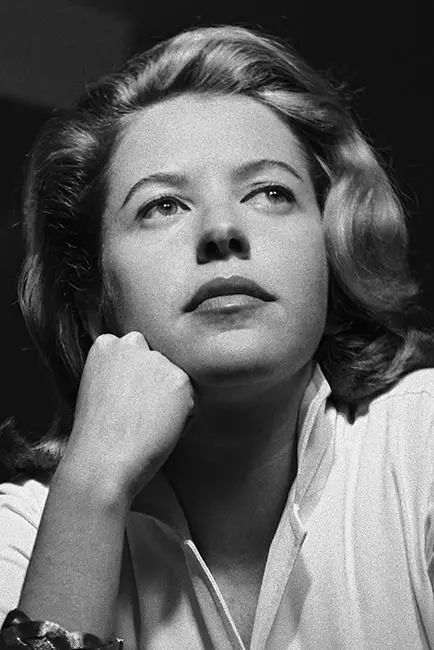
Hilda Hilst
1930–2004
· lived 73 years
 BR
BR
BR
Hilda Hilst was one of the most unique and transgressive voices in Brazilian literature. Her work, which moves between poetry, novels, and plays, is marked by a visceral exploration of sexuality, religiosity, death, and language itself, in a dense, dreamlike style of great lyrical intensity.
n. 1930-04-21, Jaú · m. 2004-02-04, Campinas
59
Views
Bio
Identification and basic context
Hilda Hilst, born Hilda Míriam Gonçalves Hilst, was a renowned Brazilian writer, known for her multifaceted work encompassing poetry, fiction, and theater. A unique figure in Brazilian literature, her writing is recognized for its thematic boldness and formal experimentation. She wrote in Portuguese.Childhood and education
Born in Jaú, in the interior of São Paulo, Hilda Hilst had a childhood marked by fragile health and an education that provided her with contact with music and literature. She graduated in Law from the University of São Paulo (USP), but soon dedicated herself entirely to her literary career. Her intellectual formation was largely self-taught, with vast literary and philosophical knowledge.Literary career
Hilda Hilst's literary career began in poetry, with the publication of "Outros Cantos" in 1961. Over the following decades, she expanded her range of genres, exploring novels, short stories, and plays. Her work is marked by a constant search for new forms of expression, challenging conventions and exploring the limits of language. She published in various literary magazines and anthologies, consolidating her position as one of the most original voices of her generation.Work, style, and literary characteristics
Hilda Hilst's work is complex and dense, characterized by the exploration of themes such as sexuality, desire, solitude, death, religiosity, madness, and the search for the transcendent. Her language is marked by intensity, visceral lyricism, and the fusion of the sacred and the profane, the erotic and the mystical. She uses resources such as metalanguage, fragmentation, repetition, and a rich, sometimes unusual vocabulary. Free verse predominates in her poetry, and in prose, she experiments with non-linear narrative structures. "Balada da Praia dos Cães" and "Da Morte. O Roteiro" are examples of her prose that blends fiction, essay, and lyricism. She is often associated with an aesthetic that flirts with existentialism and surrealism, but with a very distinct identity.Cultural and historical context
Hilda Hilst produced her work during a period of great transformations in Brazil, including the military dictatorship. Her transgressive stance and the boldness of her writing sometimes placed her in opposition to society and more conservative criticism. She belonged to a generation of writers who sought to renew Brazilian literature, engaging with international avant-gardes and exploring new themes and forms.Personal life
Hilda Hilst lived intensely, although her personal life was marked by periods of voluntary seclusion, especially at her home in Itu, where she founded the Hilda Hilst Cultural House. Her affective and family relationships, as well as her personal crises, often shine through in the intensity of her work. She maintained friendships with other writers and artists, but her uniqueness sometimes made her solitary in her creative journey.Recognition and reception
Although she faced difficulties in recognition and publication during her lifetime, Hilda Hilst is today widely considered one of the greatest Brazilian writers of the 20th century. Her work has received increasing critical and academic attention, being the subject of theses, books, and articles. She won several literary awards throughout her career, and her work is translated into various languages, indicating growing international recognition.Influences and legacy
Hilst was influenced by poets such as Fernando Pessoa, Cecília Meireles, and thinkers like Jean-Paul Sartre. Her legacy is immense, marked by the courage to explore the deepest corners of the human soul, by formal boldness, and by the ability to create an unmistakable poetic language. She has influenced generations of writers through her originality and creative freedom.Interpretation and critical analysis
Hilda Hilst's work has been interpreted from various perspectives, notably the analysis of her exploration of the relationship between body and spirit, the sacred and the erotic, and the human condition in its search for meaning. Her writing is seen as a testament to the complexity of existence, marked by anguish, desire, and transcendence.Curiosities and lesser-known aspects
A curiosity is the fact that she graduated in Law, although she never practiced the profession, preferring to dedicate herself entirely to literature. Her "house-studio" in Itu became a symbol of her creative seclusion and a space dedicated to culture. Her work "Da Morte. O Roteiro" was written during a period of intense personal crisis.Death and memory
Hilda Hilst passed away in 2004, in São Paulo, leaving an invaluable literary legacy. Her work continues to be studied, published, and to inspire new readers and writers, perpetuating her memory as one of the most powerful and original voices in Portuguese-language literature.Poems
0No poems found
Videos
50
Comments (0)
Log in
to post a comment.
No comments yet. Be the first to comment.