
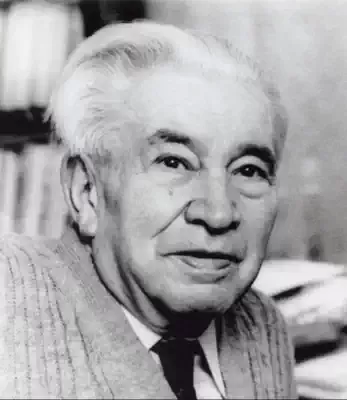
Jaroslav Seifert
 CZ
CZ
Jaroslav Seifert was a prominent Czech poet, writer, and journalist, awarded the Nobel Prize in Literature in 1984. His work is recognized for its lyricism, humanism, and its ability to capture the essence of Czech life and culture, often in times of great political adversity. Seifert navigated the complexities of the 20th century, expressing love for his homeland, its traditions, and its ordinary people, in poetry that became a symbol of cultural resistance and hope. With a style that combined the everyday with the sublime, and the personal with the universal, Seifert left a lasting legacy as one of the most important European poets, whose voice resonates through its authenticity and its deep connection to national identity.
n. 1901-09-23, Žižkov · m. 1986-01-10, Praga
Bio
Identification and Basic Context
Jaroslav Seifert was born in Prague, Austro-Hungarian Empire (present-day Czech Republic), in 1901, and passed away in the same city in 1986. He was a Czech poet, writer, journalist, and translator, widely regarded as one of his nation's greatest poets and a central figure of 20th-century Czech literature. He was awarded the Nobel Prize in Literature in 1984 for his poetic work which, "with every verse, with sensual freshness and invention, provides a liberating image of man's indomitable spirit and versatility."Childhood and Education
Seifert grew up in Žižkov, a working-class district of Prague, where daily life and its people shaped his sensibility. He attended high school, but his passion for literature and journalism led him to abandon formal studies to dedicate himself to writing. He was self-taught, absorbing influences from European poetry and the rich Czech literary tradition.Literary Career
Seifert began his literary career as a journalist and poet. He was an active figure on the Prague cultural scene, collaborating with various publications and becoming a prominent voice of his generation. His poetry evolved from an initial lyricism, influenced by surrealism and poetism (a Czech avant-garde movement), to a more introspective and reflective form, marked by the historical experiences he lived through. He was the editor of important newspapers and literary magazines, such as "Lidové noviny" and "Reflex."Work, Style, and Literary Characteristics
Seifert's work is vast, encompassing poetry, prose, essays, and memoirs. His most celebrated poetry collections include "Fatum," "Song about Prague," "The Ring of Coral," and "The Blind Angel." The central themes of his work are love, the city of Prague, memory, the beauty of everyday life, nature, and, above all, Czech identity and its preservation in times of oppression. His style is characterized by an accessible yet profound lyricism, with a masterful use of language, rhythm, and musicality. He often combined the trivial with the sublime, the concrete with the abstract, creating vivid and touching poetic images. He was associated with the "poetism" movement, valuing the joy of life, spontaneity, and art integrated into life.Work, Style, and Literary Characteristics
Cultural and Historical Context Seifert lived and wrote during a turbulent period in Czech history, marked by the First Republic, the Nazi occupation, the communist regime, and the Prague Spring. His work reflects the resilience and indomitable spirit of the Czech people. He was a subtle but firm critic of the restrictions imposed by censorship and political ideology, which sometimes led to persecution. He maintained relationships with other important Czech intellectuals and artists, being a central figure in literary and cultural circles.Work, Style, and Literary Characteristics
Personal Life Seifert's personal life was marked by political uncertainties and losses. He married twice and had one daughter. His personal experiences, his loves, his losses, and his deep connection to the city of Prague served as constant inspiration for his work. Professionally, he dedicated himself to journalism and writing, living largely off his literary production and editorial work.Work, Style, and Literary Characteristics
Recognition and Reception Jaroslav Seifert enjoyed broad recognition in Czechoslovakia and internationally. He was a revered figure during his lifetime, with his poetry being read and recited by many. The ultimate recognition came with the Nobel Prize in Literature in 1984, a historic achievement for Czech literature. His work is widely translated and studied, and he is considered one of the most important European poets of the 20th century.Work, Style, and Literary Characteristics
Influences and Legacy Seifert was influenced by French poetry (Apollinaire, Verlaine) and the Czech literary tradition. In turn, his work influenced generations of Czech poets and poets from other Slavic countries. His legacy lies in his ability to preserve and celebrate Czech cultural identity through poetry of great beauty and humanity, serving as a beacon of hope and artistic freedom in dark times.Work, Style, and Literary Characteristics
Interpretation and Critical Analysis Seifert's work is often analyzed from the perspective of his cultural resistance and humanism. His poetry is seen as an act of affirmation of national identity and freedom of expression, even under authoritarian regimes. Critics highlight his ability to find the universal in the particular and to give voice to the aspirations of ordinary people.Work, Style, and Literary Characteristics
Curiosities and Lesser-Known Aspects Seifert was known for his love of popular music, wine, and art. His writing habits were regular, but he was also known for his spontaneity and bohemian spirit. His memoirs, such as "All the Beauties of the World" (1982), offer fascinating insights into his life and the era in which he lived.Work, Style, and Literary Characteristics
Death and Memory Jaroslav Seifert passed away in Prague in 1986. His death was felt as a great loss to Czech culture. Posthumously, his work continued to be published and studied, solidifying his place as one of the greatest poets in world literature.Poems
0No poems found
Comments (0)
No comments yet. Be the first to comment.