
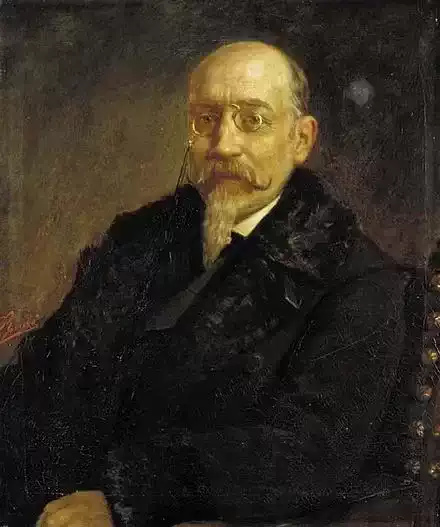
José Echegaray
 ES
ES
José Echegaray y Eizaguirre was a prominent Spanish playwright, novelist, and politician, whose work earned him the Nobel Prize in Literature in 1904. Recognized for his contribution to Spanish theater, Echegaray explored moral and social themes with an intense and often dark dramatic style. His plays, marked by passionate conflicts and ethical dilemmas, reflect the concerns of Spanish society of his time, addressing honor, duty, justice, and the consequences of human actions. As a public and intellectual figure, Echegaray played a significant role in Spain's political and cultural life. His vast literary production, which includes both theater and prose, solidified his position as one of the most important authors of the late 19th and early 20th centuries in Spain, influencing later generations of writers and artists.
n. 1832-04-19, Madrid · m. 1916-09-14, Madrid
Bio
Identification and Basic Context
José Echegaray y Eizaguirre (1832-1916) was a prominent Spanish playwright, novelist, mathematician, economist, and politician. He was born in Madrid and died in the same city. He is often known simply as José Echegaray. His family background, although not detailed here, placed him in a context that allowed him to receive a solid education. He was of Spanish nationality and wrote in the Castilian language.Childhood and Education
José Echegaray had a childhood marked by his father's illness, a doctor who introduced him to the love of reading and studies. He graduated in Civil Engineering and Mining, demonstrating a strong inclination for exact sciences and mathematics. This scientific training influenced his rational and, at times, logical approach to constructing his literary works and his professional life. He absorbed the ideals and intellectual environment of 19th-century Spain, a period of great political and cultural debates.Literary Career
Echegaray's literary career began late, as he first dedicated himself to mathematics and politics. His theater debut was with "El libro talonario" (1871), a play that brought him success and propelled him into a prolific career. Over time, his work evolved, exploring different facets of drama, but always with a distinctive mark of intensity and morality. His work encompassed plays, novels, and essays. He collaborated with various publications and was an active figure in the literary and intellectual circles of the time.Work, Style, and Literary Characteristics
Echegaray's major works include "El Gran Galeoto" (1881), "Mariucha" (1903), and "O Locio" (1912), among many others. The dominant themes in his work are honor, duty, love, jealousy, marriage, justice, revenge, and social criticism. His preferred form was drama, often structured in three acts, with a strong emotional charge and intense psychological conflicts. He used an engaging dramatic rhythm, with passionate dialogues and moments of great tension. The poetic tone is often elegiac or tragic, with a voice that reflects deep moral dilemmas. The language is elaborate, with a rich vocabulary and careful, sometimes grandiose, rhetorical construction. He introduced innovations in Spanish drama by exploring the psychology of characters and complex moral conflicts with greater depth. Echegaray engaged with the tradition of classic Spanish theater but also adapted it to the sensibilities and concerns of his time, being associated with the "thesis play" and, to some extent, "realist theater."Cultural and Historical Context
Echegaray lived in a period of intense political and social instability in Spain, including the Bourbon Restoration and its challenges. He was an influential intellectual, a member of the Royal Spanish Academy, and Minister of Public Instruction and Fine Arts. His literary generation faced the transition from Romanticism to Realism and Naturalism. His political stance was liberal, but his literary work often transcended mere pamphleteering, exploring universal dilemmas.Personal Life
José Echegaray had a multifaceted life. He was married and had children. He maintained an active political career, even becoming a minister. His literary friendships and rivalries were also notable in his time. His dedication to the arts and sciences, combined with his political activity, shaped his life and work, reflecting a commitment to progress and morality.Recognition and Reception
The pinnacle of Echegaray's recognition was the award of the Nobel Prize in Literature in 1904, "in recognition of his numerous and brilliant merits as a creator of Spanish art dramas." He was a celebrated figure during his lifetime, both in Spain and internationally, although his work also faced criticism, particularly from more avant-garde authors who considered his theater dated.Influences and Legacy
Echegaray was influenced by Shakespeare, Goethe, and classical tragedy. In turn, he significantly influenced Spanish theater, paving the way for greater psychological depth and the exploration of complex moral themes. His legacy lies in his ability to create impactful dramas and his contribution to the consolidation of modern Spanish national theater. His work continues to be studied and performed, forming an integral part of the Spanish literary canon.Interpretation and Critical Analysis
Echegaray's work has been interpreted as a reflection of the moral and social conflicts of late 19th-century Spain. Themes such as sexual repression, social hypocrisy, and the search for justice are central to his plays. His often pessimistic view of the human condition has been a subject of critical debate, comparing it to that of other European authors of the time.Curiosities and Lesser-Known Aspects
One curiosity is that, despite winning the Nobel Prize, his work fell into relative obscurity in the 20th century, only to be rediscovered by more recent studies. His period as Minister of Public Instruction and Fine Arts demonstrates his direct involvement in promoting culture.Death and Memory
José Echegaray died in Madrid in 1916. After his death, several of his works were published and continued to be performed, keeping alive his memory as one of the great names in Spanish theater.Poems
0No poems found
Videos
50
Comments (0)
No comments yet. Be the first to comment.