
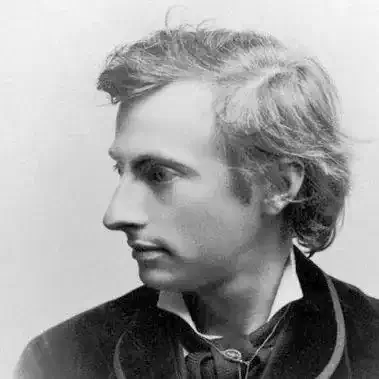
Karl Adolph Gjellerup
 DK
DK
Karl Adolph Gjellerup was a Danish writer, awarded the Nobel Prize in Literature. His work, deeply influenced by Buddhism and Eastern philosophy, explores the search for spiritual truth and the connection between the individual and the cosmos. Gjellerup is recognized for his erudite prose and his reflections on the human condition, evolution, and the nature of reality. His literary journey began with naturalism, but evolved into a spirituality that led him to abandon Western conventions in search of a deeper understanding of the universe. His later work, written in German, reflects this transcendence and his admiration for Asian culture.
n. 1857-06-02, Roholte · m. 1919-10-13, Klotzsche
Bio
Identification and basic context
Karl Adolph Gjellerup (born Karl Adolph von Gjellerup) was a Danish writer, awarded the Nobel Prize in Literature in 1917. He was born on June 2, 1857, and died on October 11, 1919. His family background was relatively humble, the son of a customs official, but with ties to an old family of jurists and clergymen. His intellectual formation and life experiences shaped him into a transitional figure between naturalism and profound spirituality.Childhood and education
Karl Adolph Gjellerup was born in Rogeløkke, a suburb of Copenhagen. His father died when he was young, leaving him under the guardianship of an uncle. Gjellerup studied theology at the University of Copenhagen, but quickly moved away from orthodox religion, developing a strong interest in naturalism and the ideas of Charles Darwin. His early readings included works by Shakespeare, Goethe, and the German romantics, as well as contemporary naturalists like Georg Brandes. Contact with evolutionary theories was a turning point in his formation, moving him away from traditional religious faith and closer to a more scientific and philosophical view of the world.Literary career
Gjellerup's literary career began with naturalism. His first published work, the novel "En Vinterdag" (A Winter's Day), in 1878, still reflected the influences of realism and naturalism. However, his dissatisfaction with the limitations of materialism and his growing search for spiritual meaning led him to gradually distance himself from these currents. From the 1880s onwards, his work began to manifest a growing spirituality, influenced by Eastern philosophies, especially Buddhism. This transition marked a significant evolution in his style and the themes he addressed. Gjellerup collaborated with literary newspapers and magazines of the time, and his work evolved from naturalism to Eastern mysticism.Work, style, and literary characteristics
Gjellerup's main works include "Antigon" (1884), "Mennesket uden Sjæl" (The Man without a Soul, 1890), "Det højeste Væsen" (The Supreme Being, 1890), and his most famous works in German, "Der erobrer" (The Conqueror, 1902) and "Pilgrimmen Kamanita" (The Pilgrim Kamanita, 1910). The dominant themes in his work are the search for spiritual truth, evolution, the relationship between the individual and the universe, and the transcendence of the ego. His style is erudite, reflective, and, in his later works, markedly orientalist. He frequently uses allegories and symbols to express complex philosophical and spiritual concepts. His language, especially in German, becomes denser and more introspective, reflecting his spiritual journey. Gjellerup is associated with a personal quest for truth, transcending the limits of the literary movements of his time, although he began in naturalism.Cultural and historical context
Gjellerup lived during a period of great transformations in Europe, marked by scientific advancements, philosophical revolutions, and a growing interest in Eastern cultures. He was part of the generation of Danish writers who emerged after the golden age of Danish literature, and he engaged with figures like Georg Brandes, although he followed a distinct spiritual path. His philosophical position distanced him from the prevailing scientific materialism, seeking a synthesis between science and spirituality. His work reflects a dialogue with evolutionary ideas, but recontextualizes them within a pantheistic and Buddhist view.Personal life
Gjellerup's personal life was marked by an intense inner quest. He married the opera singer Eugenia Preumayer, and his relationship with her, as well as his exploration of the arts, influenced his thinking. Gjellerup suffered from health problems throughout his life, which may have intensified his search for solace and spiritual meaning. Professionally, he lived off his writing, although with financial difficulties at certain periods. His spiritual beliefs evolved significantly, culminating in his deep immersion in Buddhism and Eastern thought, which led him to live in various parts of Europe and eventually reside in Germany and Switzerland.Recognition and reception
Although Gjellerup was a respected writer in Denmark, his international recognition was consolidated late. The Nobel Prize in Literature in 1917 was a recognition of his originality and the depth of his spiritual reflections, although it was a controversial award for some, given his lesser-known work compared to other candidates. His critical reception varied over time, with some criticizing his more spiritualist work as overly abstract, while others praised it for its depth and originality.Influences and legacy
Gjellerup was influenced by authors such as Shakespeare, Goethe, Spinoza, and Eastern thinkers like Buddha. His work, in turn, influenced a generation of writers who sought a spiritual path in literature, especially those interested in Buddhism and Eastern philosophy. His legacy lies in his pioneering attempt to integrate Western and Eastern thought, and in his exploration of evolution as a cosmic and spiritual process. His work has been translated into several languages, although with greater dissemination after the Nobel Prize.Interpretation and critical analysis
Gjellerup's work is often interpreted as a spiritual journey in search of enlightenment and the understanding of the unity of all things. Central philosophical themes include the nature of consciousness, the concept of karma, evolution as a cosmic process, and the overcoming of the ego. His work represents an attempt to reconcile science with spirituality, which generated critical debates about the validity of his philosophical syntheses.Curiosities and lesser-known aspects
A curiosity about Gjellerup is his conversion to Buddhism, which was not just an adoption of beliefs but a profound reorientation of his life and work. His writing in German, especially in his later works, demonstrates a mastery of the language that made him recognized in that sphere as well. His financial difficulties at times contrasted with the richness of his ideas and the depth of his spiritual quest.Death and memory
Karl Adolph Gjellerup died in Klotzschen, near Dresden, Germany, in 1919. His death occurred after a long period of declining health. His memory endures mainly through his recognition as a Nobel laureate, and for his pioneering work in fusing Western philosophy with Eastern thought, paving the way for future spiritual explorations in literature.Poems
0No poems found
Comments (0)
No comments yet. Be the first to comment.