
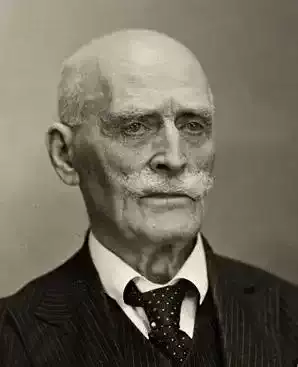
Knut Hamsun
 NO
NO
Knut Hamsun was a prominent Norwegian writer, awarded the Nobel Prize in Literature in 1920, whose works explore the human psyche with unique intensity and innovative style. His writing is marked by the exploration of themes such as alienation, poverty, madness, and man's relationship with nature, often through tormented and marginal characters. Hamsun is recognized for significantly influencing literary modernism, especially through his stream-of-consciousness technique and his penetrating gaze into the complexities of existence. Despite his literary brilliance, his figure is also marked by controversies due to his sympathies for the Nazi regime, an aspect that raises complex debates about art and the artist.
n. 1859-08-04, Vågå · m. 1952-02-19, Grimstad
Bio
Identification and basic context
Knut Hamsun, born Knud Pedersen, was one of the most important and influential Norwegian writers of the late 19th and early 20th centuries. He adopted the pseudonym Hamsun, the name of a village where he spent part of his childhood. He was born in Vågå, Norway, on August 4, 1859, and died in Nørholm, Norway, on February 19, 1952. Originating from a family of farmers with economic difficulties, his social class of origin and the rural cultural context profoundly shaped his worldview and his work. Hamsun was a Norwegian citizen and wrote predominantly in Norwegian.Childhood and education
Hamsun's childhood was marked by poverty and a strict family environment. Raised on an isolated farm in Hamarøy, in northern Norway, he attended few formal schools and was largely self-taught. His early readings included the Bible, folk tales, and romantic literature. His education was also influenced by readings of philosophers such as Schopenhauer and Nietzsche, and by Rousseau's ideas on the state of nature. Significant events in his youth include his leaving home at 17 and his first experiences of precarious work and travel.Literary career
Hamsun began writing early, but his literary recognition came later. His literary career can be divided into several phases, noting an evolution from romanticism to psychological realism and, subsequently, to a more existential and critical approach. The publication of "Hunger" (Sult) in 1890 marked his great breakthrough. He collaborated in various publications and anthologies. He was also a literary and theater critic, and dedicated himself to translation.Work, style, and literary characteristics
Hamsun's main works include "Hunger" (1890), "Mysteries" (1892), "Pan" (1894), "Victoria" (1898), "Beneath the Autumn Star" (1906), "A Wanderer Plays a Muted String" (1909), and "The Road Leads On" (1910). Dominant themes in his work are solitude, alienation, poverty, madness, decay, man's relationship with nature, and criticism of modern society. His style is marked by formal experimentation, especially the use of stream of consciousness, allowing direct access to the thoughts and feelings of his characters. He uses vivid and imagistic language, with a frequently lyrical, melancholic, and sometimes ironic tone. Hamsun is considered a precursor of literary modernism and profoundly influenced writers such as James Joyce, Ernest Hemingway, and Franz Kafka.Work, style, and literary characteristics
Cultural and historical context Hamsun lived in a time of great transformations in Europe, including the decline of romanticism and the emergence of new currents such as naturalism and symbolism, which he, in turn, helped to transcend. His works reflect the social and cultural tensions of Norway in transition to modernity. Although initially critical of materialism and industrialization, his political positions became more complex and controversial in the 1930s and 1940s, when he expressed sympathy for the Nazi regime, a fact that tarnished his legacy.Work, style, and literary characteristics
Personal life Hamsun married twice. His first wife was Bergljot Bech, with whom he had a daughter. Later, he married Marie Andersen, with whom he had four children. His family and personal relationships were complex and sometimes conflicted. He was a man of strong and passionate temperament, which was reflected in his interactions and also in his work. Professionally, he lived from his writing and other literary activities. His philosophical beliefs, influenced by Nietzsche, evolved throughout his life.Work, style, and literary characteristics
Recognition and reception Knut Hamsun received the Nobel Prize in Literature in 1920 "for his monumental work 'Growth of the Soil'". He was widely recognized in Norway and internationally as one of the great innovators of modern prose. However, his reputation suffered a significant blow due to his pro-Nazi political positions during World War II, which led to a trial and a fine after the war. Academic recognition of his work today coexists with the debate about his political alignment.Work, style, and literary characteristics
Influences and legacy Hamsun was influenced by authors such as Dostoevsky, Strindberg, and Poe. His legacy is immense, having influenced generations of modernist and postmodernist writers worldwide with his narrative technique and his profound psychological exploration. He firmly entered the world literary canon. His work continues to be translated and studied, although his figure remains an object of critical debate due to his political controversies.Work, style, and literary characteristics
Interpretation and critical analysis Hamsun's work is often analyzed from the perspective of psychology and existential philosophy. His characters, often in conflict with society and themselves, offer fertile ground for interpretation on themes such as freedom, isolation, and the search for identity. Critical debate about Hamsun often centers on the complex relationship between his literary genius and his extremist political views.Work, style, and literary characteristics
Curiosities and lesser-known aspects A curious aspect is the contradiction between his work, which sometimes criticizes society and progress, and his later admiration for authoritarian figures. Hamsun was known for being a passionate farmer and for his rural life in Nørholm, where he tried to create an isolated and self-sufficient life. His writing habits were intense, dedicating long periods to literary creation. Manuscripts and correspondence reveal the depth of his reflections and, at times, his volatile personality.Work, style, and literary characteristics
Death and memory Knut Hamsun died at the age of 92 in Nørholm. After the war, his reputation was tarnished by his political connections, but his literary work continued to be recognized for its artistic and innovative value. Posthumous publications and studies on his life and work continue to emerge, seeking to balance the appreciation of his literary genius with criticism of his political choices.Poems
0No poems found
Quotes
2
Videos
50
Comments (0)
No comments yet. Be the first to comment.