
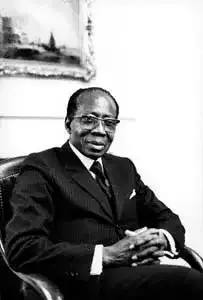
Léopold Sédar Senghor
 SN
SN
Léopold Sédar Senghor was a Senegalese poet, writer, and politician, known as one of the greatest African intellectuals of the 20th century. He was one of the founders of the Négritude movement, which celebrated African cultural identity and black heritage. His poetic work is marked by a profound musicality, influences from African oral tradition and French poetry, exploring themes such as the homeland, African identity, love, and spirituality. Senghor played a crucial role in Senegal's independence and became its first president, leading the country for more than two decades. As a statesman, he promoted cultural cooperation between Africa and Europe and advocated for a vision of universal civilization. His vast literary work and political legacy make him an unavoidable figure in the history of Africa and world literature.
n. 1906-10-09, Joal-Fadiout · m. 2001-12-20, Verson
Bio
Identification and basic context
Léopold Sédar Senghor was a Senegalese poet, writer, politician, and statesman. He was born on October 9, 1906, in Joal, Senegal, and died on December 20, 2001, in Verson, France. He was one of the most influential African intellectuals of the 20th century and one of the main promoters of the cultural and ideological Négritude movement. He was the first president of Senegal, a position he held from 1960 to 1980. Senghor wrote predominantly in French, but his work is deeply rooted in African culture and languages. The historical context in which he lived was that of the decolonization of Africa and the affirmation of African identity on the world stage.Childhood and education
Senghor was born into a Christian Serer family, in a region where Islam was predominant. His family background, although from an African ethnic group with a strong cultural identity, was part of a colonial society marked by social and cultural tensions. He received his primary education in a Catholic school and later attended high school in Dakar, where he excelled academically. In 1928, he left for Paris to pursue his studies at the Sorbonne, where he obtained a degree in Literature. During his studies in France, he absorbed influences from classical French literature, Symbolist and Surrealist poetry, and existentialist philosophical thought. It was in Paris that he met Aimé Césaire and Léon-Gontran Damas, with whom he would go on to found the Négritude movement.Literary career
Senghor's writing began in his youth, but it was in Paris, during the 1930s, that his literary career consolidated. He published his first poems in French literary journals, such as *Esprit*. His work evolved over time, passing through different phases, but always maintaining a strong connection with African identity and its cultural heritage. His main poetic works include "Chants d'ombre" (1945), "Hosties noires" (1948), "Éthiopiques" (1956), and "Paroles poétiques" (1961). In addition to poetry, Senghor was also an essayist and politician, and his literary activity was intrinsically linked to his fight for independence and the affirmation of Africa.Work, style, and literary characteristics
Senghor's work is characterized by the celebration of the beauty and richness of African culture, the exploration of black identity, love, the homeland, and spirituality. Dominant themes include the African diaspora, homesickness, reconciliation between Africa and the West, and the affirmation of human dignity. Formally, Senghor combined elements of traditional African poetry, with its musicality and orality, with Western poetic forms, such as free verse and, at times, the sonnet. He prominently used poetic devices such as metaphor, rhythm, and musicality, creating a dense and imagistic language. The tone of his poetry is often lyrical, elegiac, and sometimes epic, conveying a poetic voice that is simultaneously personal, universal, and deeply rooted in his African identity. His language is erudite, yet accessible, and his style seeks harmony and beauty. Senghor is associated with the Négritude movement, but he also engaged with Surrealism and Modernism.Cultural and historical context
Léopold Sédar Senghor lived in a crucial period of history, marked by World War II, the anti-colonial struggle, and the decolonization of Africa. As a politician, he was a central figure in the struggle for Senegal's independence and one of the main exponents of pan-Africanism. He belonged to a generation of African intellectuals who sought to define and affirm African cultural identity in the face of colonial domination. His work reflects the tensions and dialogues between African and Western culture, and his political stance was always to defend the dignity and equality of African peoples. His relationship with other writers and intellectuals of the time, such as Aimé Césaire and Léon-Gontran Damas, was fundamental to the development of the Négritude movement. His influence extended beyond literature, impacting African politics and diplomacy.Personal life
Senghor's personal life was marked by his dedication to writing, politics, and family. He married three times and had children, who were a source of inspiration. His friendships with other intellectuals and artists were important for his development and the evolution of his ideas. Senghor was a man of deep faith and spirituality, which is reflected in his work. His political career demanded great personal sacrifices, but he always managed to balance his responsibilities as a statesman with his passion for poetry.Recognition and reception
Léopold Sédar Senghor received vast national and international recognition. He was awarded numerous prizes and distinctions, including the Grand Prize for French Language from the Académie Française and the Goethe Prize. His poetic work has been translated into several languages, and he is considered one of the greatest French-language poets of the 20th century. His popularity as a political leader contributed to the dissemination of his literary work, and his academic recognition is undeniable. He was elected to the Académie Française in 1983, becoming the first African to join this prestigious institution.Influences and legacy
Senghor was influenced by classical and modern French poetry, particularly by poets such as Baudelaire, Rimbaud, and the Surrealists. He also drew influences from African oral tradition and African philosophy. His legacy is immense, both in literature and politics. Négritude, the movement he helped found, had a profound impact on the affirmation of African identity and the fight against racism. African and black diaspora poets and writers who succeeded him were influenced by his work and thought. Senghor is considered one of the founders of modern African literature, and his work continues to be studied and to inspire new generations.Interpretation and critical analysis
Senghor's work has been the subject of numerous critical interpretations. Some analyze it from the perspective of Négritude, highlighting its importance in affirming black identity. Others focus on its universalist dimension, on his search for a world civilization that integrates different cultures. His relationship with France and Western culture has also been a recurring theme of analysis, exploring the complexity of his identity and his work. His political positions and his relationship with power have also generated debates.Curiosities and lesser-known aspects
Beyond his role as a poet and statesman, Senghor was also passionate about music and the arts. He had a deep knowledge of African and European culture. A curiosity is that, despite being the first president of Senegal, he always maintained a strong connection with his native village, Joal. His writing habits were regular, dedicating time to poetry even during his presidential terms. There are records that he wrote in notebooks, sometimes by hand, and that he revised his poems with great care.Death and memory
Léopold Sédar Senghor passed away peacefully at his residence in Verson, France, in 2001, at the age of 95. His death was mourned worldwide, especially in Africa. After his death, his work continued to be published and studied. His memory is celebrated through institutions, awards, and events that bear his name, perpetuating his legacy as a poet, intellectual, and political leader.Poems
0No poems found
Quotes
2Comments (0)
No comments yet. Be the first to comment.