
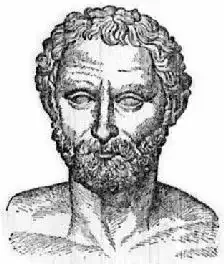
Marcial
40–104
· lived 63 years
 ES
ES
ES
Martial was a Hispano-Roman poet known for his satirical and irreverent epigrams, which offered a vivid and often comical glimpse into daily life in Imperial Rome. His work is celebrated for its keen observation, biting irony, and masterful use of language, addressing themes such as love, marriage, social hypocrisy, and the pursuit of wealth. His concise and impactful epigrams continue to entertain and provoke reflection, serving as an invaluable source for the study of Roman society and human nature.
n. 0040-03-01, Augusta Bilbilis · m. 0104, Augusta Bilbilis
38
Views
Bio
Identification and basic context
Marcus Valerius Martialis, known as Martial, was a Hispano-Roman poet. He was born in the Roman province of Hispania Tarraconensis (modern-day Spain).Childhood and education
Martial received an education typical of the Roman elite, studying rhetoric and literature. He spent a significant part of his youth in Rome, where he sought patrons and opportunities for his literary career.Literary career
Martial's literary career is intrinsically linked to his production of epigrams. He arrived in Rome around 64 AD and, after years of financial difficulties and seeking patrons, achieved some recognition and success. He published several books of epigrams, which became his trademark.Work, style, and literary characteristics
Martial's work consists almost entirely of epigrams, short, satirical poems that comment on the social, political, and personal life of ancient Rome. His style is characterized by wit, irony, often sharp humor, and precision of language. He addresses themes such as marriage, hypocrisy, old age, vanity, politics, and the customs of the time. Martial is a master of the *punchline*, ending many of his poems with a witty and surprising observation. His language is colloquial yet refined, and he uses a wide range of meters, although the elegiac couplet is the most common.Work, style, and literary characteristics
Cultural and historical context Martial lived during the height of the Roman Empire, under the rule of emperors such as Domitian, Nerva, and Trajan. His work offers a vivid and often critical portrait of Roman society of that era, including its vices, virtues, and contradictions. He frequented the literary circles of the capital and interacted with other prominent figures, but also depended on the patronage of wealthy Romans.Work, style, and literary characteristics
Personal life Little is known about Martial's personal life. He depended on patrons for survival and, although he achieved some fame, he never seems to have accumulated great wealth. There are indications that he had some relationships, but details are scarce. His work is full of observations about human relationships, but his own private life remains largely a mystery.Work, style, and literary characteristics
Recognition and reception During his lifetime, Martial gained considerable recognition in Rome, being read and admired by his contemporaries. His work was popular and influential. After his death, his epigrams continued to be read and studied, maintaining their relevance through the centuries as a document of Roman life and a model of satire.Work, style, and literary characteristics
Influences and legacy Martial profoundly influenced the Western tradition of the epigram. His work served as a model for satirical and humorous poets in different eras, from the Middle Ages to modern times. His ability to condense insightful observations into short, impactful verses is a lasting legacy.Work, style, and literary characteristics
Interpretation and critical analysis Martial's work is often analyzed as a mirror of Roman society, revealing its moral and social complexities. Modern criticism highlights his skill in portraying the human condition with humor and realism, and his contribution to the development of satire as a literary genre.Work, style, and literary characteristics
Curiosities and lesser-known aspects Martial was known for his wit and his ability to observe the details of daily life. Despite his literary output, he always struggled to establish himself financially, depending on the generosity of others. His poems offer a glimpse into the concerns and pleasures of ancient Rome.Work, style, and literary characteristics
Death and memory Martial returned to his homeland, Hispania, in his final years, where he passed away. His memory endures through his epigrams, which continue to be studied and appreciated for their literary quality and historical value.Poems
0No poems found
Quotes
12Comments (0)
Log in
to post a comment.
No comments yet. Be the first to comment.