
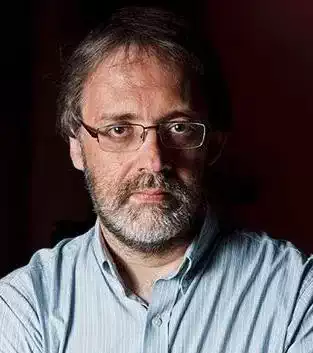
Marco Lucchesi
b. 1963
 BR
BR
BR
Marco Lucchesi is a Brazilian poet, translator, and essayist, recognized for his poetic work that explores the relationship between word and image, memory and time, and the sacred in everyday life. With a dense and imagistic language, Lucchesi has been one of the most important names in contemporary Portuguese-language poetry, receiving several awards and being translated into various languages. He is currently a member of the Brazilian Academy of Letters.
n. 1963-12-09, Rio de Janeiro
49
Views
Bio
Identification and basic context
Marco Lucchesi was born in Rio de Janeiro, Brazil. He is a poet, essayist, translator, and university professor. He is a member of the Brazilian Academy of Letters, where he occupies Chair 23. His work is part of the context of contemporary Brazilian poetry, marked by the search for new forms of expression and reflection on language, memory, and human experience.Childhood and education
Lucchesi graduated in Literature from the Federal University of Rio de Janeiro (UFRJ) and obtained a master's and doctorate in Literary Theory from the Pontifical Catholic University of Rio de Janeiro (PUC-Rio). His academic background, combined with a deep interest in philosophy and visual arts, shaped his intellectual journey and literary production.Literary career
He began his literary career with the publication of poetry books that quickly attracted attention for their originality and imagistic strength. In addition to his poetic work, Lucchesi has extensive experience as a translator, having rendered works by authors such as Rainer Maria Rilke, Friedrich Nietzsche, and William Shakespeare into Portuguese. He is also the author of several essays on literature, philosophy, and arts.Work, style, and literary characteristics
Marco Lucchesi's poetry is marked by density, musicality, and the exploration of the relationship between the verb and the image. His poems often address themes such as memory, time, finitude, the body, the city, and the sacred. The language is precise and evocative, constructing a universe of profound sensitivity and existential questioning. Notable works include "O Óbvio Ululante", "A Última Porta", and "Diante de Tudo". He experiments with poetic form, mixing free verse with more traditional structures, and demonstrates an impressive command of the Portuguese language.Work, style, and literary characteristics
Cultural and historical context Marco Lucchesi emerged on the Brazilian literary scene during a period of renewal and diversity, engaging with different strands of contemporary poetry. His work connects with discussions about Brazilian identity, cultural memory, and the social and technological transformations of the current world. He is a prominent figure on the Brazilian intellectual scene, actively participating in debates about literature, culture, and education.Work, style, and literary characteristics
Personal life Little is publicly known about Marco Lucchesi's personal life, as he tends to maintain a discreet profile. His dedication to writing, translation, and university teaching appears to be the center of his life.Work, style, and literary characteristics
Recognition and reception Marco Lucchesi is widely recognized in Brazilian and international literary circles. He has received several important awards, such as the Jabuti Prize and the Oceanos Prize for Literature in Portuguese. His work has been the subject of academic study and is translated into various languages, attesting to its reach and relevance.Work, style, and literary characteristics
Influences and legacy His work shows influences from poets such as Fernando Pessoa, Carlos Drummond de Andrade, João Cabral de Melo Neto, and Rainer Maria Rilke. Lucchesi's legacy lies in his ability to renew Portuguese-language poetry with sophisticated language and a profound reflection on the human condition. His poetry is an invitation to contemplation and a dive into the complexities of existence.Work, style, and literary characteristics
Interpretation and critical analysis Critics highlight Lucchesi's ability to combine formal rigor with a deep exploration of the unconscious and subjectivity. His poetry is seen as a mirror of the anxieties and aspirations of contemporary man, but also as a space for transcendence and beauty.Work, style, and literary characteristics
Curiosities and lesser-known aspects In addition to his activity as a poet and essayist, Lucchesi is known for his work as an art exhibition curator and for his passion for engravings and antique objects, which often inspire his writing.Work, style, and literary characteristics
Death and memory (Not applicable, as the author is alive).Poems
0No poems found
Comments (0)
Log in
to post a comment.
No comments yet. Be the first to comment.