
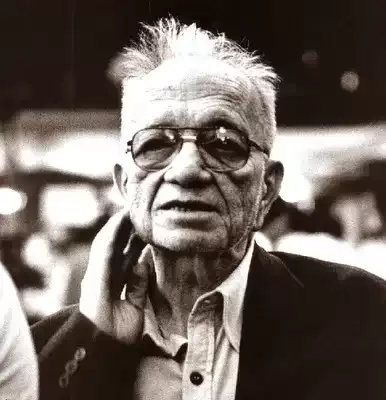
Mário Quintana
1906–1994
· lived 87 years
 BR
BR
BR
Mário Quintana was a Brazilian poet, journalist, and translator, known for his lyrical, accessible, and tender poetry. His work, often marked by apparent simplicity and a melancholic and ironic gaze at everyday life, addresses themes such as time, memory, childhood, and the small joys and sorrows of life. His poetry invites reflection on the human condition with a gentle and accessible tone.
n. 1906-07-30, Alegrete · m. 1994-05-05, Porto Alegre
128
Views
Bio
Identification and basic context
Mário de Miranda Quintana, known as Mário Quintana, was one of the most important Brazilian poets of the 20th century. He was born in Alegrete, Rio Grande do Sul, and died in Porto Alegre. His work is intimately linked to the Gaúcho culture and the deep Brazil. He wrote predominantly in Portuguese.Childhood and education
The son of a pharmacist, Mário Quintana had a childhood marked by the tranquility of the Rio Grande do Sul countryside. He did not attend university but was a voracious autodidact, developing vast literary and cultural knowledge through reading. His education was essentially literary and informal, shaped by his sensitivity and keen observation of the world.Literary career
Quintana began his literary career early, publishing his first book, "A Rua dos Cataventos" (The Street of Windmills), in 1940. Throughout his life, he published more than twenty books of poetry, as well as short stories, chronicles, and translations. He worked as a journalist for several newspapers, such as "O Estado de São Paulo" and "Correio do Povo," and also as a translator of classic and contemporary works.Work, style, and literary characteristics
Mário Quintana's poetry is recognized for its delicacy, lyricism, and apparent simplicity. Recurring themes include the passage of time, the fleetingness of life, memory, lost childhood, loneliness, love, and death. He uses clear and accessible language, often with a touch of melancholy, irony, and humor. Free verse and fixed form coexist in his work, but what stands out most is his ability to find the universal in the particular and the poetic in the everyday. "Poesia Completa" (Complete Poetry), "O Caderno H" (Notebook H), and "Apontamentos de Viagem" (Travel Notes) are some of his most significant works.Cultural and historical context
Mário Quintana lived and produced most of his work in the 20th century, a period of great transformations in Brazil and the world. Although he maintained a more reserved stance regarding the major political and literary movements of the time, his work dialogues with the Brazilian lyrical tradition and, in a way, with the modernist spirit, through his search for a language closer to spoken language and his approach to everyday themes.Personal life
Quintana was known for his shyness and reclusiveness. His personal life was marked by dedication to literature and a certain detachment from the outside world. He never married or had children. His house in Porto Alegre became a landmark for friends and admirers of his work.Recognition and reception
Quintana achieved great popularity with the public, who identified with his sensitive and accessible poetry. Although he was a poet admired and respected by critics, he did not always receive the institutional recognition that his work deserved. However, he is today considered one of the great names in Brazilian poetry.Influences and legacy
He was influenced by poets such as Fernando Pessoa, Manuel Bandeira, and Cecília Meireles. His legacy lies in his ability to touch the reader with poetry that, despite its apparent simplicity, contains profound reflections on life and human existence. His work continues to be rediscovered and appreciated by new generations of readers.Interpretation and critical analysis
Quintana's poetry is often interpreted as a mirror of the human soul, with its joys and sorrows. His approach to the passage of time and mortality is marked by serene acceptance, but also by a tender melancholy. His work invites a reading that values emotion and contemplation.Curiosities and lesser-known aspects
Quintana was known for his love of animals, especially cats, who frequently appear in his work. He also developed a fascination for antique objects and the aesthetics of the "old guard." He had the habit of jotting down ideas and verses in small notebooks he carried with him.Death and memory
Mário Quintana passed away at the age of 87 in Porto Alegre. His death was widely reported and lamented. His memory is celebrated through the preservation of his work, his house in Porto Alegre which became a memorial, and the continued popularity of his poetry among Brazilians.Poems
0No poems found
Comments (0)
Log in
to post a comment.
No comments yet. Be the first to comment.