Identification and basic context
Maya Angelou, born Marguerite Annie Johnson, was an American poet, memoirist, and civil rights activist. She was born on April 4, 1928, in St. Louis, Missouri, and died on May 28, 2014, in Winston-Salem, North Carolina. She had a brother, Bailey Jr. Her parents were Vivian Baxter and Bailey Johnson Sr. Angelou came from a middle-class background and experienced the harsh realities of racism and segregation in the American South. She was an American citizen and wrote in English. Her life spanned significant periods of American history, including the Civil Rights Movement and the ongoing struggle for racial equality.
Childhood and education
Angelou's childhood was marked by significant trauma, including the separation of her parents and a period of mutism following sexual abuse. She spent much of her childhood in Stamps, Arkansas, raised by her paternal grandmother, Annie Henderson, known as 'Momma,' who instilled in her strong values and a sense of pride. She also lived in California. Angelou attended high school and pursued further education informally, working various jobs, including as a cook, singer, dancer, journalist, and cable car conductor, before dedicating herself to writing.
Literary trajectory
Angelou's literary career began with her autobiography, 'I Know Why the Caged Bird Sings' (1969), which achieved international acclaim and became a landmark work. She went on to write numerous other autobiographies, poetry collections, and essays. Her poetry, known for its lyrical quality and powerful social commentary, became widely popular. She was a significant voice in the Civil Rights Movement, working with Martin Luther King Jr. and Malcolm X. She also worked in theater and television.
Works, style, and literary characteristics
Key works include the autobiographical series starting with 'I Know Why the Caged Bird Sings' (1969), and poetry collections such as 'Just Give Me a Cool Drink of Water, Run On' (1971) and 'And Still I Rise' (1978). Dominant themes in her work are racism, identity, motherhood, the resilience of the human spirit, the importance of community, and the quest for freedom and self-love. Her style is often described as accessible, musical, and deeply personal, blending vernacular speech with eloquent prose and verse. Her poetic voice is strong, compassionate, and authoritative, often speaking from the perspective of the marginalized. Her language is vivid and rich, employing metaphor and rhythm to convey profound emotion and insight.
Cultural and historical context
Angelou's life and work were profoundly shaped by the racial segregation and discrimination prevalent in the United States. She was an active participant in the Civil Rights Movement, using her voice and writing to advocate for equality and justice. She was a contemporary of many influential figures of the 20th century, including James Baldwin, Martin Luther King Jr., and Rosa Parks. Her work reflects the Black American experience and its ongoing struggle for recognition and liberation.
Personal life
Angelou experienced a rich and varied personal life. She was married four times and had one son, Guy Johnson. Her relationships with significant figures like Martin Luther King Jr. and Malcolm X were pivotal to her activism. She traveled extensively and lived abroad, including in Egypt and Ghana. Her personal experiences of hardship, joy, love, and loss are woven into the fabric of her writings, lending them authenticity and emotional depth.
Recognition and reception
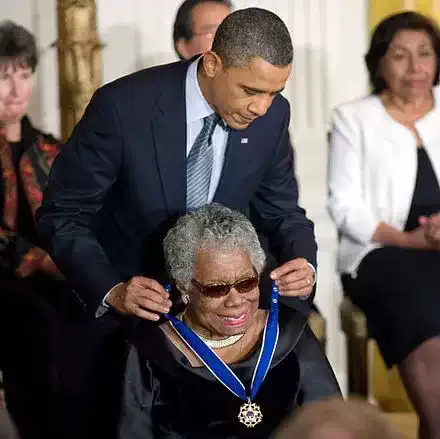
Angelou received numerous awards and honors throughout her career, including the Presidential Medal of Freedom and dozens of honorary doctorates. 'I Know Why the Caged Bird Sings' became a bestseller and a classic of American literature. Her work has been widely celebrated for its literary merit and its social impact, though it has also faced censorship challenges due to its frank discussions of race and sexuality.
Influences and legacy
Angelou cited authors like Langston Hughes, William Shakespeare, and the Bible as influences. Her legacy is that of a powerful storyteller and a courageous advocate for human rights. She inspired millions with her message of hope and resilience, and her writings continue to be read and studied globally. She is remembered as a pivotal figure in African American literature and a testament to the power of the spoken and written word.
Interpretation and critical analysis
Angelou's work is often analyzed for its exploration of the Black female experience, its themes of trauma and healing, and its celebration of resilience. Critics have noted the intersectionality of race, gender, and class in her writings. Her ability to transform personal pain into universal messages of hope is a consistent subject of critical discussion.
Curiosities and lesser-known aspects
Angelou's diverse career included performing in Broadway shows, singing jazz, and working as a journalist in Egypt and Ghana. Her ability to recall vast amounts of literature verbatim, developed during her childhood mutism, was a remarkable feat. She was also known for her distinctive fashion sense and her warm, engaging public persona.
Death and memory
Maya Angelou died peacefully at her home in Winston-Salem, North Carolina. Her death was mourned globally, and her legacy continues to be celebrated through her extensive body of work and her enduring influence on literature and social justice movements.