
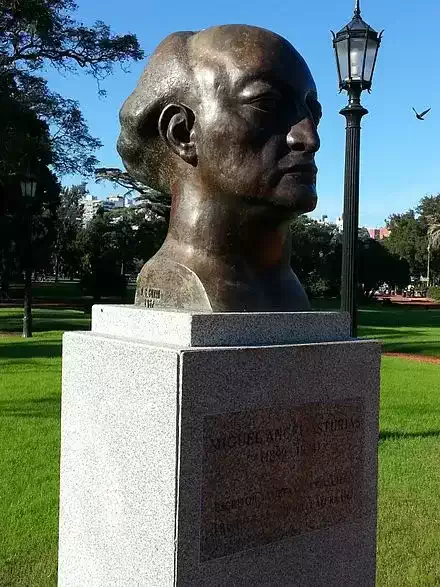
Miguel Ángel Asturias
 GT
GT
Miguel Ángel Asturias was a Guatemalan writer, awarded the Nobel Prize in Literature in 1967. His work is deeply rooted in the traditions, myths, and social realities of Guatemala and Latin America. Through poetic and innovative language, Asturias explored themes such as cultural identity, oppression, social injustice, and the relationship between the indigenous and Western worlds. He is considered one of the pioneers of magical realism in Latin American literature, influencing generations of writers. With a life marked by political activism and exile, Asturias dedicated his writing to giving voice to the marginalized and denouncing the power structures that oppressed indigenous peoples and the working classes. His literary contribution is fundamental to understanding the complex social and cultural reality of Central America, leaving a lasting legacy in universal literature.
n. 1899-10-19, Cidade da Guatemala · m. 1974-06-09, Madrid
Bio
Identification and basic context
Miguel Ángel Asturias Rosales was a prominent Guatemalan writer, journalist, and diplomat. He was born on November 14, 1899, in Guatemala City, and died on June 9, 1974, in Madrid, Spain. He is known for his deep connection with the indigenous roots of Guatemala and for his strong social and political criticism.Childhood and education
Asturias was born into a middle-class family, the son of a university professor and a housewife. He spent part of his childhood in the region of Salama, where he came into contact with the Kaqchikel culture, which profoundly influenced his later work. He studied Law at the University of San Carlos of Guatemala, where he became involved in student movements against the dictatorship of Manuel Estrada Cabrera. He later went into exile in Paris in 1923, where he studied Ethnology at the Sorbonne, deepening his knowledge of pre-Columbian cultures.Literary career
Asturias's literary career began early, with the publication of poems and short stories in Guatemalan newspapers. His first major work, "Leyendas de Guatemala" (1930), already showed the fusion of indigenous mythical elements with innovative poetic language. In Paris, he came into contact with surrealism, an influence that would be reflected in later works, such as "El Señor Presidente" (1946), a powerful portrayal of the dictatorship in Guatemala. Throughout his career, he published novels, short stories, poems, and plays, becoming one of the most important voices in Latin American literature.Work, style, and literary characteristics
Work, style, and literary characteristics Miguel Ángel Asturias's works are marked by the exploration of the myths, legends, and cosmogonies of the indigenous peoples of Guatemala, especially the Maya. He used a language rich in sound, rhythm, and imagery, often influenced by surrealism, creating what would become known as magical realism. His central themes include Latin American cultural identity, political oppression, social exploitation, the struggle for land, and the relationship between the ancestral world and modernity. Works such as "Hombres de Maíz" (1949) are considered milestones in literature that seeks to rescue and give voice to indigenous cultures. Lesser-known works include "Viento Fuerte" (1950) and "El Papa Verde" (1954), which make up the "Banana" trilogy, addressing the exploitation by fruit companies.Work, style, and literary characteristics
Cultural and historical context Asturias lived in a period of intense political and social turmoil in Guatemala and throughout Latin America. His work is intrinsically linked to the dictatorships, foreign interventions, and social struggles of his time. He was a contemporary of other great names in Latin American literature, such as Alejo Carpentier and Gabriel García Márquez, and is considered a precursor to the Latin American "boom." His political stance, marked by criticism of imperialism and injustice, led him to exile on several occasions.Work, style, and literary characteristics
Personal life Miguel Ángel Asturias had a complex life, marked by political activism and exile. He was married twice and had children. His dedication to the cause of social justice and the preservation of Guatemalan cultural identity was a constant in his life. His experience as a diplomat in various countries also contributed to his cosmopolitan vision.Work, style, and literary characteristics
Recognition and reception The pinnacle of Asturias's recognition was the Nobel Prize in Literature in 1967, "for his vibrant literary achievements, deeply rooted in the national characteristics and traditions of the peoples of Latin America." Before that, he had already received other important awards, such as the Lenin Peace Prize in 1966. His work is widely studied and admired internationally.Work, style, and literary characteristics
Influences and legacy Asturias was influenced by authors such as James Joyce and European surrealism, but he managed to fuse these influences with the richness of Mayan traditions. In turn, he profoundly influenced the so-called "Generation of '60" of Latin American literature, being one of the fathers of magical realism. His legacy is the revaluation of indigenous cultures and the denunciation of social injustices through an innovative and powerful literary language.Work, style, and literary characteristics
Interpretation and critical analysis Asturias's work is often analyzed from the perspective of cultural decolonization and the representation of oppressed voices. The complexity of his language and the fusion of myths and reality raise debates about the nature of identity and history in Latin America.Work, style, and literary characteristics
Curiosities and lesser-known aspects Asturias was passionate about music and dance. His work "Hombres de Maíz" is considered one of the most difficult books to translate due to its linguistic and cultural complexity. He was also a fervent defender of the rights of indigenous peoples.Work, style, and literary characteristics
Death and memory Miguel Ángel Asturias died in Madrid in 1974, after a long illness. His remains were later transferred to Guatemala, where they rest in a mausoleum in the General Cemetery. His memory is celebrated annually in his home country, and his work continues to inspire readers and writers.Poems
0No poems found
Videos
50
Comments (0)
No comments yet. Be the first to comment.