
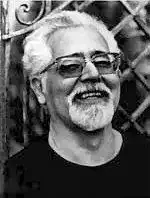
Moacyr Felix
1926–2005
· lived 79 years
 BR
BR
BR
Moacyr Felix was a Brazilian poet, playwright, and literary critic, associated with modernism. His work is marked by vigorous and colloquial language, exploring themes of everyday life, social criticism, and Brazilian popular culture. Felix also dedicated himself to theater and literary criticism, contributing to the dissemination and analysis of the literature of his time.
n. 1926-03-11, Rio de Janeiro · m. 2005-10-25, Roma
50
Views
Bio
Identification and basic context
Moacyr Felix was a Brazilian poet, playwright, storyteller, literary critic, and university professor. Born in Rio de Janeiro, he is considered an important figure of the second generation of Brazilian modernism. His work stands out for its colloquial language, social criticism, and exploration of popular culture.Childhood and education
Moacyr Felix was born and raised in the city of Rio de Janeiro. His university education took place at the Faculdade Nacional de Filosofia, where he graduated in Letters. This academic training, combined with his involvement in the literary circles of the time, was fundamental to the development of his career.Literary career
Felix began his literary career as a poet, publishing his first work in 1944. He quickly inserted himself into the modernist scene, dialoguing with other writers of his generation. In addition to poetry, he dedicated himself to playwriting, writing plays that often addressed social and political themes. He also worked as a storyteller and literary critic, contributing to various newspapers and magazines, such as "Revista Brasileira de Poesia" and "Jornal do Brasil". His activity as a university professor was equally relevant to his trajectory.Work, style, and literary characteristics
Moacyr Felix's poetry is marked by the use of an oralized language, close to Brazilian speech, in contrast to the more formal lyricism of previous generations. His recurring themes include urban everyday life, social inequalities, popular culture (samba, carnival), and reflection on the human condition itself. In his poetic work, free verse is predominant, with an often agile and musical rhythm. The tone can vary from ironic to engaged, with a strong critical sense. In his plays, his works explore social and existential conflicts, using incisive dialogues. His work aligns with the spirit of Brazilian modernism, with an emphasis on national identity and authentic language.Work, style, and literary characteristics
Cultural and historical context Moacyr Felix lived and produced during a period of intense transformations in Brazil, including the Estado Novo period and the post-World War II era. He actively participated in the cultural and literary debates of his time, being one of the representatives of the so-called "Generation of 45" or the second phase of modernism. His work reflects the social and political tensions of Brazil, engaging with other intellectuals and artists who sought a more genuine expression of national identity.Work, style, and literary characteristics
Personal life Little is known about the intimate details of his personal life. However, his dedication to literature and university teaching demonstrates a strong commitment to intellectual and cultural life.Work, style, and literary characteristics
Recognition and reception Moacyr Felix was a respected author in his field, recognized for his originality and the strength of his language. His works were published and reissued, and his name appears in important anthologies of Brazilian poetry. His work as a literary critic also contributed to the consolidation of his reputation.Work, style, and literary characteristics
Influences and legacy Felix was influenced by poets such as Oswald de Andrade and by concrete poetry in his experimentation with language. On the other hand, his work influenced later poets who sought to incorporate colloquialism and social criticism into their verses. His legacy lies in his contribution to the renewal of Brazilian poetry and in the defense of a language closer to national reality.Work, style, and literary characteristics
Interpretation and critical analysis Moacyr Felix's work has been analyzed for its pioneering use of colloquialism in poetry, its ability to capture the spirit of its time, and its strong social criticism. His poetry is seen as an authentic reflection of Brazilian culture and society.Work, style, and literary characteristics
Curiosities and lesser-known aspects In addition to his literary work, Felix had a prolific career as a university professor, dedicating himself to teaching and research in Brazilian literature, which enriched his understanding and approach to literary art.Work, style, and literary characteristics
Death and memory Moacyr Felix passed away in 1997, in Rio de Janeiro. His work continues to be studied and appreciated as a fundamental part of the Brazilian literary heritage.Poems
0No poems found
Videos
50
Comments (0)
Log in
to post a comment.
No comments yet. Be the first to comment.