
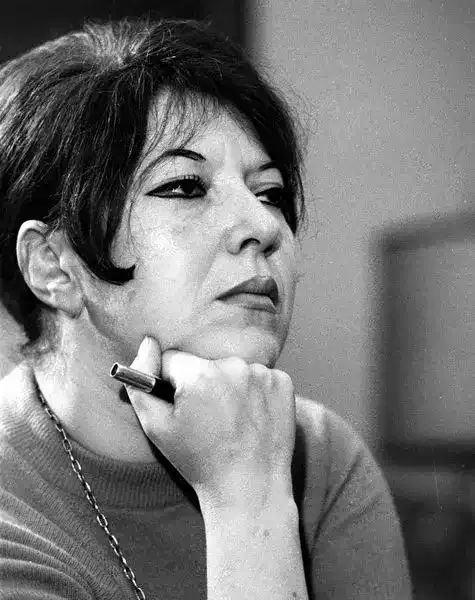
Natália Correia
1923–1993
· lived 69 years
 PT
PT
PT
Natália Correia was a Portuguese writer, poet, and political activist, known for her transgressive, sensual, and engaged work, which addressed themes such as love, death, freedom, and female identity. Her poetry, marked by expressive force, humor, and social criticism, made her an iconic figure of the counterculture in Portugal. She was also an ardent defender of democracy and human rights.
n. 1923-09-13, Fajã de Baixo · m. 1993-03-16, Lisboa
82
Views
Bio
Identification and basic context
Natália de Oliveira Correia was born in Azinhaga, Golegã, Portugal. She was a multifaceted figure: poet, writer, playwright, essayist, politician, and activist. Her work is marked by a strong intervention in the social and political reality of Portugal, especially during the Estado Novo and the transition to democracy. Her nationality is Portuguese and her writing language is Portuguese.Childhood and education
She grew up in Lisbon, where she attended high school and early on revealed a rebellious spirit and sharp intelligence. She studied Law at the University of Lisbon, graduating in 1953. During her studies, she absorbed influences from classical and contemporary literature, as well as from philosophical and artistic movements that questioned the status quo.Literary career
Natália Correia began her literary career in the 1950s, publishing poems in newspapers and magazines. Her first poetry book, "O Surrealismo em Portugal" (1956), was a critical essay, but it was with "Comunicação" (1959) that she established herself as a poet. Her work evolved boldly, exploring transgression and formal and thematic freedom. She was a central figure in literary circles that challenged the censorship of the Salazar regime.Work, style, and literary characteristics
Among her most important poetic works are "Comunicação" (1959), "Antologia de Poesia Portuguesa Erótica e Satírica" (1974), "O Seio e a Sombra" (1961), "As Maiores Penas do Mundo" (1975), "Canções de Fazer-se Amor Sem Deus" (1977), and "Mar Novo" (1978). Her poetry addresses themes such as carnal and spiritual love, death, revolt against oppression, freedom of expression, and the condition of women. Natália Correia's style is characterized by expressive force, musicality, the use of bold metaphors, and humor. Her poetic voice is simultaneously lyrical, satirical, erotic, and combative. The language is rich, sometimes colloquial, but always precise and impactful. She did not adhere to fixed forms, exploring free verse and experimenting with poetic structure. She introduced a strong component of eroticism and social criticism into her work, challenging taboos and conventions.Work, style, and literary characteristics
Cultural and historical context Natália Correia lived immersed in the Portuguese political and cultural context of the 20th century, marked by the Estado Novo dictatorship and the subsequent transition to democracy. She was a dissonant and contesting voice, firmly opposing censorship and repression. She belonged to a generation of intellectuals and artists who fought for freedom of expression and the modernization of the country.Work, style, and literary characteristics
Personal life Her personal life was intense and marked by strong convictions. She was married and had children, but always maintained remarkable intellectual and personal independence. Her challenging stance and her uncompromising defense of her ideals earned her admiration and controversy. She was an active public figure, participating actively in Portugal's political and cultural life.Work, style, and literary characteristics
Recognition and reception Natália Correia was a prominent and controversial figure during her lifetime. Her poetry, sometimes shocking for the time, found an audience that admired her for her courage and authenticity. She received several awards and distinctions, and her work is now widely recognized as a landmark of modern Portuguese literature.Work, style, and literary characteristics
Influences and legacy Influenced by poets such as Fernando Pessoa and Camões, Natália Correia created an original and transgressive work. Her legacy is that of a poet who dared to say the unsayable, who fought for freedom, and who gave voice to women and the oppressed. Her work continues to inspire with its strength, intelligence, and its ability to merge the personal with the political.Work, style, and literary characteristics
Interpretation and critical analysis Natália Correia's work is often analyzed as a manifesto for freedom in all its forms: sexual, political, and existential. Her poetry is an invitation to reflect on the limits of morality, oppression, and the incessant pursuit of human emancipation.Work, style, and literary characteristics
Curiosities and lesser-known aspects Natália Correia was one of the writers who most challenged the censorship of the Estado Novo, often using humor and irony to circumvent prohibitions. Her active participation in the Carnation Revolution and her election as a deputy demonstrated her commitment to democracy. She was known for her sharp wit and acid humor.Work, style, and literary characteristics
Death and memory Natália Correia died in Lisbon. Her memory is celebrated as that of one of the most important and courageous voices in 20th-century Portuguese literature and culture, a woman who lived and wrote with the intensity of one who fears no confrontation with the world.Poems
0No poems found
Comments (0)
Log in
to post a comment.
No comments yet. Be the first to comment.