
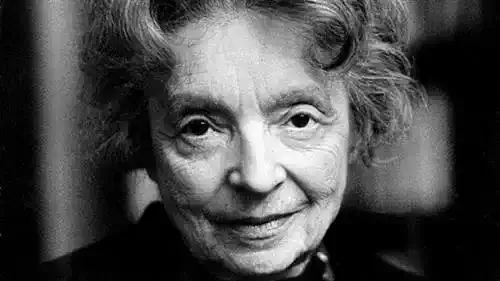
Nelly Sachs
 DE
DE
Nelly Sachs was a German-language Jewish poet and playwright, awarded the Nobel Prize in Literature. Her work is deeply marked by the experience of the Holocaust and her life as a refugee. Her poetry, often described as a "song of mourning and hope," explores themes such as suffering, memory, diaspora, and the search for redemption. Through a lyrical and visionary style, Sachs gives voice to the victims of persecution, but also seeks a sense of transcendence and communion with the divine. Her writing is a poignant testament to the resilience of the human spirit in the face of barbarity.
n. 1891-12-10, Berlin-Schöneberg · m. 1970-05-12, Estocolmo
Bio
Identification and basic context
Nelly Sachs was born in Berlin, Germany, on December 10, 1891, and died in Stockholm, Sweden, on May 12, 1970. She was a Jewish poet and playwright whose work is inseparable from her experience of antisemitism in Germany and the Holocaust. A German national, she wrote in German and spent much of her life in exile. Her work is considered one of the most important poetic manifestations of the 20th century, marked by profound humanity and exploration of the wounds of history.Childhood and education
Nelly Sachs grew up in a wealthy Jewish family. Her childhood was marked by reading and artistic sensitivity, and she showed an aptitude for writing from an early age. She was educated at home and had access to a vast library, where she discovered poets like Goethe and Schiller, who influenced her. Her mother had a strong inclination towards music, and the family atmosphere stimulated her cultural development. However, the rise of Nazism and the persecution of Jews cast a shadow over her life, culminating in the need to flee.Literary career
Her first book, "Liebesgedichte" (Love Poems), was published in 1910, revealing a romantic lyricism. However, after World War II and the Shoah, her poetry acquired a darker dimension, reflecting suffering and destruction. In 1940, with the help of friends, including the Swedish poet Hjalmar Gullberg, she managed to escape Nazi Germany and settle in Stockholm, where she lived the rest of her life. From then on, her work became a lament for the victims of the Holocaust and a search for a new beginning for humanity. She published numerous poetry collections, such as "In den Wohnungen des Todes" (In the Dwellings of Death) and "O die Sternen," as well as plays, such as "Eli: Ein Mysterienspiel vom Leiden Israels" (Eli: A Mystery Play about the Suffering of Israel).Work, style, and literary characteristics
Nelly Sachs's work is marked by her deep empathy with human suffering, especially that of persecuted Jews. Her poems, often brief and fragmented, evoke images of pain, exile, and death, but also of hope and resilience. She uses strong symbolism, resorting to images from the cosmos, nature, and biblical figures to express existential anguish and the search for redemption. Her style is lyrical, visionary, and sometimes hallucinatory, with a rhythm that reflects the fragility and strength of the human spirit. Central themes include memory, diaspora, the tragic fate of the Jewish people, and the need for a new covenant with life and the divine. Her writing is a testament to poetry's ability to confront evil and find a path to healing.Work, style, and literary characteristics
Cultural and historical context Nelly Sachs lived through the horrors of Nazism and the Holocaust, events that profoundly shaped her worldview and her work. Her experience of exile in Sweden, a neutral country during the war, allowed her to survive, but the memory of persecution and the loss of her loved ones remained an open wound. She was a contemporary of many writers who addressed the horrors of war and totalitarianism, but her voice is distinguished by its uniqueness and its deep connection to Jewish mystical tradition.Work, style, and literary characteristics
Personal life Nelly Sachs lived a discreet life dedicated to poetry. Her health was often fragile, and the trauma of the Holocaust left deep psychological scars. Her relationships with family and close friends were fundamental to her emotional support. The loss of her parents and the separation from many loved ones during the war were painful experiences that influenced her writing. Despite her suffering, she maintained an unwavering faith in the possibility of redemption and the strength of the human spirit.Work, style, and literary characteristics
Recognition and reception Nelly Sachs's international recognition reached its peak with the awarding of the Nobel Prize in Literature in 1966, shared with the Israeli writer Shmuel Yosef Agnon, "for their outstanding lyrical and dramatic writing, which interprets the fate of Israel with a poetic intensity." She was the first German woman to receive this award. Her work, initially ignored by many, came to be increasingly valued for its originality and its profound human and historical relevance.Work, style, and literary characteristics
Influences and legacy Nelly Sachs was influenced by classical German poetry, Jewish mysticism, and the poets of her time. Her legacy lies in her ability to transform individual and collective suffering into poetry of profound beauty and meaning, giving voice to the victims of history and calling for a reconciled humanity. Her work continues to inspire and move readers and writers, serving as a powerful testament to art's capacity to confront tragedy and affirm hope.Work, style, and literary characteristics
Interpretation and critical analysis Nelly Sachs's work is often interpreted as a meditation on exile, guilt, suffering, and transcendence. Her poetry addresses fundamental questions about the nature of evil, the fragility of existence, and the search for meaning in a world devastated by war. Her unique approach, which combines lyricism with existential drama, invites reflection on the human condition and the need for redemption.Work, style, and literary characteristics
Curiosities and lesser-known aspects Nelly Sachs was known for her shyness and her almost ascetic dedication to poetry. She spent much of her adult life in semi-seclusion, immersed in her creative work. Her correspondence with other writers and intellectuals, such as Martin Buber and Albert Schweitzer, reveals the depth of her thought and her search for dialogue with the transcendent. Her strong connection to Jewish tradition and German culture, despite persecution, is a notable aspect of her life and work.Work, style, and literary characteristics
Death and memory Nelly Sachs died in Stockholm in 1970 at the age of 78. Her death marked the end of a life dedicated to poetry and the bearing of witness to human tragedy. Her work continues to be studied and celebrated, serving as a beacon of hope and a warning against the horrors of intolerance and violence.Poems
0No poems found
Quotes
3No poems found
Videos
50
Comments (0)
No comments yet. Be the first to comment.