
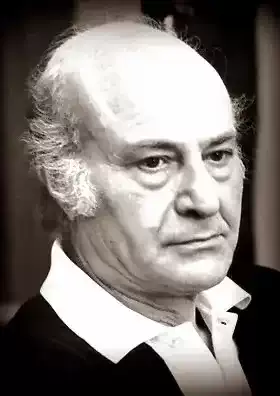
Odysséas Elýtis
1911–1996
· lived 84 years
 GR
GR
GR
Odysséas Elýtis was a Greek poet, awarded the Nobel Prize in Literature in 1979. His work is marked by a strong connection to Greek landscape and culture, exploring themes such as the sea, light, love, and mortality with a lyrical and visually rich language. Elýtis is considered one of the most important modern Greek poets, with poetry that transcends geographical and temporal boundaries.
n. 1911-11-02, Heraclião · m. 1996-03-18, Atenas
69
Views
Bio
Identification and basic context
Odysséas Elýtis (in Greek: Ὀδυσσέας Ἐλύτης) was one of the most prominent Greek poets of the 20th century. Born in Heraklion, Crete, on November 2, 1911, he died in Athens on March 18, 1996. His work is intrinsically linked to Greek identity, the Aegean light, the sea, and nature, elements he celebrated with a unique and innovative poetic language. He is widely recognized as one of the pillars of modern Greek poetry, with an influence that extends beyond Greece's borders.Childhood and education
Born into a family of origin from the island of Lesbos, Elýtis spent his childhood and youth in Crete, an environment that profoundly marked his poetic sensibility with the island's light, sea, and aromas. His intellectual education took place in Athens, where he studied Law at the University of Athens, but his true passion was always literature and poetry. From an early age, he showed great interest in European artistic avant-gardes, especially Surrealism, and in Greek culture, both ancient and Byzantine.Literary career
Elýtis began his literary career in the 1930s, publishing his first poems in literary magazines. His debut work, "Orientations" (Προσανατολισμοί), published in 1939, revealed a poet with a distinct voice and an innovative style. Over the decades, his poetry evolved but always maintained a strong connection with the central themes of his work. He actively participated in Greek literary life, being a reference figure for several generations of poets. Besides poetry, Elýtis also dedicated himself to translating literary works and writing essays.Work, style, and literary characteristics
Elýtis's work is vast and multifaceted, encompassing several poetry books that intensely explore the relationship between human beings and the cosmos, the beauty of existence, and memory. "Sun First" (Ήλιος ο πρώτος), "The Song of Jiro and Asma" (Το Άσμα του Ιησού και της Ασμας), "Maria Nefeli" (Μαρία Νεφέλη), and his most celebrated work, "The Axileu" (Το Άξιον Εστί), are some of his most important works. His style is characterized by a lyrical and imagistic language, where light, color, and natural elements play a fundamental role. He frequently uses free verse, exploring an intrinsic musicality and a particular rhythm. Themes such as love, death, Greek identity, spirituality, and the search for absolute beauty are recurrent. His poetry, although deeply rooted in Greek culture, achieves a universal dimension, celebrating the human condition and the resilience of the spirit.Cultural and historical context
Elýtis lived through a turbulent period in Greek and European history, marked by the World Wars, the Greek Civil War, and the military dictatorship. His poetry, however, always sought to transcend suffering and destruction, finding in the beauty of nature and the strength of Greek identity a form of resistance and hope. He was a figure integrated into European literary circles, maintaining relationships with other writers and artists, and his work reflects a constant dialogue with the literary currents of his time, particularly Surrealism.Personal life
Elýtis lived a discreet life, dedicated to his art. His personal and family relationships, although not as publicly explored as his work, certainly informed his worldview and poetic sensibility. His deep connection with Greece, its islands, and its sea shaped his identity and artistic expression.Recognition and reception
Odysséas Elýtis's recognition reached its peak with the award of the Nobel Prize in Literature in 1979, "for his poetry, which, against the background of tradition, builds with great sensory strength and intellectual clarity its vision of a Greek destiny of suffering." This award consolidated his position as one of the great poets of the 20th century, both in Greece and internationally. His work is the subject of study and admiration by critics and academics worldwide.Influences and legacy
Elýtis was influenced by ancient and Byzantine Greek poetry, as well as by European avant-gardes, especially Surrealism. His work, in turn, profoundly influenced modern and contemporary Greek poetry, and his approach to language and themes continues to inspire poets around the world. His celebration of Greek identity and the beauty of the Aegean has become a landmark in literature.Interpretation and critical analysis
Elýtis's work has been interpreted in various ways, often highlighting its metaphysical dimension and his search for transcendence through beauty. His explorations of suffering, memory, and Greek identity, combined with a language of rare plasticity, invite multiple readings, both aesthetically and philosophically. His poetry is seen as a hymn to life and hope, even in the face of adversity.Curiosities and lesser-known aspects
Although recognized as a world-renowned poet, Elýtis maintained a reserved stance regarding his personal life. His passion for painting, which he practiced with dedication, reveals another facet of his artistic talent. The way the light and colors of the Aegean are translated into his poetry is one of the most fascinating aspects of his work, demonstrating a deep sensory connection with his environment.Death and memory
Odysséas Elýtis passed away peacefully in Athens in 1996. His death marked the end of an era in Greek poetry, but his poetic legacy remains alive and vibrant. His works continue to be read, studied, and translated, maintaining their relevance and their ability to inspire new generations of readers and writers. His name is etched in the history of world literature.Poems
0No poems found
Comments (0)
Log in
to post a comment.
No comments yet. Be the first to comment.