
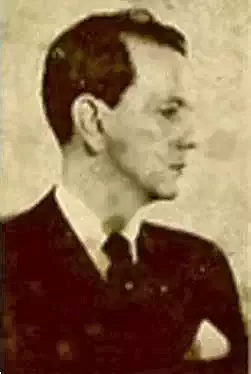
Onestaldo de Pennafort
 BR
BR
Onestaldo de Pennafort, literary pseudonym of Eduardo de Almeida Catroga, was a Portuguese poet and writer of the 20th century. His poetic work, marked by a strong lyrical and existential current, explores themes such as solitude, the search for meaning, and the complexity of human relationships, with a refined and musical language. Although his figure and work are less known to the general public, Pennafort left a poetic record of value, characterized by introspection and sensitivity, which dialogues with the concerns of modernity and the human condition.
n. 1902, Rio de Janeiro · m. 1987, Rio de Janeiro, RJ
Bio
Identification and basic context
Onestaldo de Pennafort is the literary pseudonym of Eduardo de Almeida Catroga, a Portuguese writer and poet. He was born in Lisbon in 1929 and died in the same city in 2003. His work, although not as vast or widely disseminated as that of other contemporary authors, represents a unique voice in 20th-century Portuguese poetry.Childhood and education
Eduardo de Almeida Catroga had a childhood and youth marked by the cultural atmosphere of Lisbon in the first half of the 20th century. His studies and readings shaped his literary sensibility, allowing him to absorb influences that would be reflected in his future poetic production. Specific details about his academic training and early influences are less publicly documented.Literary career
Onestaldo de Pennafort's literary career developed in parallel with his professional life, with poetry being his main means of expression. He published some works during his lifetime, which, despite not achieving great media notoriety, were recognized by a more restricted circle of readers and critics for their intrinsic quality. No significant activity as a critic, translator, or editor is known.Work, style, and literary characteristics
Onestaldo de Pennafort's poetic work is characterized by introspective lyricism and a deep exploration of the inner universe. Themes such as solitude, the passage of time, melancholy, the search for an ultimate meaning of existence, and the ephemerality of life are recurrent. His poetic language is generally careful, refined, and musical, with a strong attention to the rhythm and sonority of the verses. He frequently uses free verse, although he does not shy away from more traditional forms when they serve his expression. The poetic voice is mostly confessional and lyrical, conveying a sharp sensitivity to the anguish and existential dilemmas of human beings. His style tends to be dense in imagery, although subtle, and less ornate than that of Baroque or Symbolist authors. It fits, in a way, within the context of modern Portuguese poetry, with a personal and introspective approach.Cultural and historical context
Onestaldo de Pennafort lived most of his life in Portugal during the Estado Novo dictatorship and the transition to democracy. This social and political context, although it may not have been an explicit theme in his poetry, certainly shaped the cultural atmosphere and life experiences that, indirectly, were reflected in his work, often focused on the intimate and existential sphere.Personal life
Detailed information about the personal life of Eduardo de Almeida Catroga (Onestaldo de Pennafort) is scarce in public sources. It is known that he dedicated part of his life to his professional activity outside the literary sphere, and that poetry was a passion and a space for intimate expression. Family relationships, literary friendships, or specific personal crises are rarely mentioned in analyses of his work.Recognition and reception
Onestaldo de Pennafort's recognition was largely limited to a niche of Portuguese contemporary poetry enthusiasts. His work did not achieve massive institutional recognition or major awards, but it maintained a place of respect among those who value more introspective poetry of deep lyrical quality.Influences and legacy
Specific influences on Onestaldo de Pennafort are less explicit, but it is possible to infer dialogues with the Portuguese lyrical tradition, as well as with trends in modern poetry that explore the self and its relationship with the world. His legacy lies in his contribution to poetry of sensibility and formal rigor, which calls for reflection on the human condition.Interpretation and critical analysis
Pennafort's work invites attentive reading between the lines, exploring melancholy and the search for meaning in a constantly changing world. Critical analyses, when they exist, tend to focus on his ability to express the interiority and complexity of human feelings with elegant language.Curiosities and lesser-known aspects
As a figure with a more discreet literary public presence, many aspects of his life and creative process remain less known. The choice of the pseudonym "Onestaldo de Pennafort" may have been motivated by personal or aesthetic reasons, but its specific meanings are not widely disclosed.Death and memory
Onestaldo de Pennafort passed away in 2003, leaving a body of poetic work that, although modest in volume, is appreciated for its quality and lyrical sincerity. His memory is kept alive by his poems and his contribution to the diversity of 20th-century Portuguese poetry.Poems
0No poems found
Comments (0)
No comments yet. Be the first to comment.