
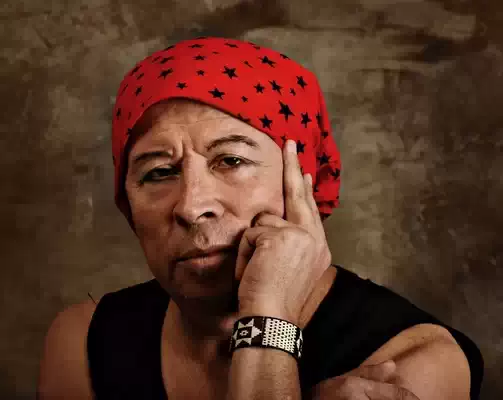
Pedro Lemebel
1952–2015
· lived 62 years
 CL
CL
CL
Pedro Lemebel was a Chilean writer, journalist, chronicler, and cultural activist, known for his work that blends humor, social criticism, and transgressive language, frequently exploring identity, marginality, and queer culture. His vibrant and irreverent writing made him an iconic figure in Latin American literature, challenging social norms and celebrating dissenting voices.
n. 1952-11-21, Santiago · m. 2015-01-22, Santiago
52
Views
Bio
Identification and Basic Context
Pedro Segundo Lemebel Araneda was a Chilean writer, journalist, chronicler, cultural activist, and performer. He was born in Santiago, Chile, on November 21, 1952, and died in the same city on January 4, 2015. His work is fundamental to understanding Chilean and Latin American literature of the last decades of the 20th century and the beginning of the 21st, noted for its thematic and stylistic boldness, marked by chronicles and poetry with a strong social and gender component.Childhood and Education
Lemebel grew up in Santiago in a working-class family, which shaped his perception of social inequalities and marginality. His education included studies in visual arts and literature. From a young age, he showed an inclination for creative writing and cultural intervention, absorbing influences from artistic and social movements that questioned established structures.Literary Career
His literary career began with the publication of chronicles and poems in alternative newspapers and magazines. Lemebel gained notoriety for his active participation in independent cultural spaces and for his unique voice. Throughout his career, his work consolidated with the publication of books that established him as a chronicler of customs and often invisible realities. His activity as a cultural activist and his presence in performances were also an intrinsic part of his journey.Work, Style, and Literary Characteristics
Among his most important works are "Tengo que decir algo" (1991), "Loco afán: crónicas de un nomadismo literario" (1996), "De perverticios y otros atropellos" (2004), and "Adiós Mariquita Linda" (2012). Central themes in his work are gay identity, urban marginality, Chilean popular culture, criticism of neoliberalism and the military dictatorship, and the celebration of eccentric and dissident characters. His style is marked by irreverence, acidic humor, colloquial language, and the ability to blend the personal with the social. Lemebel predominantly used the chronicle as a form of expression, but also explored poetry and short stories. His poetic voice is visceral, challenging, and profoundly human. The relationship of his work with the tradition of Latin American chronicles is evident, but he renews it with a queer perspective and a transgressive aesthetic.Cultural and Historical Context
Pedro Lemebel lived and produced during the period of the Chilean military dictatorship and the transition to democracy, contexts that profoundly marked his work. He was a staunch critic of neoliberal policies and social exclusion. His work engages with counterculture and social movements, especially those fighting for LGBTQIA+ rights. He belonged to a generation of artists and intellectuals who sought to break with the silencing imposed by repression, using art as a form of resistance and denunciation.Personal Life
Lemebel openly lived his homosexuality in a conservative society, which made him an icon for the LGBTQIA+ community. His personal relationships, urban experiences, and participation in cultural and activist circles were sources of inspiration for his writing. His life was marked by the struggle for visibility and the recognition of marginalized identities.Recognition and Reception
Pedro Lemebel earned a prominent place in Chilean and Latin American literature, becoming a revered and influential voice. His work received recognition for its originality and social relevance, although its transgressive aesthetic generated debate. His popularity grew significantly, both in academia and among the general public, who identified with his authenticity and social critiques.Influences and Legacy
Lemebel was influenced by chroniclers such as Roberto Bolaño, Julio Cortázar, and authors who addressed queer themes and marginality. His legacy is immense, especially for LGBTQIA+ literature and Latin American chronicles, inspiring new generations of writers to address difficult themes with courage, humor, and poetry. His work contributed to the visibility of identities and experiences previously relegated to silence.Interpretation and Critical Analysis
Lemebel's work is often analyzed from the perspective of gender studies, cultural studies, and queer theory. His chronicles offer a critical reading of Chilean society, exposing its contradictions and hypocrisies. Interpretations of his texts highlight the power of his language and the depth of his reflections on the human condition and the search for authenticity.Curiosities and Lesser-Known Aspects
Lemebel was known for his extravagant public persona and acidic humor, but also for his profound sensitivity. His activism and participation in public events made him a charismatic figure. The intrinsic relationship between his life and work is one of the most striking aspects of his career.Death and Memory
Pedro Lemebel died in 2015, victim of cancer. His death caused great emotion in Chile and Latin America. His memory is preserved through his works, which continue to be read and studied, and through his activism, which inspired and continues to inspire the fight for rights and visibility.Poems
0No poems found
Comments (0)
Log in
to post a comment.
No comments yet. Be the first to comment.